
What Can I Do with a Drill Press? Projects and Ideas to Try
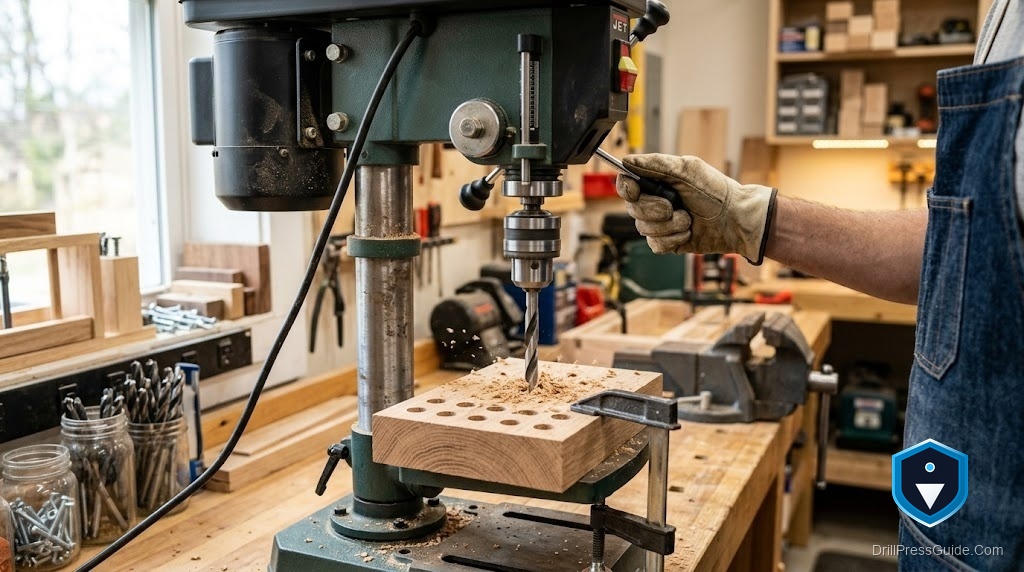
You bought or inherited a drill press, and now it is standing in the corner used for the occasional hole. That is a shame, because it is one of the most quietly capable machines in a home shop, and once you start giving it real projects, it changes how you build. This is less a spec sheet and more a list of things you can actually make and do with one, from clean joinery to shaping curved parts, so you can put the machine to work this weekend.
With a drill press you can make strong dowel and shelf-pin joints, drill clean flat-bottomed holes for hardware and plugs, shape and smooth curved parts with a drum sander, bore repeatable holes for jigs and furniture, cut mortises with an attachment, and clean or polish metal parts. It turns tasks that are fiddly by hand into accurate, repeatable steps, which opens up better woodworking and metal projects.
Build stronger joints
The drill press shines at joinery because it drills dead-square. Dowel joints come out tight and aligned because the holes are truly perpendicular and at consistent depth, set once on the depth stop. Shelf-pin rows march up a cabinet side evenly when you use a fence and stop. And pocket-style and hardware holes land exactly where your layout says. If your hand-drilled joints have ever come out slightly crooked, this is the fix.
Make clean holes for hardware and plugs
With Forstner bits, the press drills flat-bottomed holes that look finished, for concealed hinges, inlays, and recessed hardware. Pair a plug cutter and a Forstner or counterbore and you can make your own wooden plugs to hide screws, then drill the matching counterbores, a small touch that makes furniture look custom. Controlled feed and the right speed, as Pro Tool Reviews notes, are what keep these holes clean.
Shape and smooth curved parts
Here is the project many owners miss: fit a drum sander in the chuck and the drill press becomes a spindle sander. Cut a curved bracket, a rounded shelf, or a toy part on the bandsaw or jigsaw, then smooth the curve against the spinning drum for a fair, even edge. A sanding drum kit with several drum diameters lets you match the drum to tight or gentle curves, turning rough-cut shapes into finished parts.
Project ideas to try
| Project | What the press does | Helper tool |
|---|---|---|
| Dowel-joined box or frame | Square, aligned dowel holes | Depth stop, fence |
| Adjustable shelving | Even shelf-pin rows | Fence and stop |
| Custom cutting board with hanging hole | Clean large bore | Forstner bit |
| Curved brackets or toys | Smooth the curves | Drum sander |
| Furniture with hidden screws | Counterbores and plugs | Plug cutter, Forstner |
| Metal brackets | Accurate holes in steel | Slow speed, clamp |
A few metal projects too
It is not just for wood. Drill accurate holes in flat bar and angle to make brackets, hangers, and repair plates, at slow speed with the work clamped. Add a wire wheel or buffing wheel and you can strip rust from old hardware or polish a small metal part. These are exactly the jobs a handheld drill does poorly and the press does easily, so long as you clamp the work and mind the safety basics from OSHA and CCOHS.
The verdict
With a drill press you can build stronger square joints, make finished-looking holes for hardware and plugs, shape curved parts as a spindle sander, bore repeatable holes for jigs and furniture, mortise with an attachment, and drill or clean metal parts. Three takeaways: think in projects, not just holes, and the machine earns its space; a drum sander opens up curved-part shaping many owners never try; and its dead-square, repeatable holes make joinery and hardware look custom. Who should try these? Any home builder whose press mostly gathers dust, give it a project and it changes how you work.
Frequently asked questions
What can I do with a drill press? Make square dowel and shelf-pin joints, drill clean flat-bottomed holes for hardware and plugs, shape curved parts with a drum sander, bore repeatable holes for jigs, cut mortises with an attachment, and drill or clean metal parts. It makes fiddly tasks accurate and repeatable.
What can I make with a drill press? Dowel-joined boxes and frames, adjustable shelving, cutting boards with clean bored holes, curved brackets and toys smoothed on a drum sander, furniture with hidden screws under wooden plugs, and metal brackets and hangers.
Can I use a drill press as a sander? Yes. Fit a drum sander in the chuck and it works like a spindle sander for smoothing curves and edges. A kit with several drum sizes lets you match the drum to tight or gentle curves.
Can a drill press make wooden plugs? Yes, with a plug cutter. Cut plugs from matching stock, then drill counterbores with a Forstner or counterbore bit and glue the plugs in to hide screws, a detail that makes furniture look custom.
Is a drill press good for beginners? Very. It makes accurate, repeatable holes almost automatic, so beginners get square joints and clean hardware holes that are hard to achieve by hand. Start with dowel joints and drum sanding to build confidence.
Can I do metal projects with a drill press? Yes. Drill accurate holes in flat bar and angle for brackets and repair plates at slow speed with the work clamped, and add a wire or buffing wheel to strip rust or polish small parts.
What accessories expand what I can do? Forstner bits and a plug cutter for clean holes and plugs, a drum sander kit for shaping curves, a hollow-chisel mortising attachment for joinery, and a wire or buffing wheel for metal cleanup, each opens a new set of projects.
References
- Pro Tool Reviews, How to Use and Set Up a Drill Press. https://www.protoolreviews.com/how-to-use-drill-press/
- OSHA, Woodworking eTool: Drill Press. https://www.osha.gov/etools/woodworking/production/machines-tools/drill-press
- CCOHS, Metalworking Machines: Drill Presses. https://www.ccohs.ca/oshanswers/safety_haz/metalworking/drillpresses.html


