Can You Use a Drill Press to Mill? Capability, Limits, and the Safer Setup
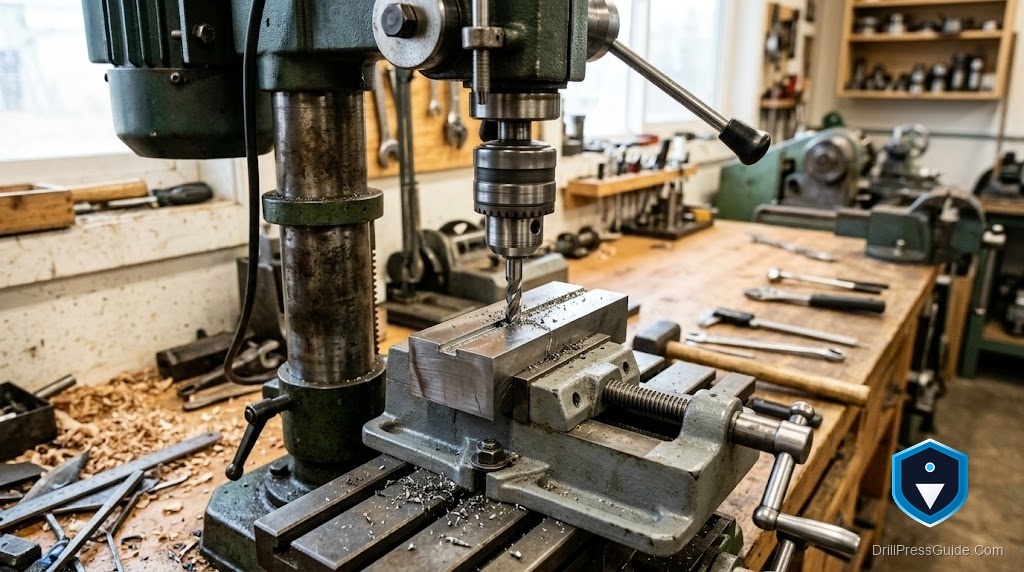
Milling means removing material by moving the work sideways past a spinning cutter, cutting slots, flattening a face, squaring an edge. People look at a drill press, see a spinning cutter pointing down, and wonder if they can add an XY table and mill. The short version is that you technically can coax a few light milling operations out of a drill press, and the longer version is why that is risky, imprecise, and hard on the machine. Understanding the specific operation of milling, not just “using it as a mill,” is what makes the answer clear.
You should not rely on a drill press to mill. A drill press spindle and quill are built to take downward force, not the sideways loads that milling creates, so cutting sideways can flex the quill, loosen the chuck, and wear the bearings, giving rough, inaccurate results. Light, occasional cuts in soft aluminum with an XY table and an end mill are possible, but a mill or mill/drill is the correct tool.
What milling actually demands
Milling is different from drilling in one decisive way: the cutter removes material from its sides as the work moves past it, which pushes the cutter sideways the whole time. A milling machine is built for that, a rigid spindle in stout bearings designed for side loads, a collet that grips the cutter hard, and a heavy frame that resists flex. A drill press has none of those. Its quill is a sliding sleeve tuned for straight-down travel, its bearings expect downward thrust, and its chuck grips by a friction taper. Ask it to cut sideways and every one of those is working out of its element.
Why the drill press fights you
Quill flex. The extended quill can deflect under side load, so your cut wanders and the depth changes, ruining accuracy.
Chuck slip and drop. A friction chuck can loosen under sideways force, and an end mill can pull down or the whole chuck can walk off its taper mid-cut, which is dangerous.
Bearing wear. Radial loads the bearings were not designed for accelerate wear, so milling shortens the life of a machine you rely on for accurate drilling.
These are the same reasons the safety guidance from OSHA and CCOHS keeps returning to matching the tool to its intended job.
The narrow window where it half-works
If you must, the realistic ceiling is very light, occasional work: shallow slots or facing in soft aluminum or plastic, using a proper end mill (not a drill bit), a rigid XY table clamped to the drill press table, tiny depths of cut, slow feed, and a firmly held cutter. Even then expect imprecision and accept the wear you are causing. This is coaxing a wrong tool through a job, not milling, and it does not scale to steel, deep cuts, or anything needing real accuracy.
Drill press versus a milling machine
| Factor | Drill press | Milling machine |
|---|---|---|
| Load direction | Downward thrust | Side loads by design |
| Spindle and quill | Sliding quill, can flex | Rigid, stout bearings |
| Cutter holding | Friction chuck | Gripping collet |
| Table | Fixed or tilt | Precise XY (and Z) travel |
| Milling result | Rough, imprecise, hard on machine | Accurate, as intended |
What to use instead
If you need to mill even occasionally, a mill/drill or a benchtop mini-mill is the right tool and is far kinder than a repair bill and ruined workpieces. A mill/drill in particular doubles as a drilling machine, so it can replace the temptation entirely. Keep the drill press doing what it is genuinely excellent at, accurate perpendicular holes, and send milling to a machine built to take the side loads.
The verdict
A drill press can be pushed through a few light milling cuts, but it is the wrong tool: its quill flexes, its friction chuck can slip or drop the cutter, and its bearings wear because milling loads the machine sideways when it is built for downward force. Three takeaways: milling means continuous side loads a drill press is not designed for, the only defensible version is tiny, occasional cuts in soft aluminum with an XY table and end mill, and a mill or mill/drill is the correct answer for real milling. Who should avoid it? Anyone milling steel, cutting with any depth, or needing accuracy, which is most people who ask.
Frequently asked questions
Can you use a drill press to mill? Not reliably. A drill press is built for downward force, not the sideways loads milling creates, so cutting sideways flexes the quill, can loosen the chuck, and wears bearings, giving rough, inaccurate cuts. A mill or mill/drill is the right tool.
Why is milling bad for a drill press? Milling pushes the cutter sideways continuously. The drill press quill can flex, the friction chuck can slip or let the cutter drop, and the bearings, meant for downward thrust, wear from the radial load. The result is poor accuracy and a shortened machine life.
Can I mill aluminum on a drill press? Only very light, shallow cuts with a proper end mill, a rigid XY table, tiny depths, and slow feed, and even then with imprecision and machine wear. Soft aluminum is the most forgiving, but a mill remains the correct tool.
Do I need an end mill or a drill bit to mill? An end mill, which is designed to cut on its sides. A drill bit is made to cut on its tip and can grab or break under side loads. But even with an end mill, the drill press itself is not built for milling.
What is the difference between a drill press and a milling machine? A milling machine has a rigid spindle in bearings built for side loads, a gripping collet, and a precise XY table. A drill press has a sliding quill, a friction chuck, and bearings for downward thrust, so it drills but does not mill well.
What should I use instead of a drill press for milling? A mill/drill or a benchtop mini-mill. A mill/drill also drills, so it can cover both jobs. Both are built to take the side loads milling creates, giving accurate results without harming the machine.
Is a milling table for a drill press worth it? An XY table can hold work for careful positioning, but it does not fix the drill press’s flexing quill, friction chuck, or thrust-only bearings. For anything beyond tiny aluminum cuts, put the table on a machine built to mill.
References
- OSHA, Woodworking eTool: Drill Press. https://www.osha.gov/etools/woodworking/production/machines-tools/drill-press
- CCOHS, Metalworking Machines: Drill Presses. https://www.ccohs.ca/oshanswers/safety_haz/metalworking/drillpresses.html
- Pro Tool Reviews, How to Use and Set Up a Drill Press. https://www.protoolreviews.com/how-to-use-drill-press/