
Can You Use an Annular Cutter in Drill Press? Capability, Limits, and the Safer Setup
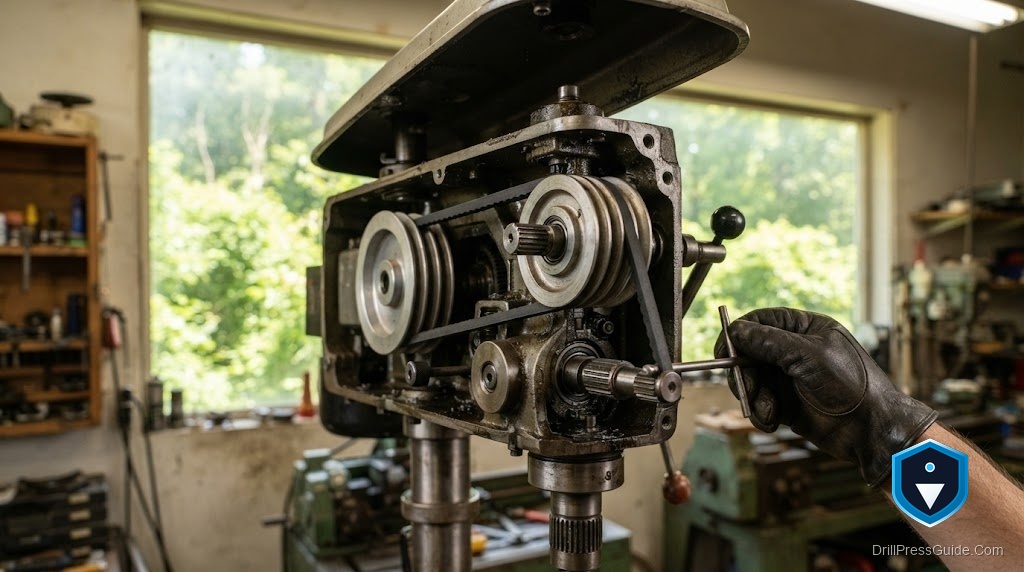
Annular cutters make big, clean holes in metal far faster than a twist drill, so it is natural to want to run one in the drill press you already own. Sometimes you can, and sometimes the press simply is not up to it, and the difference comes down to a few specific requirements the cutter demands. This is not a flat yes or no. It is a checklist: meet the requirements and a drill press runs an annular cutter well, miss them and you get chatter, a stalled machine, or a dangerous grab.
Yes, you can use an annular cutter in a drill press if the press provides a low enough speed, enough power and rigidity, a way to hold the cutter’s shank, and a firmly clamped workpiece. Annular cutters need slow speeds and steady feed, so a sturdy press at its lowest speed can run smaller cutters. Large cutters, thick steel, or a light press call for a dedicated magnetic drill instead.
Why an annular cutter is different
Unlike a twist drill that chews the whole hole into chips, an annular cutter only cuts a thin ring at the edge and leaves a solid slug in the middle. That makes it efficient and clean, but it also means the cutting happens at a large diameter, so rim speed is high even at modest RPM. The consequence is simple: annular cutters want slow spindle speeds and firm, steady feed. Run one too fast and the teeth overheat and chatter. Guides like the Hougen mag drill and annular cutter guide and Milwaukee’s mag drill documentation center on exactly this slow-speed, steady-feed rule.
The four requirements
Low speed. The big one. The cutter’s large diameter means you need a genuinely low RPM, lower for bigger cutters. If your press cannot get slow enough at its lowest belt setting, it is the wrong machine for larger cutters.
Power and rigidity. Cutting a full-diameter ring in steel demands torque and a stiff machine. A light benchtop press can stall or flex, spoiling the cut and risking a grab.
A way to hold the shank. Annular cutters commonly come with a Weldon shank (a flat for a setscrew). A drill press holds bits in a chuck, so you need a compatible arbor or holder, such as a Weldon-shank arbor or chuck adapter, to mount the cutter and its pilot pin properly.
A firmly clamped workpiece. A grabbing cutter will spin an unclamped part instantly. Clamp the work hard, in line with the CCOHS rule never to hand-hold.
Running one on a drill press
With the requirements met: set the lowest speed, mount the cutter on the correct arbor with its pilot pin, clamp the work, and add cutting fluid. Feed firmly and steadily, not timidly, so the teeth cut rather than rub, and ease off as the slug is about to release so it does not jam. A modestly sized cutter such as those in a general annular cutter set is realistic on a sturdy press. Big cutters in thick plate are where a drill press runs out of speed, power, and rigidity.
Drill press versus magnetic drill for annular cutters
| Factor | Sturdy drill press | Magnetic drill |
|---|---|---|
| Low speed | Only at lowest setting | Built for it, often two-speed |
| Rigidity | Depends on the machine | Very high, clamps to the work |
| Cutter size | Smaller cutters | Small to large |
| Portability | Fixed | Goes to the workpiece |
| Best for | Occasional small holes | Frequent or large metal holes |
When to reach for a mag drill instead
A magnetic drill is purpose-built for annular cutters: it clamps magnetically to the steel, runs slow, and is extremely rigid, so it handles large cutters and thick material a drill press cannot. If you cut big holes in steel often, or your press is light or cannot slow down enough, the mag drill is the right tool. For occasional smaller holes on a solid press, the drill press does the job.
The verdict
Yes, a drill press can run an annular cutter, but only when it meets four requirements: a low enough speed, enough power and rigidity, a proper Weldon-shank arbor to hold the cutter, and a firmly clamped workpiece. Because the cutter works at a large diameter, slow speed and steady feed are non-negotiable. Three takeaways: annular cutters need genuinely low RPM and firm feed, you need the right arbor to mount the cutter and pilot pin, and large cutters or thick steel belong on a magnetic drill. Who can use a drill press for this? Anyone with a sturdy, slow-enough press cutting occasional, modestly sized holes, everyone else should reach for a mag drill.
Frequently asked questions
Can you use an annular cutter in a drill press? Yes, if the press offers a low enough speed, enough power and rigidity, an arbor to hold the cutter’s shank, and a firmly clamped workpiece. Smaller cutters on a sturdy press work well; large cutters or thick steel need a magnetic drill.
Why do annular cutters need slow speeds? Because they cut at a large diameter, rim speed is high even at modest RPM. Too fast and the teeth overheat and chatter, so a genuinely low spindle speed with steady feed is required.
How do I mount an annular cutter in a drill press? Use a compatible arbor or holder for the cutter’s shank, commonly a Weldon shank with a flat for a setscrew, and fit the pilot pin. A standard drill chuck alone will not hold it correctly.
Will a small benchtop drill press run an annular cutter? Only a small cutter, and only if it reaches a low speed and is rigid enough. Light presses tend to stall or flex, which spoils the cut and risks a grab. Larger cutters need a mag drill.
Do I need cutting fluid? Yes, for steel. Cutting fluid keeps the teeth cool and cutting cleanly, extending cutter life and improving the finish, and it is standard practice with annular cutters.
When should I use a magnetic drill instead? When you cut large holes, work thick steel, need portability, or your press cannot slow down or is not rigid enough. Mag drills clamp to the work, run slow, and are built for annular cutters.
How should I feed an annular cutter? Firmly and steadily so the teeth cut rather than rub, easing off as the slug is about to release so it does not jam. Timid feeding causes rubbing, heat, and chatter.
References
- Hougen, Mag Drill and Annular Cutter Guide. https://www.hougen.com/downloads/Hougen_Mag_Drill_%26_Annular_Cutter_Guide.pdf
- Milwaukee, Magnetic Drill Documentation. https://documents.milwaukeetool.com/58-14-4270d7.pdf
- CCOHS, Metalworking Machines: Drill Presses. https://www.ccohs.ca/oshanswers/safety_haz/metalworking/drillpresses.html


