
Can You Use a Drill Press as a Lathe? Capability, Limits, and the Safer Setup
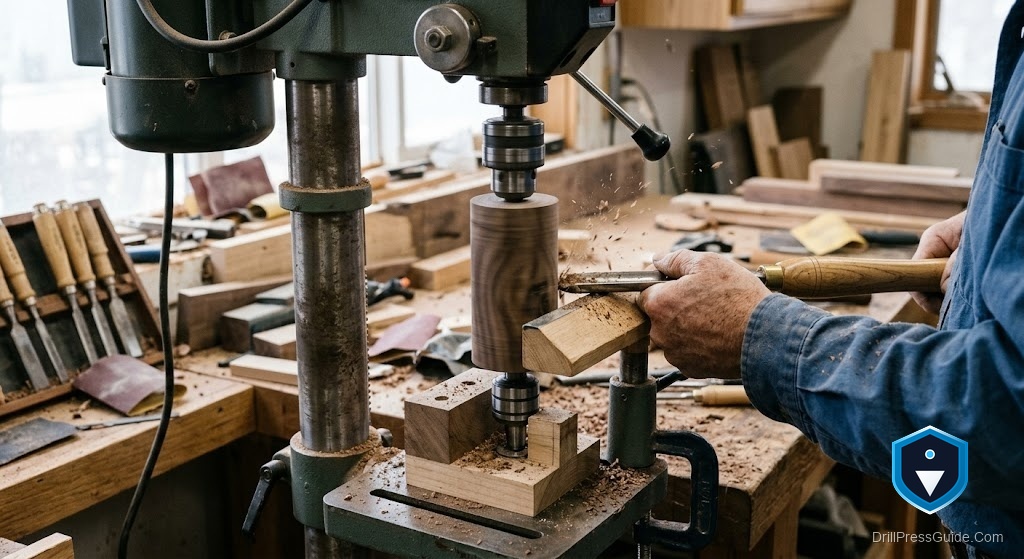
The idea is understandable. A lathe spins a workpiece so a tool can shape it, and a drill press spins a chuck, so people wonder if they can mount a piece in the drill press and turn it. You will find videos of exactly this, usually small, light shaping on wood. What those clips gloss over is that a drill press is oriented and built in almost the opposite way a lathe is, and pushing it into lathe work stacks up risks fast. It is worth understanding why before you try, and what the narrow safe version actually looks like.
No, you should not use a drill press as a lathe for anything beyond the lightest work. A drill press holds the workpiece vertically in a chuck built for downward force and has no tailstock or tool rest to support and guide a cutting tool, so applying a lathe tool sideways is unstable and can throw the piece or damage the spindle. A real lathe is the right tool.
Why a drill press is the wrong shape for turning
Orientation. A lathe spins the work horizontally between two supported points, a headstock and a tailstock, so long pieces are held at both ends. A drill press spins vertically and grips the work at one end only, in the chuck. A piece supported at just one end, spinning, is a cantilever waiting to flex or fly out.
No tool support. A lathe has a tool rest that braces your cutting tool right at the work, giving control and safety. A drill press has nothing of the kind, so you would be holding a cutting tool freehand against a spinning workpiece, which is how tools catch and kick.
Bearings and chuck. As with other misuses, the drill press spindle and chuck are built for downward thrust. Turning presses the tool sideways into the work, a radial load the bearings are not made for and the friction chuck can slip under, points the safety guidance from OSHA and CCOHS implies whenever it says match the tool to the job.
The one narrow exception
The realistic ceiling is tiny, light sanding or shaping of small wooden pieces, not true tool-rest turning. Some people mount a short wood blank in the chuck, run a low speed, and shape it with sandpaper or a file held lightly, never a lathe gouge levered against it. Even then the piece must be small, gripped securely, and the load kept gentle, because the chuck was never meant to hold a workpiece against side force. This is finishing a small part, not turning a spindle or a bowl.
Lathe versus drill press
| Feature | Lathe | Drill press |
|---|---|---|
| Work orientation | Horizontal, supported both ends | Vertical, held one end |
| Tool support | Tool rest guides the cutter | None |
| Bearing design | For side cutting loads | For downward thrust |
| Work holding | Between centers or a chuck | Friction chuck only |
| Safe for turning | Yes, by design | No |
What to use instead
If you want to turn, a lathe is the tool, and small benchtop wood lathes are modest in size and reach. For tiny parts, a rotary tool or even a handheld drill clamped safely can spin a small blank for sanding without pretending to be a lathe. Match the tool to the work: the drill press stays what it is best at, accurate vertical holes, and turning goes to a machine with a tailstock and tool rest.
The verdict
A drill press is not a lathe substitute for anything past the lightest sanding of a small wooden piece. It holds work vertically at one end, has no tailstock or tool rest, and rides on bearings and a friction chuck built for downward force, so applying a cutting tool sideways is unstable and can throw the workpiece or damage the machine. Three takeaways: a lathe supports work at both ends and braces the tool while a drill press does neither, the only defensible drill press version is light sanding of a small, securely held blank, and real turning belongs on a lathe. Who should skip the experiment? Anyone turning anything larger than a small blank or using actual lathe tools.
Frequently asked questions
Can you use a drill press as a lathe? Not for real turning. A drill press holds work vertically at one end with no tailstock or tool rest, and its bearings and chuck are built for downward force, so side cutting loads are unstable and unsafe. Use a lathe.
Why is a drill press unsafe for lathe work? The workpiece is gripped only at one end and spins as a cantilever, there is no tool rest to brace a cutter, and the spindle and friction chuck are not designed for the sideways loads turning creates.
Is there any turning-like task a drill press can do? Only light sanding or shaping of a small wooden blank held securely at low speed, using sandpaper or a file held gently, never a lathe gouge. That is finishing a small part, not turning.
What is missing on a drill press compared to a lathe? A tailstock to support the far end of the work, a tool rest to guide the cutting tool, a horizontal orientation, and bearings meant for side cutting loads. Those are the core features that make a lathe safe to turn on.
Can I mount a lathe tool in a drill press? No. Holding a cutting tool freehand against a spinning workpiece with no tool rest invites catches and kickbacks, and the side load can loosen the chuck. It is a genuinely dangerous setup.
What should I use instead for turning? A lathe, including small benchtop wood lathes for modest work. For tiny sanding tasks, a rotary tool can spin a small blank safely without imitating a lathe.
Will light turning damage my drill press? Side loading works against thrust bearings and the friction chuck, risking runout, a dropped chuck, and wear, on top of the safety hazard. Keep the drill press to vertical drilling.
References
- OSHA, Woodworking eTool: Drill Press. https://www.osha.gov/etools/woodworking/production/machines-tools/drill-press
- CCOHS, Metalworking Machines: Drill Presses. https://www.ccohs.ca/oshanswers/safety_haz/metalworking/drillpresses.html
- Pro Tool Reviews, How to Use and Set Up a Drill Press. https://www.protoolreviews.com/how-to-use-drill-press/


