
The WEN 4214 Drill Press: Why That Variable-Speed Dial Is the Whole Story
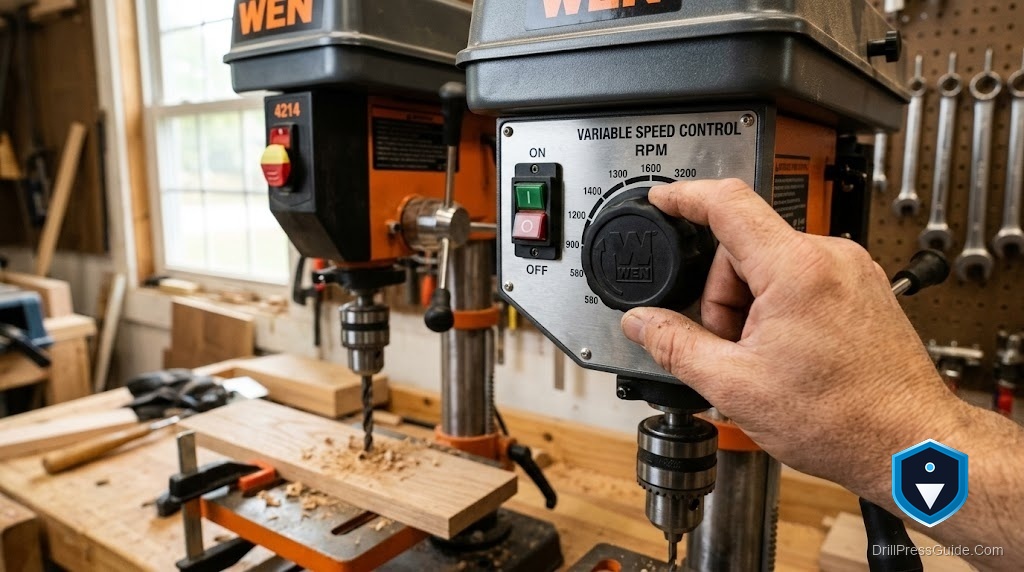
Most entry-level drill presses ask you to stop, open a cover, and wrestle a V-belt from one pulley to another every time you want a different speed. The WEN 4214 does something that used to be reserved for machines several classes up: you turn a handle while it runs and the speed changes on the fly, with the current RPM glowing on a little digital readout. That one feature is why this press has become the default recommendation for home woodworkers, and it genuinely changes how you work.
What the WEN 4214 is
The 4214 is a 12-inch benchtop drill press with a mechanical variable-speed system. Instead of five fixed belt positions, it gives you a stepless range from about 580 to 3200 RPM, adjusted with a front-mounted handle while the motor spins. A digital readout displays the speed so you can dial in the right RPM for the material instead of guessing. It runs a 5-amp motor, uses an MT2 spindle taper with a 5/8-inch keyed chuck, offers roughly 3-1/8 inches of spindle travel, and rides on a cast-iron table that bevels 45 degrees left and right. A built-in work light and a laser-free, no-nonsense layout round it out.
The practical payoff: matching speed to material is the single biggest factor in clean holes and long bit life. Wood wants speed, metal wants slow torque, and a press that lets you change between them in two seconds gets used correctly far more often than one that makes you fight a belt.
The 4214 versus its siblings
WEN’s lineup causes some confusion, so here is the map. The 4214 is the 12-inch variable-speed model with the digital readout. The 4214T is the updated version of the same machine. The smaller 4210T is a 10-inch variable-speed unit, and the 4208 and 4208T are the entry 8-inch fixed-speed presses. If the variable-speed dial and the 12-inch swing are what you want, the 4214 (or 4214T) is the one to look at; the others trade away either size or the stepless speed.
Where it earns praise, and its honest flaws
What reviewers and owners consistently like: the variable speed and digital readout, the surprisingly solid cast-iron build for a home-shop press, the usable work light, and a chuck and table that hold their own. For general woodworking and light metal, it punches well above its class.
The honest flaws: the depth stop is functional but not the most precise, so for repeated exact depths you will double-check it. The stock chuck is decent rather than premium, and picky users upgrade it eventually. And like any 12-inch machine, it is a light-to-medium tool, not a metal shop’s iron, so it will slow if you lean on a large bit in thick steel. None of these undo the value; they just set expectations.
Setup, tooling, and upgrades
Out of the box the 4214 needs little, but a few additions make it better. A quality 5/8-inch keyed drill chuck with an MT2 arbor is the upgrade most owners eventually make for tighter grip and less runout. A drill press vise makes metal work safe and repeatable, a set of Forstner bits takes full advantage of that variable-speed control in wood, and a spare drill press chuck key saves the inevitable hunt. When you are ready, the machine itself is the WEN 4214 12-inch variable-speed drill press.
The verdict
The WEN 4214 is the drill press to buy when you want real variable-speed control and a 12-inch swing without stepping up to a professional machine. That front handle and digital readout mean you actually match speed to material, which shows up directly in cleaner holes and longer-lasting bits. Go in knowing its limits: a merely adequate depth stop, a stock chuck worth upgrading, and a light-to-medium duty rating that favors wood and light metal over heavy steel. For the home woodworker who wants one press to do most things well, the 4214 is an easy recommendation, and the reason it keeps topping shortlists.
Takeaways:
- The WEN 4214 is a 12-inch benchtop press with stepless variable speed (about 580 to 3200 RPM) and a digital readout.
- Turning speed on the fly means you actually match RPM to material, for cleaner holes and longer bit life.
- Honest flaws: an adequate depth stop, an upgradeable stock chuck, and a light-to-medium duty rating.
- Confirm you want the 4214/4214T (12-inch variable) versus the smaller 4210T or fixed-speed 4208.
FAQ
What makes the WEN 4214 different from a standard drill press? It uses a mechanical variable-speed system, so you change speed (about 580 to 3200 RPM) with a front handle while the motor runs, and a digital readout shows the current RPM. No belt swapping.
What are the WEN 4214’s key specs? A 12-inch swing, 5-amp motor, MT2 taper with a 5/8-inch chuck, roughly 3-1/8 inches of spindle travel, a cast-iron table that bevels 45 degrees each way, and a built-in work light.
What is the difference between the 4214 and 4214T? The 4214T is the updated version of the same 12-inch variable-speed machine. Both share the core variable-speed design and readout.
Is the WEN 4214 good for metal? It handles light metal well at low speeds, but at 12 inches and 5 amps it is a light-to-medium machine, not a heavy metalworking press.
What is the biggest weakness of the 4214? The depth stop is functional but not the most precise, and the stock chuck is decent rather than premium. Both are easy to work around or upgrade.
Should I upgrade the chuck? Many owners fit a quality 5/8-inch keyed chuck with an MT2 arbor for a tighter grip and less runout. It is the most common upgrade.
4214 or the smaller 4210T? Choose the 4214 for a larger 12-inch swing and more capacity; the 4210T is a more compact 10-inch variable-speed option for tighter benches.
References
- WEN Products, 4214 12-inch Variable Speed Drill Press specifications: https://wenproducts.com/products/wen-4214-12-inch-variable-speed-drill-press
- WEN Products, 4214T Variable Speed Drill Press (updated model): https://wenproducts.com/products/wen-4214t-12-inch-variable-speed-cast-iron-drill-press
- WEN 4214 Drill Press owner’s manual (specifications and setup): https://wenproducts.com/cdn/shop/files/4214_Manual.pdf


