
What Is a 10-Inch Drill Press? A Practical Shop Explanation
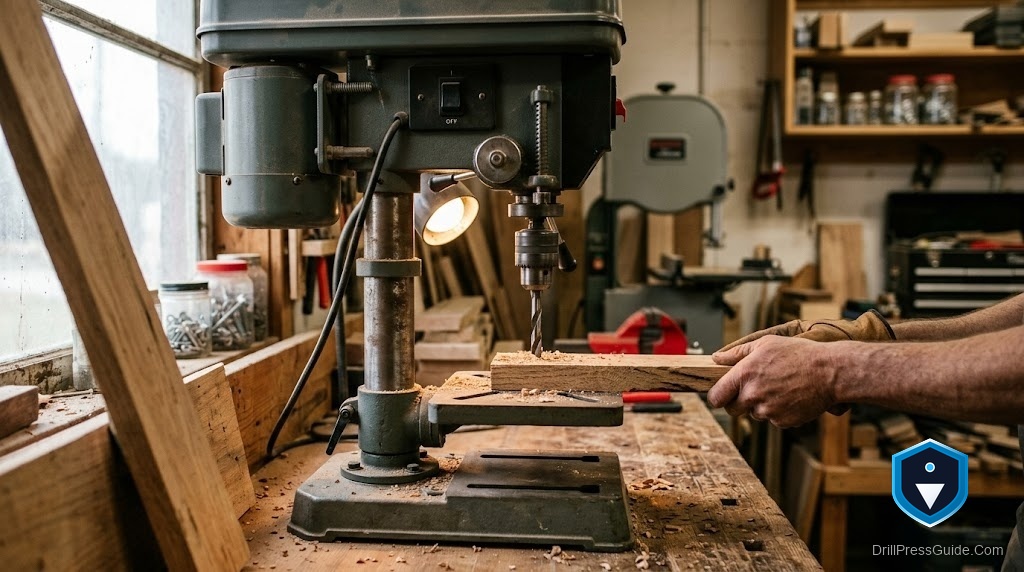
Stand in the drill press aisle and the sizes read like shoe sizes: 8-inch, 10-inch, 12-inch. It is easy to assume the number describes how deep the machine drills or how thick a board it swallows. It describes neither. The 10-inch label is a swing measurement, and once you know what swing means, the whole size question becomes simple, and you can tell in seconds whether a 10-inch press fits the work you actually do.
A 10-inch drill press is a machine with a 10-inch swing, meaning the distance from the center of the bit to the column is 5 inches, so it can drill the exact center of a workpiece up to 10 inches wide. The number describes reach across a piece, not hole depth or material thickness. A 10-inch press is a popular mid-size benchtop choice for home and hobby shops.
What the 10 inches actually measures
Swing is twice the throat depth, the gap from the bit’s centerline to the front of the column. A 10-inch swing means the bit sits 5 inches from the column, so a piece up to 10 inches wide can have its center reached by the bit. Rotate a 10-inch disc under it and the bit can touch the middle. That is all the headline number promises.
It does not tell you how deep a hole you can drill, that is spindle travel, a separate spec, nor how thick a piece fits under the bit, that is the table-to-chuck clearance. A machine can have a 10-inch swing and modest spindle travel, so always read those numbers separately.
Where a 10-inch press fits
The 10-inch size is the comfortable middle of the benchtop range. It reaches wider work than an 8-inch without the bulk of a 12-inch or a floor model, which is why it is such a common first serious drill press. A variable-speed 10-inch model like the WEN 4210T cast iron drill press covers the everyday span of home and hobby jobs: accurate holes in wood, plastic, and mild steel, with a laser and a cast-iron table on that particular model. Its honest limits are the usual benchtop ones, modest spindle travel and power, and no room for very wide panels or tall standing stock.
8, 10, and 12 inch compared
| Swing | Reaches center of | Best for |
|---|---|---|
| 8 inch | Up to 8-inch-wide work | Small parts, tight spaces, lowest cost |
| 10 inch | Up to 10-inch-wide work | Home and hobby all-rounder |
| 12 inch | Up to 12-inch-wide work | Wider panels, more capacity |
| Floor models | Larger, plus tall stock | Big or tall workpieces, heavy use |
The jump from 8 to 10 inches buys noticeably more reach for not much more machine, which is why many people land on 10. Moving to 12 or a floor model matters mainly if you drill wide panels or tall pieces.
How to know if 10 inches is enough
Measure the widest piece you realistically drill through the center. If it is under 10 inches, a 10-inch press reaches it. Then check spindle travel against your deepest hole and table clearance against your tallest workpiece. If all three clear, the size fits. If you routinely center holes in wide panels, size up. The number on the box only answers the width question, so answer the other two yourself.
The verdict
A 10-inch drill press is a 10-inch-swing machine that can center a hole in work up to 10 inches wide, nothing more and nothing less, so treat the label as a reach spec, not a depth or thickness one. It is the mid-size benchtop sweet spot for home and hobby shops, offering more reach than an 8-inch without the size of a floor model. Three takeaways: swing is twice the throat depth and only describes width reach, check spindle travel and table clearance as separate numbers, and pick 10 inches when your widest centered work stays under 10 inches. Who should size up? Anyone drilling wide panels or tall stock, who will want a 12-inch or floor machine.
Frequently asked questions
What is a 10-inch drill press? A drill press with a 10-inch swing, meaning the bit sits 5 inches from the column and can reach the center of a workpiece up to 10 inches wide. The number describes reach, not hole depth.
What does the 10-inch measurement mean? It is the swing, twice the throat depth. A 10-inch swing lets the bit reach the middle of a 10-inch-wide piece. It does not describe how deep or thick a piece the machine handles.
Is a 10-inch drill press big enough for home use? For most home and hobby work, yes. It reaches wider pieces than an 8-inch and handles wood, plastic, and mild steel, while staying compact on a bench.
What is the difference between an 8-inch and 10-inch drill press? Swing. An 8-inch reaches the center of 8-inch-wide work, a 10-inch reaches 10-inch-wide work. The 10-inch gives more reach for a modest step up in size.
Does a 10-inch drill press drill 10 inches deep? No. Hole depth is set by spindle travel, a separate and much smaller number. The 10 inches refers only to the width the bit can center a hole in.
Should I get a 10-inch or 12-inch drill press? Choose based on the widest piece you center holes in. If it stays under 10 inches, a 10-inch is fine. Go 12-inch for wider panels.
What can a 10-inch variable-speed drill press do? Drill accurate holes in wood, plastic, and mild steel, with speed matched by a dial. Models with a laser and cast-iron table add alignment and stability for home and hobby jobs.
References
- OSHA, Woodworking eTool: Drill Press. https://www.osha.gov/etools/woodworking/production/machines-tools/drill-press
- CCOHS, Metalworking Machines: Drill Presses. https://www.ccohs.ca/oshanswers/safety_haz/metalworking/drillpresses.html
- Pro Tool Reviews, How to Use and Set Up a Drill Press. https://www.protoolreviews.com/how-to-use-drill-press/


