Can You Use an End Mill in a Drill Press? Capability, Limits, and the Safer Setup
An end mill looks like it belongs in a drill press. It has a shank, it fits a chuck, it spins. Drop it in, and the temptation is to treat it like a fancy drill bit that can also cut sideways. That is the exact assumption that snaps cutters, gouges workpieces, and puts people in the emergency room. An end mill and a drill bit are shaped to remove material in different directions, and a drill press is built to support only one of those directions.
Can you use an end mill in a drill press? For plunging straight down into soft material with a center-cutting end mill, held short and clamped tight, you can make a limited cut. For side milling, which is what end mills are actually for, no. A drill press spindle cannot safely take the sideways load, and the chuck cannot be trusted to hold an end mill against it.
The two ways an end mill cuts, and why one is off limits
An end mill has cutting edges on its end and along its sides. Plunging uses the end, like a drill. Side milling uses the flanks, sweeping the cutter through the material sideways to make slots, pockets, and profiles. That side cut is the whole reason end mills exist, and it is precisely the motion a drill press handles worst.
The drill press spindle rides in a quill that slides for downward feed. Downward force it takes well. Sideways force pushes against the sliding clearance, so the spindle flexes and chatters, the accuracy collapses, and the risk climbs. This is the same fundamental limit behind every warning that a drill press is for drilling, echoed in the CCOHS and OSHA guidance about keeping the tool to its designed job and the work firmly secured.
The chuck problem nobody mentions
Even if the spindle held, the chuck would not. A standard drill chuck grips a smooth shank by friction, tuned for the downward pull of drilling. Side loads twist an end mill, and a twisting end mill can spin in the jaws, walk out, or drop. That is why real milling uses collets or holders that lock the cutter positively, not a three-jaw drill chuck. On a drill press you almost never have that grip, which alone rules out side milling.
The one limited thing you can do
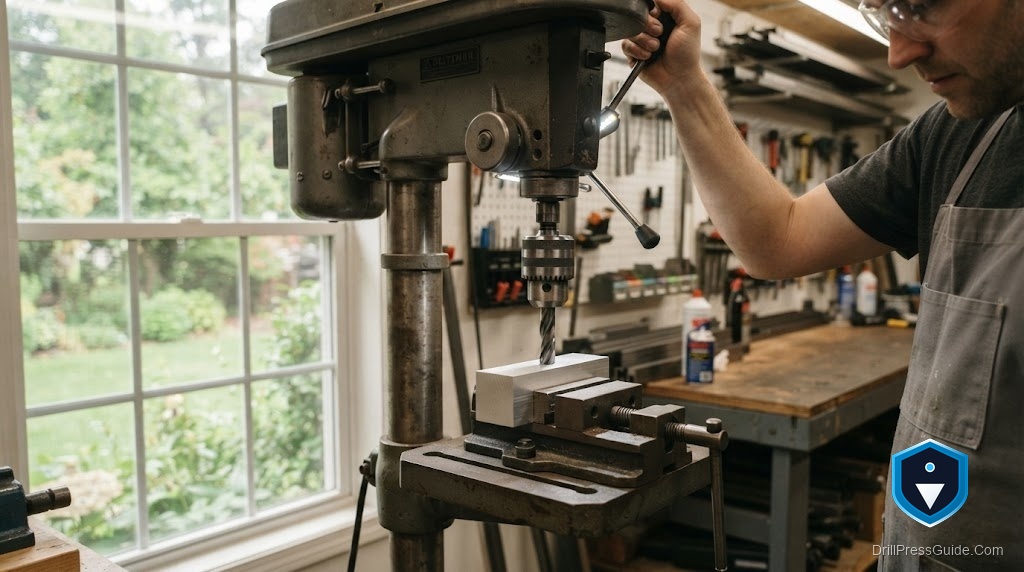
Plunging is the exception. A center-cutting end mill can plunge straight down into soft material, roughly like an oversized flat-bottomed drill, to start a pocket or flatten a spot. If you do this, use a center-cutting end mill (not every end mill can plunge), keep it choked up short in the chuck, clamp the workpiece in a solid vise, take a shallow plunge, and clear chips. Do not then push sideways. The moment you traverse, you are side milling, and you are back to the flex, chatter, and grab the machine cannot handle.
Drill bit, end mill, and the right machine
| Tool and motion | Drill press | Milling machine |
|---|---|---|
| Twist bit, plunge | Ideal | Works |
| End mill, plunge only | Limited, soft material | Works |
| End mill, side cut | Unsafe, avoid | What it is built for |
| Grip needed | Drill chuck | Collet or holder |
The honest read: a drill press can plunge an end mill a little, but the tool’s real purpose, side cutting, belongs on a mill with proper workholding. If you want what an end mill does, the machine matters as much as the cutter.
The safer path
If you need a flat-bottomed hole or counterbore on a drill press, a purpose-made counterbore or a Forstner bit in wood does the job without pretending an end mill is a drill. If you need slots and pockets, that is a milling machine or a mill-drill, and no accessory turns a drill press into one safely. Matching the tool and the machine to the cut is the whole lesson here.
The verdict
Can you use an end mill in a drill press? Only to plunge straight down, only with a center-cutting mill in soft material, held short and clamped, and never to cut sideways. Side milling asks the spindle for the one thing it cannot give and asks a friction chuck to hold against a twist it cannot resist. Three takeaways: end mills exist to cut sideways and that is exactly what a drill press cannot do, a drill chuck cannot safely hold an end mill against side loads, and plunging soft material is the only limited use worth considering. Who should skip it? Anyone wanting slots, pockets, or profiles, or working in steel, all of which belong on a milling machine.
Frequently asked questions
Can you put an end mill in a drill press? You can chuck one and plunge straight down into soft material with a center-cutting end mill held short. You cannot safely side mill, which is what end mills are actually made to do.
Why can’t you side mill on a drill press? The spindle rides in a sliding quill that resists downward force but flexes under sideways force, and a drill chuck cannot hold the cutter against the twist. The result is chatter, inaccuracy, and danger.
What is a center-cutting end mill? An end mill with cutting edges that reach the center of its tip, so it can plunge straight down. Non-center-cutting mills cannot plunge and must not be used this way.
Will an end mill come loose in a drill chuck? Under side loads, yes, it can twist, spin in the jaws, or drop. Real milling uses collets or holders that grip positively, which a drill press usually lacks.
Can I cut a slot with an end mill on a drill press? No. Cutting a slot means side milling, which overloads the spindle and chuck. Use a milling machine or mill-drill for slots and pockets.
What should I use for a flat-bottomed hole instead? A purpose-made counterbore, or a Forstner bit in wood. These are designed for the drill press and do the job safely.
Is plunging an end mill in aluminum safe on a drill press? A shallow plunge with a center-cutting mill, short in the chuck and firmly clamped, is a limited option. Do not traverse sideways, and stop at any sign of grab or chatter.
References
- CCOHS, Metalworking Machines: Drill Presses. https://www.ccohs.ca/oshanswers/safety_haz/metalworking/drillpresses.html
- OSHA, Woodworking eTool: Drill Press. https://www.osha.gov/etools/woodworking/production/machines-tools/drill-press
- Pro Tool Reviews, How to Use and Set Up a Drill Press. https://www.protoolreviews.com/how-to-use-drill-press/