Can You Use a Plunge Router as a Drill Press? Capability, Limits, and the Safer Setup
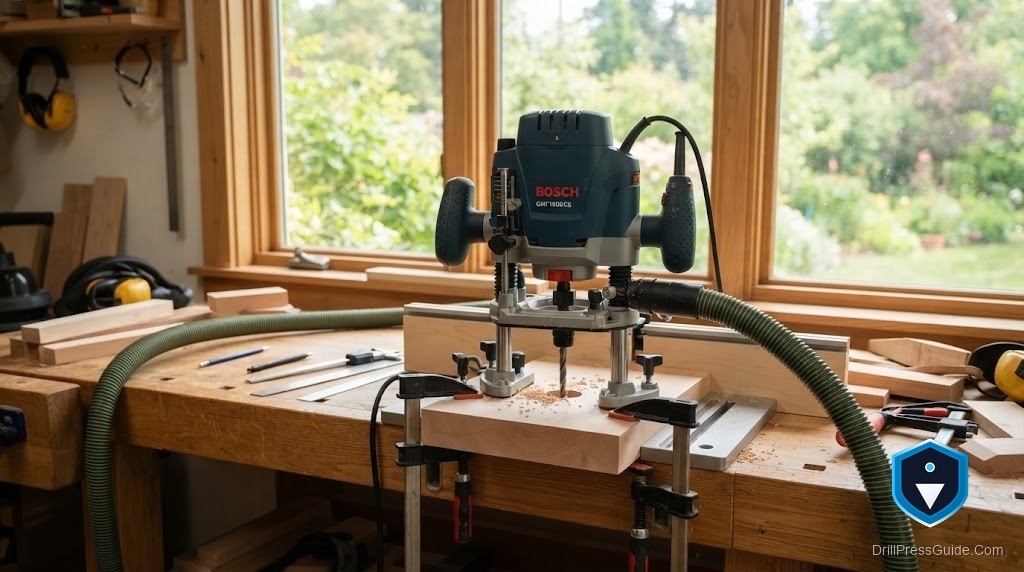
A plunge router already moves straight down. It sits over the work, drops the spinning bit into it, and returns. From across the shop it looks like it could stand in for a drill press in a pinch, and woodworkers with a router but no press ask this all the time. The mechanics are tempting, but a router and a drill press spin their bits for completely different reasons, and that difference is exactly where this idea gets risky.
Can you use a plunge router as a drill press? For a small number of shallow holes in wood, with a proper drill or brad-point bit that has cutting geometry on its tip, you can plunge carefully and get away with it. As a general substitute it is a poor and potentially dangerous idea, because routers spin far too fast for most drilling and their collets are not made to grip standard drill bit shanks.
Why a router is not a drill press in disguise
Two things separate them, and both matter.
Speed. A router screams, often tens of thousands of RPM, because router bits shear wood at high surface speed. Drill bits are designed for far lower speeds, and spinning a twist bit that fast overheats it, burns the wood, and can throw the bit. There is no low gear on a router that reaches proper drilling speeds.
Grip. A router holds bits in a collet sized for router-bit shanks, commonly a quarter inch or half inch. A standard twist bit’s round shank is not what a collet is built to clamp, and a bit that slips in a collet at router speed is a serious hazard. The unsecured-tool and point-of-operation warnings that OSHA and CCOHS give for drilling apply with extra force when the tool is turning that fast.
The narrow case where it can work
If you only need a few shallow holes in wood, there is a careful version. Use a bit made to cut on its tip and sized to fit the collet properly, such as a brad-point or a purpose-made router drilling bit, never a masonry or metal twist bit. Set the router in a table or a plunge base so it stays square, take a shallow plunge, and keep the piece clamped. Accept that you cannot drill metal, cannot drill deep, and cannot control speed the way a press would. This is a workaround for a woodworker in a bind, not a method to build around.
What each tool is actually for
| Task | Plunge router | Drill press |
|---|---|---|
| Drilling holes | Marginal, wood only, shallow | Its core job, any depth |
| Speed range | Very high, fixed range | Low to moderate, adjustable |
| Bit grip | Router collet, router shanks | Chuck, standard drill shanks |
| Mortises and dados | Excellent | Not its job |
| Metal drilling | No | Yes, with the right speed |
The table makes the point without much comment: each tool shines at what the other does poorly. A router excels at edges, grooves, and mortises. A drill press excels at holes at controllable speeds. Forcing one to do the other’s job trades safety and quality for the convenience of not owning two tools.
The safer, smarter alternatives
If you need holes and own only a router, you are usually better served by a handheld drill with a drill guide block, which keeps a proper bit square at a proper speed, than by plunging a router. And if drilling is becoming a regular need, a modest bench drill press solves it correctly for less trouble than rigging a router to misbehave. The router stays brilliant at routing, which is where it should stay.
The verdict
Can you use a plunge router as a drill press? Only for a few shallow holes in wood, with a tip-cutting bit that truly fits the collet, and even then you are working around two real problems, wrong speed and wrong grip. It is never an option for metal, deep holes, or standard twist bits. Three takeaways: routers spin far too fast for normal drilling, their collets are not made for standard drill shanks, and a handheld drill with a guide is a safer stand-in than a router when you have no press. Who should skip this entirely? Anyone drilling metal, anyone needing depth, and anyone tempted to chuck a regular twist bit into a router collet.
Frequently asked questions
Can a plunge router be used as a drill press? Only for a few shallow holes in wood, using a bit that cuts on its tip and fits the collet. It is not a general substitute because routers spin too fast and their collets are not built for standard drill bits.
Why is drilling with a router risky? Routers run at very high RPM that overheats drill bits and burns wood, and their collets are not designed to grip round drill-bit shanks, so a bit can slip or be thrown.
What bit can I use to drill with a router? A brad-point or purpose-made router drilling bit sized to fit the collet, cutting on its tip. Never use masonry or metal twist bits.
Can I drill metal with a plunge router? No. Router speeds are far too high for metal drilling, and the collet grip and lack of speed control make it unsafe.
Is a router better than a drill press for any holes? Not for drilling. A router is better for mortises, dados, and grooves. For holes, a drill press or even a guided handheld drill is the right tool.
What if I only own a router and need a hole? A handheld drill with a drill guide block is a safer stand-in, keeping a proper bit square at a proper speed. Consider a bench press if drilling becomes routine.
Can I use a router in a table to drill? A router table keeps the tool square, but it does not fix the high speed or the collet grip problem. It remains a shallow, wood-only workaround.
References
- OSHA, Woodworking eTool: Drill Press. https://www.osha.gov/etools/woodworking/production/machines-tools/drill-press
- CCOHS, Metalworking Machines: Drill Presses. https://www.ccohs.ca/oshanswers/safety_haz/metalworking/drillpresses.html
- Pro Tool Reviews, How to Use and Set Up a Drill Press. https://www.protoolreviews.com/how-to-use-drill-press/