
What Is a Bench Drill Press, and When Is It the Right Tool?
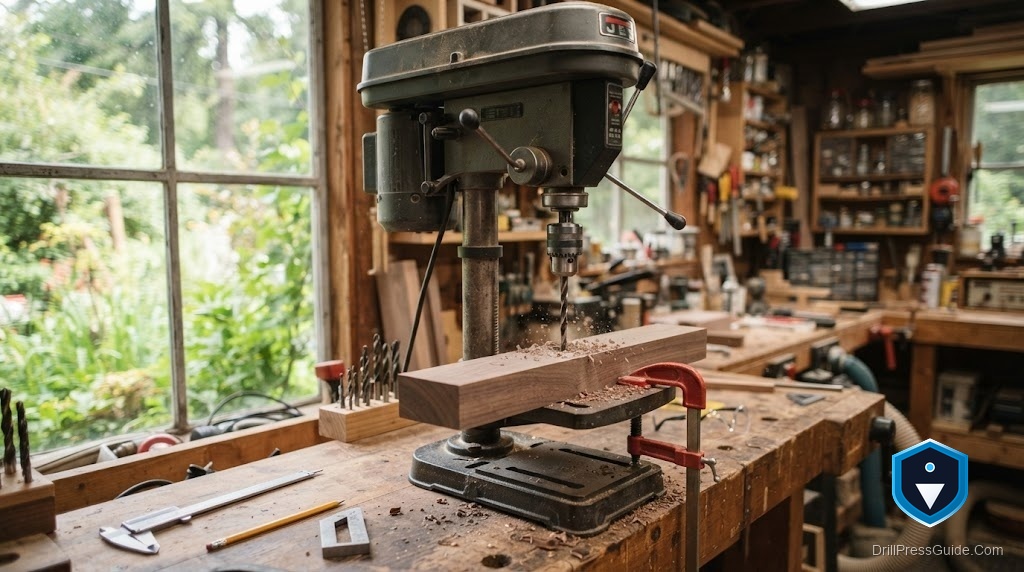
Walk into almost any home workshop that takes drilling seriously and you will find a compact machine bolted to the corner of the bench, a motor up top, a column down the middle, a small table, and a lever on the side. That is a bench drill press, and it is usually the first stationary power tool a hobbyist buys after the handheld basics. It earns that spot because it turns the shakiest part of hand drilling, holding the bit straight, into something the machine guarantees.
A bench drill press is a compact, stationary drilling machine that mounts on a workbench or stand, with a fixed motor driving a spindle that feeds straight down into a clamped workpiece by a hand lever. It is the smaller sibling of the floor standing press, built for accurate, repeatable holes in a limited footprint.
The parts that make it what it is
Four pieces define the machine. A head holds the motor and the drive, usually stepped pulleys and a belt inside an enclosure. A column supports everything and sets how wide a piece you can reach. A spindle turns the chuck and rides inside a quill that slides up and down so the bit can feed. A table holds the work, and it usually raises, lowers, and tilts. Add a depth stop to control travel and a start/stop switch, and you have the whole tool.
The swing, the headline number on the box, comes from the distance between the spindle and the column. Spindle travel, a separate spec, sets how deep a single plunge can go. Both matter, and they are not the same thing.
Why choose a bench press over a handheld drill
The case is short and strong. A bench press keeps the bit square to the table so holes do not lean. It repeats depth and placement so parts match. It drives large cutters steadily without a wrist fight. And because the work is clamped and the machine is stable, it is safer for the grabby moment when a bit breaks through, the risk both OSHA and CCOHS flag as the reason to clamp and stand clear.
When a benchtop is the right tool, and when it is not
| Your situation | Right choice | Why |
|---|---|---|
| Home or hobby shop, limited space | Bench drill press | Fits on a bench, handles most work |
| Small parts, brackets, furniture | Bench drill press | Plenty of capacity, easy to store |
| Tall workpieces, long timbers | Floor drill press | More vertical clearance and reach |
| Heavy daily metal production | Floor or industrial | More power and rigidity |
| Occasional rough holes only | Handheld drill | A press may be more than you need |
For most people reading this, the bench press is the sweet spot. A variable speed model like the WEN 4214T bench drill press covers wood, plastic, and mild steel, changes speed without moving a belt, and stores on a bench. Its honest limits are height and muscle: it will not swallow a long post standing upright, and it is not built for all-day heavy steel. Match those limits against your work and the decision is quick.
Bench versus floor, the real trade
A floor press buys you three things: taller clearance for big workpieces, more reach, and usually more power and rigidity. A bench press buys you back the floor space and the money. If you never drill anything taller than what fits under a benchtop machine, the floor model’s advantages sit unused while its footprint eats your shop. Choose based on the tallest, heaviest work you actually do, not the work you imagine doing.
The verdict
A bench drill press is a compact stationary machine that guarantees the one thing hand drilling cannot, a square and repeatable hole, in a footprint that fits a home shop. It is the right tool for the large majority of hobby and repair work, and the wrong one mainly when your workpieces are tall or your production is heavy. Three takeaways: the machine’s value is square, repeatable, controlled holes, a variable speed model spares you the belt-swapping dance, and you should size swing and spindle travel to your real work rather than the biggest number on the shelf. Who should look elsewhere? Anyone regularly drilling tall stock or running heavy metal all day, who will want a floor standing machine.
Frequently asked questions
What is a bench drill press? A compact, stationary drilling machine that mounts on a bench, using a fixed motor and a hand-fed spindle to drill accurate, repeatable holes into a clamped workpiece.
What is the difference between a bench and floor drill press? A bench press sits on a bench and saves space, suiting most home work. A floor press stands on the floor with more height clearance, reach, and power for tall or heavy jobs.
What can a bench drill press do? Drill accurate holes in wood, plastic, and mild metal, plus counterbore, ream, sand with a drum, and drive large cutters like hole saws far more steadily than a handheld drill.
What does the swing number mean? It is twice the distance from the spindle to the column, so it sets the widest workpiece you can center a hole in. It does not describe hole depth.
Is a bench drill press good for metal? Yes for mild steel and aluminum at the right slow speed with cutting fluid. Heavy daily steel work is better suited to a larger, more rigid machine.
Do I need variable speed? It is a convenience worth having. It lets you match RPM to bit and material by a dial instead of moving a belt between jobs.
How big a bench drill press should I buy? Size the swing to the widest piece you drill and the spindle travel to your deepest hole, then pick the smallest machine that comfortably covers both.
References
- OSHA, Woodworking eTool: Drill Press. https://www.osha.gov/etools/woodworking/production/machines-tools/drill-press
- CCOHS, Metalworking Machines: Drill Presses. https://www.ccohs.ca/oshanswers/safety_haz/metalworking/drillpresses.html
- Pro Tool Reviews, How to Use and Set Up a Drill Press. https://www.protoolreviews.com/how-to-use-drill-press/


