
Can You Use a Drill Press as a Mill? Capability, Limits, and the Safer Setup
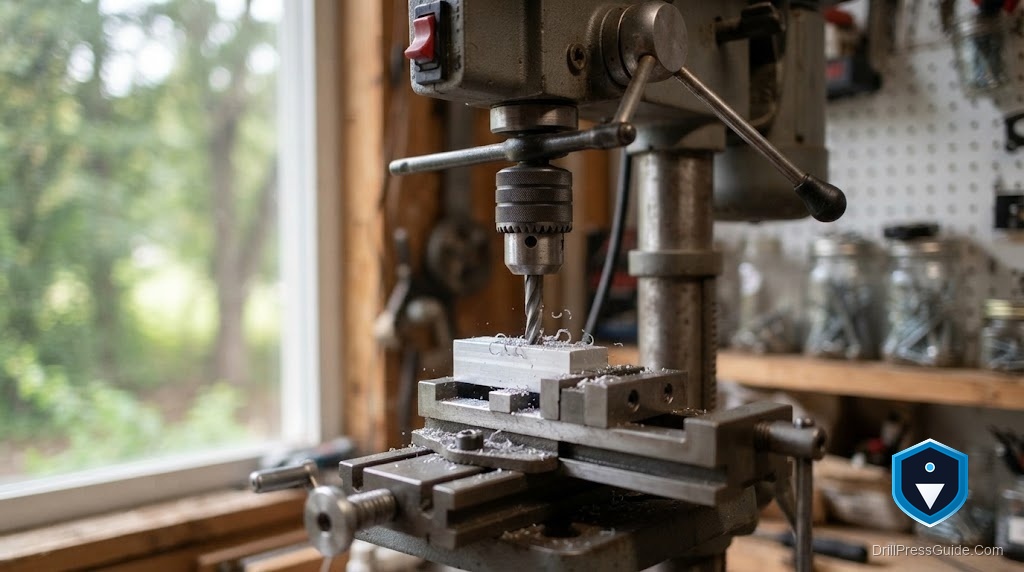
Somewhere online, someone is bolting a cross-slide vise to a drill press and calling it a milling machine. It looks convincing in photos. The part moves side to side, the cutter spins, chips come off. Then the bit deflects, the quill flexes, and a chunk of the workpiece launches across the shop. The question is not whether a drill press can move metal sideways. It can, a little. The question is whether it should, and the honest answer is mostly no.
Can you use a drill press as a mill? For very light, occasional side cutting in soft material, with the right cutter and a locked setup, you can get away with it. As a real substitute for a milling machine, no. A drill press is designed to push straight down, and side loads are the exact force it is built to resist least.
Why the geometry fights you
A milling machine has a rigid spindle in sturdy bearings meant to take sideways force. A drill press has a quill: a sleeve that slides up and down so the spindle can feed into the work. That sliding fit needs a little clearance to move, and that clearance becomes play the moment you push sideways. The bit wanders, the finish chatters, and the spindle can pull out of the chuck or the taper under side load.
The safety authorities are consistent about the underlying risk of an unsecured or improperly loaded setup. The CCOHS drill press page stresses that work must be clamped and that the tool is meant for drilling, and OSHA’s drill press eTool makes the same point about keeping hands and stock away from the point of operation. Side milling multiplies every one of those hazards because the cutting force is trying to throw the work, not press it down.
What actually goes wrong
Three failures show up again and again.
The chuck lets go. A standard drill chuck grips a smooth shank well enough to resist downward drilling force, but a side load can twist an end mill loose so it drops or spins in the jaws.
The quill flexes. Extend the quill for a deeper cut and you add more force against that sliding clearance, so accuracy gets worse the deeper you go.
The cutter grabs. End mills cut on their sides, and a drill press has no power feed to control that bite, so the tool can dig in and either stall the motor or snatch the work.
If you insist on a light pass, here is the safer version
Some people will do this anyway for a slot in aluminum or a quick edge cleanup. If that is you, stack the odds in your favor.
Use a workholding setup that cannot move: a heavy vise clamped and bolted, not just resting on the table. Take tiny cuts, a few thousandths at a time, and keep the quill retracted so it is short and stiff. Run a two or four flute end mill sized for light work, never a fragile bit. Clear chips often, and stop the moment you feel chatter or hear the motor loading up. A cross-slide vise makes the side movement controllable, but understand that it does not fix the spindle’s weakness, it only makes a marginal operation slightly less twitchy.
That is the ceiling. Light, soft, shallow, locked down, and slow.
Drill press versus mill, the comparison that settles it
| Question | Drill press | Milling machine |
|---|---|---|
| Primary force | Straight down | Down and sideways |
| Spindle support | Sliding quill, some play | Rigid, side-load bearings |
| Feed control | Hand lever | Precise, geared, often powered |
| Side cutting | Marginal, risky | What it is built for |
| Right job | Holes, reaming, sanding drums | Slots, faces, pockets, profiles |
Read that table and the decision makes itself. If you need real milling more than once in a while, the money and space go toward a small mill or a mill-drill, not a bracket that turns a good drill press into a poor mill and a damaged spindle.
What a drill press is genuinely good at instead
The better move is to use the drill press for the jobs it dominates and reach for the right tool for the rest. A bench model like the WEN 4214T variable speed drill press is excellent at accurate holes, counterbores, reaming, and light sanding with a drum. Ask it to mill a steel pocket and you are asking a ladder to be a scaffold.
The verdict
Can you use a drill press as a mill? Only in the narrowest sense, for the lightest cuts in the softest metal, with a locked setup and full protective gear, and even then you are working against the machine’s design. It is not a milling machine and treating it like one wears out the spindle and risks the operator. Three takeaways: side loads are a drill press’s weakest direction, a cross-slide vise controls motion but not spindle flex, and anyone milling regularly should skip the workaround and buy an actual mill. Who should skip this entirely? Anyone working in steel, anyone needing a real finish, and anyone tempted to take more than a whisper of a cut.
Frequently asked questions
Can you mill with a drill press at all? Only very lightly, in soft metal, with tiny cuts and a locked-down setup. It is not safe or accurate for real milling, and side loads can pull the cutter from the chuck.
Why is milling on a drill press dangerous? The spindle rides in a sliding quill built to resist downward force, not sideways force. Side cutting causes flex, chatter, and the risk of the cutter grabbing or the chuck releasing.
Will a cross-slide vise turn my drill press into a mill? It lets you move the work sideways in a controlled way, but it does nothing for the spindle’s lack of side rigidity. It makes light passes manageable, not safe for heavy work.
Can I use a milling machine as a drill press? Yes, and that direction works well. A mill has a rigid spindle and can drill accurately, though a dedicated drill press is faster to set up for plain hole drilling.
What end mill should I use if I try a light cut? A small two or four flute end mill rated for light duty, held as short as possible, taking cuts of only a few thousandths at a time.
Is aluminum safer to mill on a drill press than steel? Softer metals like aluminum are more forgiving, but the spindle weakness and grab risk remain. Steel is a hard no for anything beyond trivial cleanup.
What should I buy if I need to mill regularly? A small benchtop mill or a mill-drill. It costs and weighs more, but it is built for the side loads that destroy a drill press spindle.
References
- CCOHS, Metalworking Machines: Drill Presses. https://www.ccohs.ca/oshanswers/safety_haz/metalworking/drillpresses.html
- OSHA, Woodworking eTool: Drill Press. https://www.osha.gov/etools/woodworking/production/machines-tools/drill-press
- Pro Tool Reviews, How to Use and Set Up a Drill Press. https://www.protoolreviews.com/how-to-use-drill-press/


