Adjustable Drill Press Table: Fit, Capacity, and Setup Explained
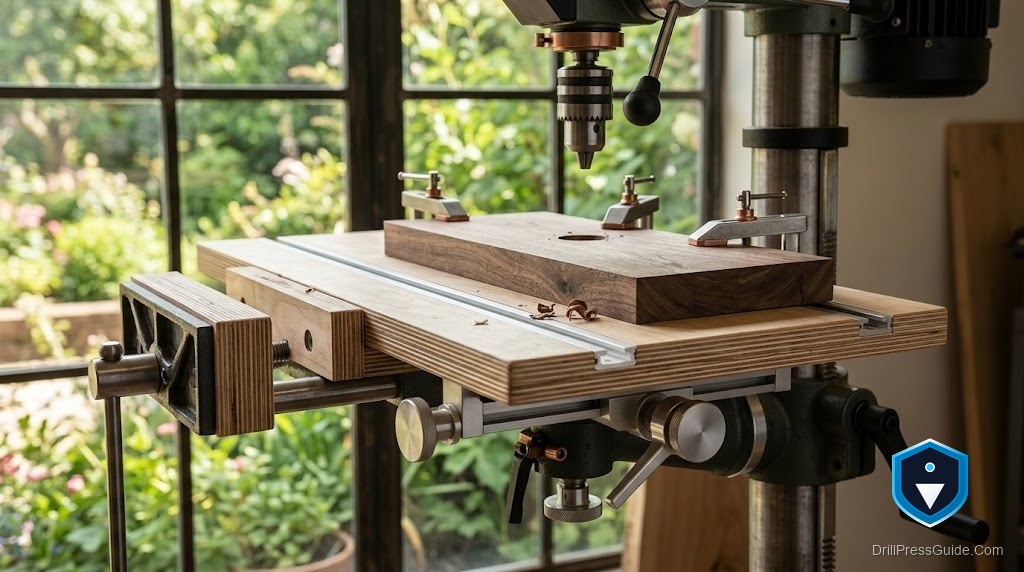
The cast-iron table that came with your drill press is small, slick, and unforgiving. Lay a cabinet door on it and most of the panel hangs in the air. Try to drill a repeatable line of holes and you are back to a pencil and a square. An adjustable drill press table fixes the parts of that machine the manufacturer left rough: it gives you a big flat surface, a fence you can move and lock, stops for repeat holes, and hold-downs so the work stays put. The catch is that “adjustable” covers everything from a shop-built plywood top to a machined aluminum system, and the one you want depends on what you build.
An adjustable drill press table is an auxiliary top that mounts over or in place of the factory table and adds a sliding fence, adjustable stops, and clamping track. “Adjustable” refers to the fence and stops you can reposition, and on some models a top that tilts or a fence that sets angles.
The short version: an adjustable table is one of the best value upgrades for a woodworking drill press, and fit comes down to your factory table’s slots and your spindle-to-table height. Match those two things and almost any aftermarket table bolts on.
What “capacity” really means here
Capacity is more than table size. It is how large a panel the top will support without tipping, how tall a workpiece the fence can back up, how far the fence travels, and how much headroom you lose. A thick MDF-and-laminate top adds an inch or more under your work, so a tall part that used to fit may not. Before you buy, check the distance from your chuck to the table and subtract the new table’s thickness.
Fitting it to your machine
Most aftermarket tables mount with knobs through your factory table’s slots. Look under your cast table: through-slots take mounting bolts directly, while a plain or T-slot table may need an interface board. Note the notch that clears the column, and confirm the top is wide enough to support your typical work but not so wide it crashes into the column or a wall when you raise the table. A table that fits the machine but not the room is a common and avoidable mistake.
A solid ready-made option
If you would rather buy than build, the Fulton drill press table with aluminum L-fence is a well-proven choice. You get a 15 by 24 inch laminated top sealed top and bottom to resist warping, an adjustable fence with a flip stop for repeat holes, PVC-tipped hold-downs, and zero-clearance inserts that cut tear-out and double as clearance for sanding drums. It bolts to most slotted factory tables. The honest drawbacks: it is MDF-cored, so it is heavy and will sag if you overhang a long panel far past the edge without support, and the laminate can chip if you drop something hard on a corner. For the money it does everything a home woodworker needs.
Setting it up so it earns its keep
Mount the table square to the fence, then check that the fence is parallel to a slot and locks without shifting. Set the zero-clearance insert flush so the bit backs up your work on breakthrough and reduces tear-out. Position the flip stop for your first hole and let it index the rest. Keep the hold-downs on the fence or in the track so a piece cannot lift or spin. Take a minute to confirm the drill enters over the insert, not the bare top, so you never bore into the table itself.
The verdict
An adjustable drill press table is the upgrade that makes a woodworking drill press feel finished. It supports big panels, backs up tall work, and turns a row of holes into a two-minute job with a fence and a stop. Buy a ready-made top like the Fulton if you want it working today, or build your own if you enjoy the project and want a custom footprint. Either way, measure your slot type and your spindle-to-table height first, and support long overhangs so the top does not sag. Do that and you will wonder how you drilled without it.
FAQ
Will an aftermarket table fit my drill press? Most do. They mount through the factory table’s slots or on an interface board. Check your slot type and that the top clears the column.
Does a thicker table cost me drilling height? Yes. The top’s thickness reduces the gap between the chuck and the work surface, so measure before buying if you drill tall parts.
MDF top or build my own? A laminated MDF top is flat, cheap, and ready to use. A shop-built top lets you size it to your machine. Both work; pick by time versus customization.
What are zero-clearance inserts for? They sit under the bit to back up the work, reducing tear-out on breakthrough, and they save the table from being drilled. Replace them as they wear.
Do I need a fence on a drill press? For repeatable holes and edge drilling, yes. A fence with a stop lets you place a line of holes without measuring each one.
Can I tilt an adjustable table for angled holes? Some models tilt or use an angled fence. If angled drilling matters to you, confirm the table or fence supports it before buying.
References
- Fulton Deluxe Drill Press Table, product specifications: Check on Amazon
- Woodcraft, “Drill Press Table” shop knowledge guide (table design, fence, and stops): https://www.woodcraft.com/blogs/shop-knowledge-guides/drill-press-table