
XY Milling Table for Drill Press: Compatibility and Setup Guide
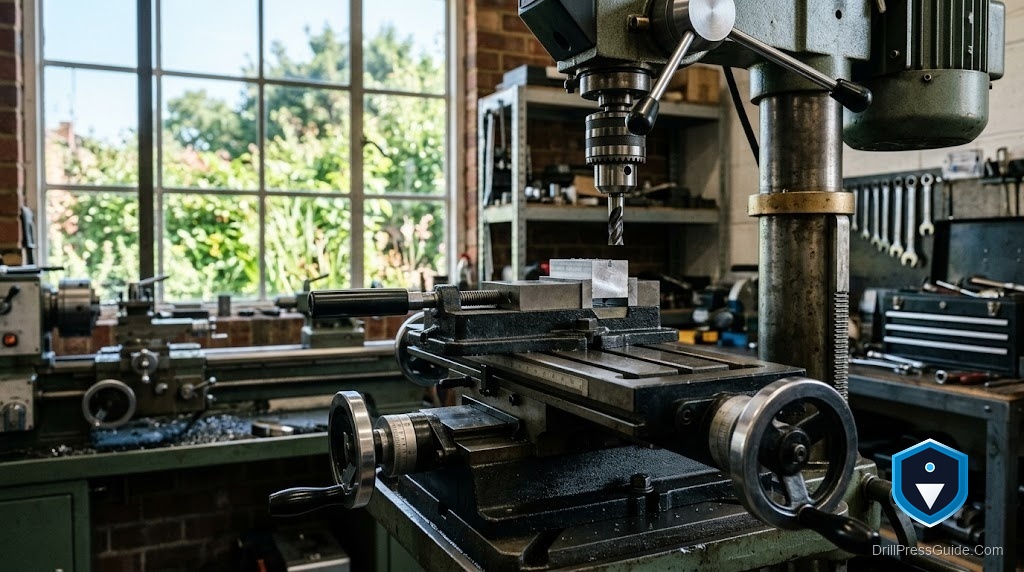
Search for an “XY milling table for drill press” and you will find dozens of cast-iron cross-slides promising to turn your drill press into a milling machine. Half the reviews call them brilliant and half call them junk. Both groups are right, and the difference between them is almost never the table. It is what each person tried to do with it. This guide is about fitting one to your machine and using it for the jobs it is actually good at.
An XY milling table for a drill press is a two-axis slide, usually with a built-in vise, that lets you move a clamped workpiece left-to-right and front-to-back by turning handwheels. On a drill press its honest purpose is precise, repeatable hole positioning, not milling in the machinist sense.
Start with the compatibility question, because it is the one that trips people up. Any XY table needs a drill press table large enough to bolt it to, and enough distance from the spindle to the table to fit the slide, the vise, and your workpiece under the chuck. Measure that vertical gap at the lowest table position before you buy, since a tall cross-slide eats several inches of headroom.
Checking that it fits your machine
Three measurements decide fit. First, the table size: lay out the cross-slide’s footprint and confirm it sits on your drill press table with room to reach the mounting slots. Second, spindle-to-table height: add the height of the table plus a typical workpiece and make sure the chuck can still reach with the quill retracted. Third, the mounting slots: the slotted base needs to line up with your table’s slots or accept a clamp. If your factory table is small, a large XY table can hang off the edges and lose rigidity.
Setting it up the right way
Bolt the table down through its base slots; do not let it float. Before the first hole, tune each gib so the slides move without wobble, and back off just enough that the wheels turn smoothly. Set your zero against a stop or an edge, then move to each position by the dial or, better, by a rule or dial indicator. Lock the axis you are not moving before you drill. Put a sacrificial board under the work so the bit has clearance on breakthrough. None of this is hard, and all of it is the difference between holes on a grid and holes that drift.
A common, capable option
The HFS 2-way 4-inch drill press XY compound vise is the table most people mean when they search this term. It gives you both axes, a 4 inch serrated jaw, and a cast-iron body for a modest outlay, and for drilling patterns it is genuinely useful. Be clear-eyed about its limits: the dials are rough, so you confirm positions with a rule; the gibs need tuning; and the whole assembly, like every budget cross-slide, will flex and chatter if you ask it to take a real milling cut. Bought as a positioning table for drilling, it delivers. Bought as a milling machine, it disappoints, which is exactly the split you see in the reviews.
The mistake to avoid
The single biggest error is trying to mill with it. A drill press quill is built to resist downward thrust, not the sideways force of an end mill, and side loads can spin the chuck loose off its taper and throw the cutter. If you catch yourself wanting to cut a slot, that is the signal you have outgrown the drill press and want a benchtop mill. Use the XY table to place holes, hold work for light spot-facing, and set up repetitive drilling. Stay in that lane and it is a smart, cheap upgrade.
The verdict
An XY milling table fits most drill presses as long as you check the footprint, the spindle-to-table height, and the mounting slots first. Set it up by bolting it down, tuning the gibs, locking the idle axis, and trusting a rule over the dials. The budget HFS cross-slide is a capable positioning table and a poor milling machine, and if you treat it as the former you will be happy. Want to cut sideways? That is a mill’s job, not a drill press’s, and no cross-slide changes that.
FAQ
Can an XY table turn my drill press into a milling machine? Not for real milling. It adds two-axis positioning for drilling. Side cutting loads exceed what a drill press spindle, quill, and chuck are built to handle.
How do I know it will fit under my chuck? Measure the spindle-to-table height at the lowest table setting, then subtract the table height plus your workpiece. If the chuck can still reach, it fits.
Why does the table feel loose? The gibs are not adjusted. Tighten each gib strip until the slide moves smoothly with no wobble, then lock the axis you are not using.
Can I trust the handwheel dials? Use them to get close, then verify with a rule or dial indicator. Budget dials are not accurate enough to trust blind.
Do I need to bolt it to the table? Yes. Anchor it through the base slots so it cannot shift when the bit loads the work.
What size table should I buy? One that fits your drill press table without hanging off the edges, with enough travel for your parts.
References
- HFS 2-Way 4-Inch Drill Press X-Y Compound Vise, product specifications: Check on Amazon
- Woodcraft, “Drill Press Table” shop knowledge guide (mounting and hold-downs): https://www.woodcraft.com/blogs/shop-knowledge-guides/drill-press-table


