
Getting Better Results From an XY Axis Table for Drill Press
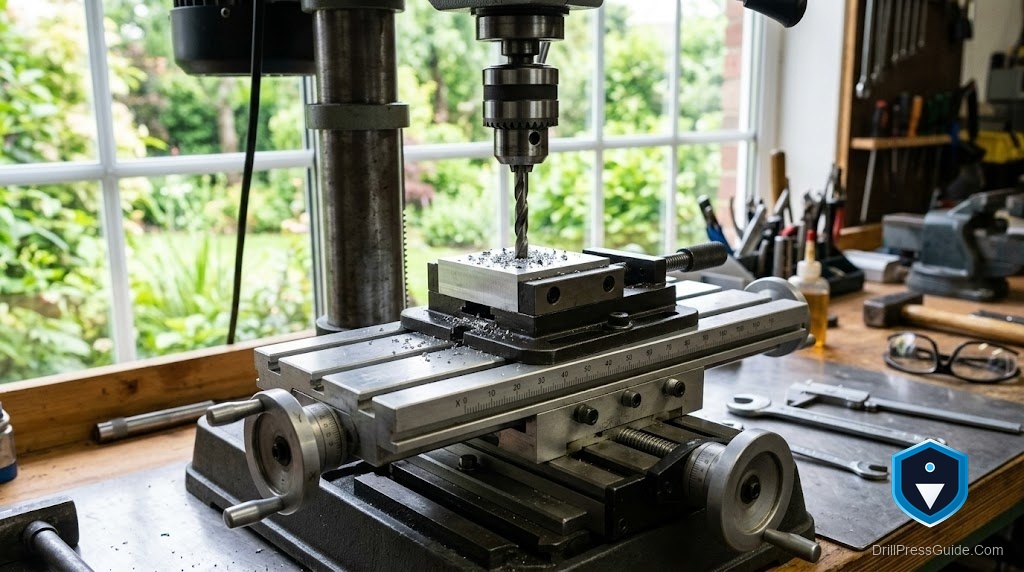
You clamp a plate to the drill press, drill the first hole, then spend two minutes nudging and re-clamping to place the second one a precise distance away. Do that across a row of holes and you understand why an XY axis table looks so appealing. Turn two handwheels, watch the work slide left and forward by measured amounts, and drill. That is the promise. The results you get from it depend almost entirely on how you set it up and how honest you are about what the tool is.
An XY axis table for a drill press, often sold as a cross-slide vise, is a vise mounted on two stacked slides. One handwheel moves the jaws and workpiece side to side, the other moves them front to back, so you can position a part in two axes without unclamping it. It bolts to your drill press table like any vise.
The honest headline: an XY table makes a drill press far better at accurate, repeatable hole placement, and it is not a substitute for a milling machine. Use it to place holes on a grid and it shines. Try to take sideways cuts with an end mill and you will find the slop, the flex, and the load limits fast.
Where it genuinely helps
Repeatable hole patterns are the sweet spot. Bolt circles, a line of shelf-pin holes in metal, a grid of holes in a bracket: set a zero, turn the wheels to your spacing, and every hole lands where the numbers say. It also lets you creep up on a location by thousandths, which is nearly impossible by hand. For anyone who drills small metal parts, that alone is worth the bench space.
The three things that decide your results
Gib adjustment. Each slide rides on a gib, a strip you tighten to remove side-to-side play. Out of the box it is usually loose. Snug the gib screws until the table moves smoothly with no wobble, then lock the axis you are not using. Skip this and your “precise” holes wander.
Locking the idle axis. When you drill, lock the axis you are not adjusting. A slide free to move is a slide that will drift under the bit and give you an oval hole.
Backlash. Turn a handwheel one way, and the first fraction of a turn back takes up slack before the table moves. Always approach your final position from the same direction so backlash does not creep into your spacing.
A pick that does the job
For most home shops the HFS 2-way XY compound cross-slide vise is the common starting point, with a 4 inch jaw and travel in both axes on two crank handles. It is cast iron, it bolts down through slotted holes, and it does exactly what an XY table should for drilling. The honest flaws are the ones every budget cross-slide shares: the handwheel dials are not precise enough to trust blindly, so you verify with a rule or a dial indicator, and the gibs need that initial tuning before it feels tight.
If you want a more polished slide and a name behind it, the Yost CSV8 cross-slide drill press vise is a heavier, wider option. It costs more and takes up more table, and for that you get a more solid base and smoother travel. Choose the HFS if you want the function for the least outlay and are willing to tune it; choose the Yost if you drill bigger parts and want less fiddling to get smooth motion.
Who should skip it
If your real goal is milling slots or profiling metal, skip the XY table on a drill press and save for a benchtop mill. The drill press spindle and quill are built for downward thrust, and side cutting loads will chatter, wear the bearings, and can pull the chuck loose. An XY table earns its place for positioning and drilling, not for cutting sideways.
The verdict
An XY axis table turns a drill press into a precise hole-placement machine, and that is a real upgrade for anyone drilling patterns in metal or small parts. Get the results by tuning the gibs, locking the idle axis, and always approaching your final position from the same direction to beat backlash. Buy the budget HFS if you will do the tuning, step up to the Yost for heavier work, and buy a mill instead if you actually want to cut sideways. Respect what it is and it will place holes you could never hit by hand.
FAQ
What is the difference between an XY table and a cross-slide vise? For drill press use they are the same idea: a vise on two slides that move in X and Y. Bare XY tables without jaws also exist for mounting fixtures.
Can I mill with an XY table on my drill press? Not safely for real material removal. The spindle and quill are not built for side loads, and the chuck can loosen. Use it for positioning and drilling.
Why are my holes still slightly off? Usually loose gibs, an unlocked idle axis, or backlash. Tighten the gibs, lock the axis you are not moving, and approach each position from the same direction.
Do I need to bolt it down? Yes. Use the slotted base holes to anchor it to the drill press table so it cannot shift under load.
How much travel do I need? Match it to your parts. A few inches in each axis covers most small brackets and plates; larger work needs a larger table.
Will it work on any drill press? Any press with a table big enough to bolt it to and enough spindle-to-table height for the vise plus the workpiece.
References
- HFS 2-Way 4-Inch Drill Press X-Y Compound Vise, product specifications: Check on Amazon
- Yost Vises, cross-slide and drill press vise line: https://yostvises.com/collections/drill-press-vises


