
T-Bolts for Drill Press Table: Matching Size, Fit, and Grip
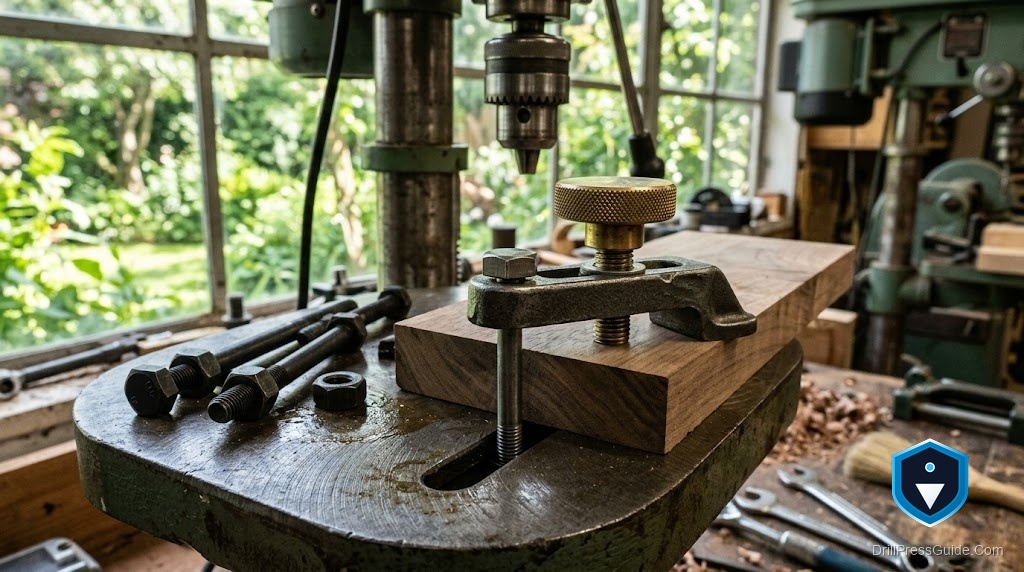
A T-slot table is only as useful as the T-bolts you feed it, and the wrong ones turn a great clamping surface into a frustrating one that rocks, pulls out, or refuses to seat. T-bolts are the simple hardware that lets you anchor a vise, a clamp, or a fence anywhere along a slot, but simple does not mean interchangeable. Matching the bolt to your table’s slot is the whole game. Get the size and profile right and clamping is fast and rock-solid; get it wrong and nothing holds. Here is how to choose.
T-bolts for a drill press table are bolts with a T-shaped head that slides into the table’s T-slots, letting you anchor clamps, vises, and fences anywhere along the channel. The head sits in the slot while the threaded shank sticks up to take a nut and clamp. Fit depends entirely on matching the head to the slot’s width and profile.
Short answer: choose T-bolts whose head matches your table’s slot width and profile so they seat fully and grip, and whose thread matches your clamps and knobs. The right T-bolt drops in, seats flat, and locks the work solid; the wrong size rocks or pulls out.
Why the head profile matters most
T-slots are machined to a specific width and internal profile, and the T-bolt head has to match both. A head too wide will not enter the slot; too narrow, and it rocks and can twist out under load instead of gripping the slot’s shoulders. The head also needs the right thickness to sit below the slot’s lip so it pulls against the shoulders when tightened. So the first measurement is your slot: its opening width, its internal width, and its depth. Buy T-bolts specified for that slot.
Thread and length come next
Once the head fits, the thread has to match your clamps, flange nuts, or hold-down knobs, and the shank has to be long enough to clear the work and the clamp but not so long it bottoms out or wobbles. A set of T-bolts in a couple of lengths covers most parts, since a tall workpiece needs more thread showing than a thin one. Matching thread pitch to your existing clamp kit saves frustration.
Check before you buy
- Slot size. Measure the slot opening, internal width, and depth.
- Head match. The head must seat below the lip and grip the shoulders.
- Thread. Match the thread to your clamps, nuts, and knobs.
- Length. Enough shank for your work, without bottoming out.
T-bolts versus T-nuts and studs
Against T-nuts with separate studs, one-piece T-bolts win on speed and simplicity, drop in and tighten, and lose a little flexibility on stud length. T-nuts let you thread in studs of any length, which suits tall or varied work, while T-bolts are quicker for everyday clamping. Many shops keep both. You can compare a set of drill press table T-bolts with a full T-slot clamping kit that includes nuts, studs, and step blocks.
Setting them up
- Measure your table’s slot opening, internal width, and depth.
- Choose T-bolts whose head seats below the lip and grips the shoulders.
- Match the thread to your clamps, nuts, and knobs, in a couple of lengths.
- Slide the bolts into the slots and position the vise or clamps at the work.
- Clamp solid, set the correct speed, wear eye protection, and keep clear of the chuck, per OSHA and CCOHS.
Who should read this
If you have a T-slot table and want fast, solid clamping, matched T-bolts are the simplest way to get it, measure the slot first. If your work varies a lot in height, add T-nuts and studs alongside your T-bolts for more flexibility.
Bottom line
T-bolts for a drill press table are simple hardware with one rule that decides everything: the head must match your slot’s width and profile so it seats and grips. Get that right, match the thread to your clamps, and keep a couple of lengths on hand, and clamping is fast and rock-solid. The wrong size just rocks and pulls out, so measure your slot before you buy.
- The T-bolt head must match the slot’s width and profile to seat and grip.
- Match the thread to your clamps and keep a couple of shank lengths on hand.
- For tall or varied work, add T-nuts and studs alongside T-bolts.
FAQ
How do I know which T-bolts fit my table? Measure the slot’s opening width, internal width, and depth, then buy T-bolts specified for that slot so the head seats and grips.
Why do my T-bolts rock or pull out? The head is too narrow or too thin for the slot, so it does not grip the shoulders. Match the head profile to your slot.
What thread should the T-bolts have? Whatever matches your clamps, flange nuts, and knobs. Matching thread pitch to your existing clamp kit avoids mismatches.
How long should the shank be? Long enough to clear the work and clamp with thread to spare, without bottoming out. A couple of lengths cover most parts.
T-bolts or T-nuts and studs? T-bolts are quicker for everyday clamping; T-nuts with studs suit tall or varied work. Many shops keep both.
Can I use any hardware-store bolt in a T-slot? Only if its head matches the slot profile. A standard bolt head will not grip a T-slot’s shoulders, so use proper T-bolts or T-nuts.
References
- OSHA Woodworking eTool, Drill Press: https://www.osha.gov/etools/woodworking/production/machines-tools/drill-press
- CCOHS, Metalworking Machines - Drill Presses: https://www.ccohs.ca/oshanswers/safety_haz/metalworking/drillpresses.html
- WEN DPA2412T Drill Press Table: https://wenproducts.com/products/24-by-12-inch-drill-press-table-with-an-adjustable-fence-and-stop-block-t


