
Milling Machine Table for Drill Press: Why It Positions, but Does Not Mill
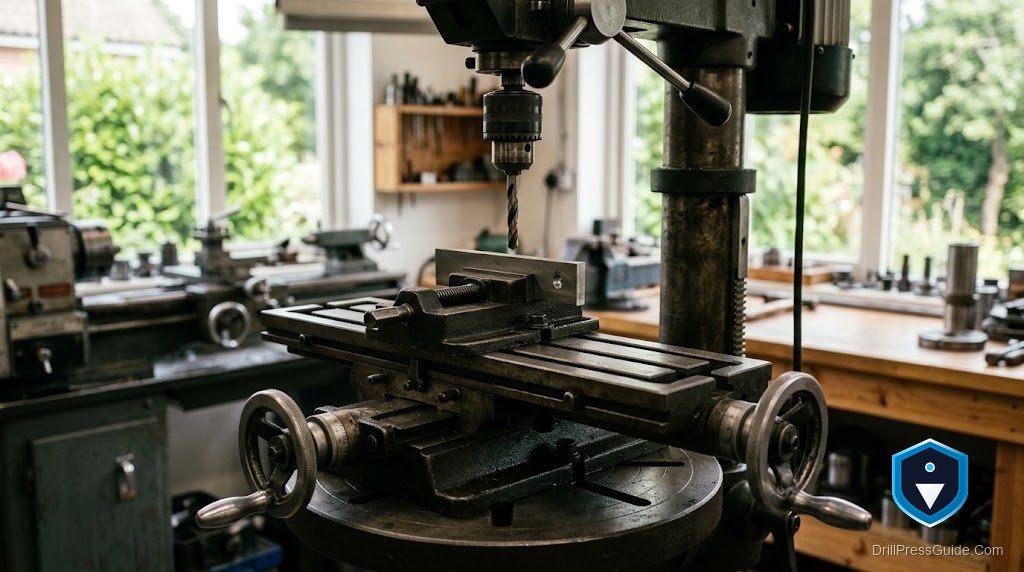
Search for a “milling machine table for drill press” and you will find X-Y tables that bolt to your press and let you crank the work in two axes, and it is easy to conclude you have just built a poor man’s milling machine. Please read this before you try to mill with one, because this is exactly where drill presses get wrecked and people get hurt. That table is a positioning tool. It lets you place the work precisely under the bit. It does not make a drill press safe to mill with, because the quill is built to take downward thrust only. Here is the honest breakdown.
A milling machine table for a drill press, usually an X-Y or compound table, mounts to the drill press table and moves the work precisely in two axes beneath the spindle. Despite the name, its safe purpose is positioning the work for accurate drilling, not milling, which is side-cutting the quill is not built to withstand.
Short answer: an X-Y table sold as a milling table for a drill press is really a precise positioner, use it to place the work under the bit and drill straight down. Do not use it to mill, because a drill press quill takes downward thrust only, not the sideways cutting force milling creates.
Why the name is misleading
The table looks like a mill’s table, so it borrows the name, but the machine underneath it is still a drill press. A milling machine has a rigid spindle and bearings engineered to take heavy side load as a cutter chews sideways through metal. A drill press spindle and quill are engineered for axial load, force straight down as you drill. Bolting a milling-style table to a drill press does not change the spindle beneath it. The table is the easy part; the spindle is what makes milling safe, and a drill press does not have the right one.
What happens if you try to mill
Feed the work sideways into a spinning cutter on a drill press and you load the quill and chuck radially, in a direction they are not built for. The quill can deflect, the bearings wear badly, and worst of all the chuck, which is only held by a taper meant for downward force, can work loose and drop the cutter. A grabbing cutter can throw the work or shatter. This is not a small risk you manage; it is a mismatch between the tool and the task.
What the table is genuinely for
As a positioner, an X-Y table is excellent and worth owning. Crank the work to exact coordinates, drill a precise grid of holes, align a hole to a layout line, set repeatable spacing, then drill straight down each time. That is real, useful precision that plays to the drill press’s strength. You move the work between drilling operations, never during a side-cut.
Check before you buy
- Mounting. Confirm the table bolts to your press and clears the travel.
- Positioning use. Buy it to position for drilling, not to mill.
- Work holding. Clamp the work to the table; it does not replace clamping.
- Downward thrust only. Never feed the work sideways into the bit.
X-Y table on a drill press versus a real milling machine
Against a milling machine, an X-Y table on a drill press wins on using a machine you own and on precise hole positioning, and loses completely on milling, which it cannot do safely. If you need accurate hole patterns, the table delivers. If you need to cut slots, pockets, or true up edges, only a milling machine’s spindle can take that load. Do not ask the drill press to do the mill’s job. You can compare a drill press X-Y compound table with a drill press vise.
Setting it up
- Bolt the X-Y table to your drill press table so it cannot shift.
- Clamp the work to the table; the table positions, it does not replace clamping.
- Crank the axes to place each hole under the bit.
- Lock the axes if you can, then drill straight down only.
- Never feed the work sideways into the bit; wear eye protection and keep clear of the chuck, per OSHA and CCOHS.
Who should read this
If you want precise, repeatable hole placement, an X-Y table is a real upgrade, position, then drill down. If you actually need to mill, buy a milling machine; no table makes a drill press a safe substitute.
Bottom line
A milling machine table for a drill press is a precise positioner wearing a misleading name. Use it to place the work under the bit and drill straight down for accurate hole patterns, and it earns its keep. Do not use it to mill, because the quill takes downward thrust only, not the side load of a cutter. Respect that, and you get precision without wrecking the machine or yourself.
- An X-Y table on a drill press positions the work; it does not mill.
- A drill press quill takes downward thrust only, never sideways cutting force.
- For real milling, only a milling machine’s spindle can take the load.
FAQ
Can I mill with an X-Y table on my drill press? No. The quill takes downward thrust only. Side-cutting can loosen the chuck and drop the cutter. Use the table to position, then drill down.
Why is it called a milling table then? Because it looks like a mill’s table. But the spindle beneath it is still a drill press’s, built for drilling, so it only positions safely.
What is the table good for? Positioning the work precisely under the bit in two axes, so you can drill accurate hole patterns, align to lines, and set repeatable spacing.
What actually happens if I try to mill? The quill and chuck take sideways load they are not built for. The chuck can loosen and drop the cutter, which can grab and throw the work.
Do I still clamp the work? Yes. The table positions but does not hold against forces. Clamp the work to the table before drilling.
What if I really need to mill? Buy a milling machine. Its spindle is built for side load. No table turns a drill press into a safe mill.
References
- OSHA Woodworking eTool, Drill Press: https://www.osha.gov/etools/woodworking/production/machines-tools/drill-press
- CCOHS, Metalworking Machines - Drill Presses: https://www.ccohs.ca/oshanswers/safety_haz/metalworking/drillpresses.html
- WEN DPA2412T Drill Press Table: https://wenproducts.com/products/24-by-12-inch-drill-press-table-with-an-adjustable-fence-and-stop-block-t


