T-Slot Table for Drill Press: Clamping Freedom and Fit
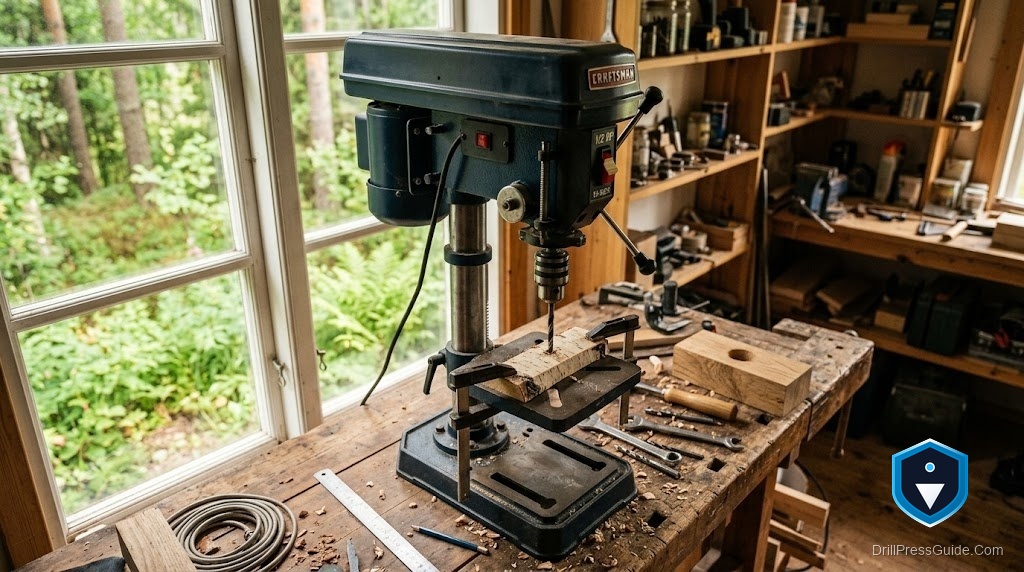
Anyone who has fought to clamp an awkward part on a bare drill press table understands the appeal of a T-slot table instantly. Those machined channels let you drop a bolt in anywhere and lock a clamp, a vise, or a fence exactly where the work needs it, instead of wrestling with the two skinny slots a factory casting gives you. A T-slot table is one of the most practical upgrades a press can get, but only if it fits your machine and you use the right hardware. Here is how to choose and set one up.
A T-slot table for a drill press is a work surface, cast iron, steel, or aluminum, machined with T-shaped channels that accept T-bolts and T-nuts anywhere along their length. It gives flexible, secure clamping across the whole surface, letting you position vises, hold-downs, and fences freely rather than at fixed points.
Short answer: a T-slot table gives you clamping freedom, drop a T-bolt into any slot and lock a clamp or vise exactly where you need it. Choose one that mounts to your machine and matches T-bolts and T-nuts sized to its slots.
Why T-slots change how you clamp
A bare factory table usually offers a couple of narrow slots, so clamping an odd-shaped part means compromising on where the clamp lands. T-slots remove that limit: because a T-bolt or T-nut slides in anywhere along the channel, you can place a hold-down right at the point that keeps the work from lifting or spinning. That is not a luxury, it is what makes tricky parts safe to drill, since OSHA and CCOHS both call for work held securely at the point of operation.
Getting the hardware right
A T-slot table is only as good as the hardware you feed it. The T-bolts and T-nuts must match the slot’s width and profile, so they seat and grip instead of rocking or pulling out. Before buying clamps or a vise, note your table’s slot size and get hardware made for it. A clamping kit sized to the slots, with studs, step blocks, and clamps, turns the table into a fast, flexible work-holding system.
Check before you buy
- Mounting. Confirm the T-slot table mounts to your machine and keeps spindle travel.
- Slot size. Note the slot width and profile so hardware fits.
- Material. Cast iron and steel for mass and durability; aluminum for lighter weight.
- Insert. Look for a way to protect the bit exit, an insert or sacrificial backer.
T-slot table versus a fence-and-insert wood top
Against a wood top with a fence and insert, a T-slot table wins on clamping anywhere and holding metal and odd shapes securely, and loses on the easily replaceable insert and light weight a wood top offers. For metalwork and irregular parts, T-slots are ideal; for repetitive wood drilling against a fence, a wood top is simpler and kinder to bits. Many shops keep a wood top over a T-slot table for the best of both. You can compare a drill press T-slot table with a drill press table clamp kit.
Setting it up
- Confirm the T-slot table mounts to your machine and clears the spindle travel.
- Note the slot size and get T-bolts and T-nuts made for it.
- Drop the hardware into the slots and position a vise or clamps at the work.
- Add an insert or sacrificial backer where the bit exits.
- Clamp the work solid, set the correct speed, wear eye protection, and keep clear of the chuck, per OSHA and CCOHS.
Who should read this
If you drill metal or awkward, irregular parts, a T-slot table’s clamp-anywhere freedom makes the work both easier and safer, just match the hardware to the slots. If you mostly drill wood against a fence, a simpler top with an insert may serve you as well.
Bottom line
A T-slot table for a drill press gives you clamping freedom: drop a T-bolt anywhere and lock the work exactly where it needs holding, which is what makes metal and odd shapes safe to drill. Choose a table that mounts to your machine, match T-bolts and T-nuts to its slots, and protect the bit exit. It is one of the most practical upgrades a press can get.
- T-slots let you clamp anywhere, ideal for metal and irregular parts.
- Match T-bolts and T-nuts to the slot width and profile so they grip.
- Confirm the table mounts to your machine and protect the bit exit.
FAQ
What is the advantage of a T-slot table? You can drop a T-bolt into any slot and clamp a vise or hold-down exactly where the work needs holding, instead of at a couple of fixed slots.
Will a T-slot table fit my press? Only if it mounts to your machine’s table or column and keeps your spindle travel. Confirm the mounting before buying.
What hardware do I need? T-bolts and T-nuts matched to your table’s slot width and profile, ideally a clamping kit with studs, step blocks, and clamps.
Is a T-slot table good for metal? Yes. The clamp-anywhere freedom lets you hold metal and odd shapes securely, which is exactly what safe metal drilling needs.
T-slot table or a wood top with a fence? T-slots for metal and irregular parts; a wood top with a fence and insert for repetitive wood drilling. Some shops layer a wood top over T-slots.
How do I protect the bit as it exits? Use a replaceable insert or a sacrificial backer under the hole so the bit exits into scrap, not the metal table.
References
- OSHA Woodworking eTool, Drill Press: https://www.osha.gov/etools/woodworking/production/machines-tools/drill-press
- CCOHS, Metalworking Machines - Drill Presses: https://www.ccohs.ca/oshanswers/safety_haz/metalworking/drillpresses.html
- WEN DPA2412T Drill Press Table: https://wenproducts.com/products/24-by-12-inch-drill-press-table-with-an-adjustable-fence-and-stop-block-t