
Cross Feed Table for Drill Press: Positioning, Not Milling
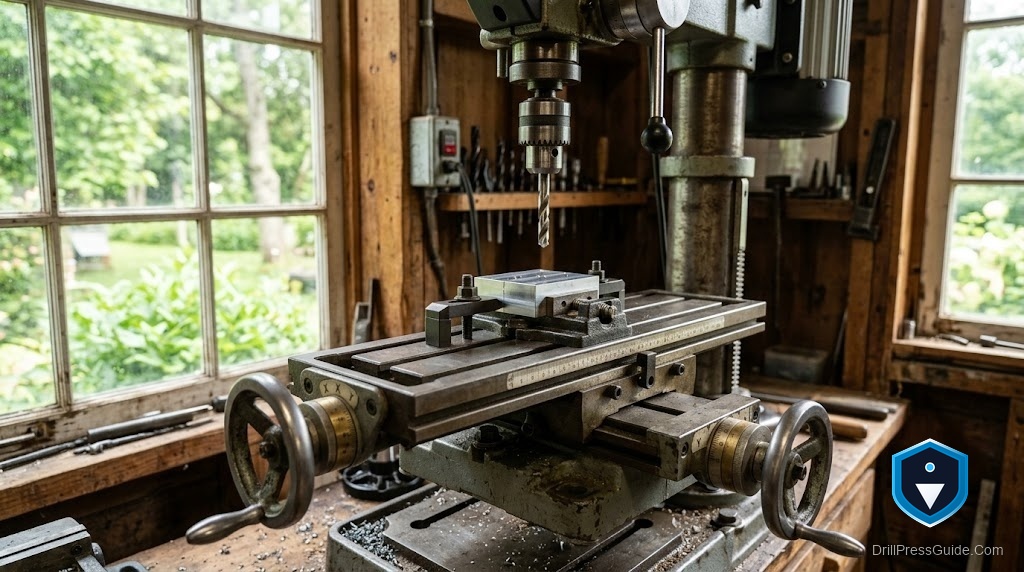
A cross feed table promises what every drill press owner secretly wants: turn a handwheel and slide the work sideways under the bit, so it feels like you could machine a slot or true up an edge. Before you try, read this, because it is exactly where drill presses get damaged and people get hurt. A cross feed table is a positioning tool. It moves the work accurately between drilling operations. It does not make a drill press into a milling machine, because the quill is built to take downward thrust only. Get that straight and the table is useful; ignore it and you risk the machine and yourself.
A cross feed table for a drill press is a sliding table, typically with one or two handwheel-driven axes, that mounts to the drill press table and moves the work precisely beneath the spindle. Its purpose is accurate positioning, aligning work, setting spacing, drilling patterns, not side-cutting or milling.
Short answer: a cross feed table is for positioning the work under the bit so you can drill accurately placed holes and align parts. It is not for feeding the work sideways into a cutter, because a drill press quill takes downward thrust only, not the side load milling demands.
The rule that keeps you safe
Here is the line you cannot cross. A drill press quill and spindle are designed for axial force, straight down as you drill. They are not designed for radial force, the sideways load of a milling cut. Use a cross feed table to feed the work sideways into a spinning bit and you push the quill and chuck in a direction they were never built for. The chuck can work loose and the bit can catch and grab, throwing the work or breaking the bit. A mill has a spindle made for side load. A drill press does not, no matter what table you bolt to it.
What the table is really for
As a positioner, a cross feed table shines. Slide the work to align a hole with a layout line, set consistent spacing along a row, or dial in a location precisely, then lock down and drill straight into it. The handwheel gives you fine, repeatable control that eyeballing never will. You are moving the work between cuts to place each hole exactly, which is squarely within what a drill press does well.
Check before you buy
- Mounting. Confirm the table bolts to your drill press table and clears the travel.
- Positioning use. Buy it to position between drilling operations, not to mill.
- Work holding. Clamp the work to the table; the slide does not replace clamping.
- Downward thrust only. Never feed the work sideways into the bit.
Cross feed table versus a compound slide
Against a two-axis compound slide, a cross feed table wins on simplicity and firm single-axis positioning, and loses the second axis of coordinate movement. A compound slide adds X-Y grid positioning; a cross feed table gives clean linear positioning along its axis. Both are positioners, and neither makes milling safe on a drill press. You can compare a drill press cross slide table with a drill press vise.
Setting it up
- Bolt the cross feed table to your drill press table so it cannot shift.
- Clamp the work to the table; the slide positions, it does not replace clamping.
- Turn the handwheel to place each hole location under the bit.
- Lock the axis if you can, then drill straight down only.
- Never feed the work sideways into the bit; wear eye protection and keep clear of the chuck, per OSHA and CCOHS.
Who should read this
If you want repeatable, accurately placed holes, a cross feed table is a real help, position, lock, drill down. If you need to cut slots or mill edges, buy a milling machine; a cross feed table does not make that safe on a drill press.
Bottom line
A cross feed table for a drill press is a precise positioner: slide the work to an exact location and drill straight down for accurate holes and alignment. It is not a milling setup, because the quill takes downward thrust only, not the sideways force of a cutter. Use it to position, keep the cutting vertical, and it is a genuinely useful upgrade.
- A cross feed table positions the work between drilling operations; it does not mill.
- A drill press quill takes downward thrust only, never sideways cutting force.
- Clamp the work to the table, position with the handwheel, then drill straight down.
FAQ
Can I mill a slot with a cross feed table on a drill press? No. The quill takes downward thrust only. Feeding sideways into a cutter loads the chuck and bearings dangerously. Use it to position, then drill.
What is a cross feed table for? Positioning the work precisely under the bit along its axis, so you can drill accurately placed holes, set spacing, and align to layout lines.
Do I still clamp the work? Yes. The table positions the work but does not resist drilling forces. Clamp the work to the table before drilling.
Why is side-cutting dangerous here? The chuck and quill are not built for sideways load, so the chuck can loosen and the bit can grab, throwing the work or snapping the bit.
Cross feed table or compound slide? A cross feed table gives simple, firm single-axis positioning; a compound slide adds a second axis for grid work. Both are positioners only.
How do I place holes accurately? Set a reference, turn the handwheel to each location, lock the axis if possible, and drill straight down for repeatable placement.
References
- OSHA Woodworking eTool, Drill Press: https://www.osha.gov/etools/woodworking/production/machines-tools/drill-press
- CCOHS, Metalworking Machines - Drill Presses: https://www.ccohs.ca/oshanswers/safety_haz/metalworking/drillpresses.html
- WEN DPA2412T Drill Press Table: https://wenproducts.com/products/24-by-12-inch-drill-press-table-with-an-adjustable-fence-and-stop-block-t


