Combination Table Saw Drill Press Lathe: Is One Machine Worth It?
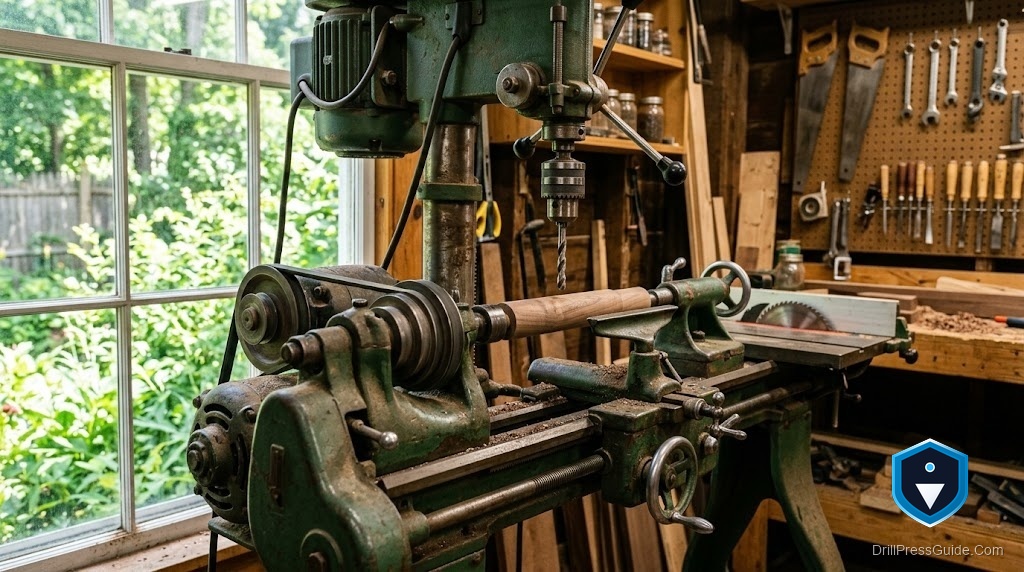
The pitch is seductive: one machine that saws, drills, and turns, taking the place of three tools and the floor space they demand. Combination machines that fold a table saw, drill press, and lathe into a single frame have been sold for decades to shops short on room. They can genuinely work, but they ask for real compromises, and the honest question is not whether the idea is clever, it is whether the tradeoffs suit how you actually work. Here is what you gain, what you give up, and who should buy one.
A combination table saw drill press lathe machine builds several functions, sawing, drilling, and turning, into one frame with a shared motor and bed. It saves floor space over three separate machines and puts one motor in place of three, though it asks for setup changes between operations and surfaces optimized for one job rather than all three.
Short answer: a combination machine is worth it if space is your hard limit and you rarely need two functions at once, since you save room and buy one motor. It is not worth it if you switch between jobs constantly or need a top-tier surface for each, because a surface built for one operation is rarely ideal for another.
The real tradeoff
Everything about a combination machine comes back to one truth: a surface and setup optimized for one operation is rarely ideal for another. A table sized and slotted for sawing is not the flat, clamp-friendly surface a drill press wants, and neither is arranged for the tool rest and centers a lathe needs. The engineering picks compromises that let all three coexist, which means each function is competent rather than excellent. That is the deal you are accepting.
What you gain
The upside is concrete and real. You get three capabilities in one footprint, one motor to buy and maintain, and a single machine to house in a shop that could never fit three. For a small or shared space, that can be the difference between having these capabilities and not. If your projects use each function occasionally rather than intensively, the combination earns its place.
What you give up
The trade-off is convenience and specialization. Switching from sawing to drilling to turning means reconfiguring the machine, so you cannot leave a fence set for one job while using another, and you cannot do two operations at once. Each surface is a compromise, so demanding work that a dedicated tool handles easily may fight you here. And a single point of failure takes all three functions down at once.
Check before you buy
- Space is the constraint. The main case is a shop too small for three machines.
- Job switching. If you change operations constantly, the reconfiguring will frustrate you.
- Surface demands. If any one function needs a top-tier surface, a dedicated tool wins.
- Single motor. One motor and frame means one point of failure for all three.
Combination machine versus separate tools
Against three separate machines, a combination machine wins on floor space and one motor to buy, and loses on convenience, on doing two jobs at once, and on a surface ideal for each task. Separate tools let you leave setups standing and give each job its best surface, though it takes more room and more machines to house. Choose the combination for a tight shop with occasional use; choose separates for frequent, demanding work. For a dedicated drill press, you can compare a benchtop drill press with a drill press table with fence.
Living with one
- Confirm space, not preference, is the reason, that is where the machine shines.
- Learn each reconfiguration so switching operations is quick and repeatable.
- For drilling, set up a flat clamping surface and an insert; never hand-hold the work.
- For turning and sawing, follow each function’s guarding and tool-rest setup.
- Clamp or secure the work for each job, wear eye protection, and keep clear of moving parts, per OSHA and CCOHS.
Who should read this
If your shop simply cannot fit three machines and you use each function occasionally, a combination machine is a sensible, space-saving choice. If you switch jobs constantly or need excellent results from each, buy separate, dedicated tools instead.
Bottom line
A combination table saw, drill press, and lathe is worth it when space is your hard limit and you use each function occasionally, you gain three capabilities in one footprint with one motor. It is not worth it when you switch operations constantly or need a top surface for each, because a surface optimized for one job is rarely ideal for another. Match the machine to how you really work.
- The core tradeoff: a surface built for one operation is rarely ideal for another.
- Worth it when space is the hard constraint and each function sees occasional use.
- Not worth it for constant job switching or when each task needs a top-tier surface.
FAQ
Is a combination machine as good as three separate tools? No. Each function is competent rather than excellent, because the shared surfaces and frame are compromises. Its real advantage is space.
Can I do two operations at once? No. One motor and frame mean one function at a time, and switching requires reconfiguring the machine.
When is a combination machine the right call? When your shop cannot fit three machines and you use each function occasionally rather than intensively. Space is the deciding factor.
What is the biggest downside? Reconfiguring between jobs and living with surfaces that compromise each function, plus a single point of failure for all three.
Is the drill press function safe for metal? Only with proper work holding. Clamp the work on a flat surface with an insert; never hand-hold it, just as on a dedicated press.
Should demanding turners or sawyers buy one? No. If any one function is central to your work and needs top results, a dedicated tool for that job serves you far better.
References
- OSHA Woodworking eTool, Drill Press: https://www.osha.gov/etools/woodworking/production/machines-tools/drill-press
- CCOHS, Metalworking Machines - Drill Presses: https://www.ccohs.ca/oshanswers/safety_haz/metalworking/drillpresses.html
- WEN DPA2412T Drill Press Table: https://wenproducts.com/products/24-by-12-inch-drill-press-table-with-an-adjustable-fence-and-stop-block-t