Band Saw and Drill Press Table: Fit, Capacity, and Setup Explained
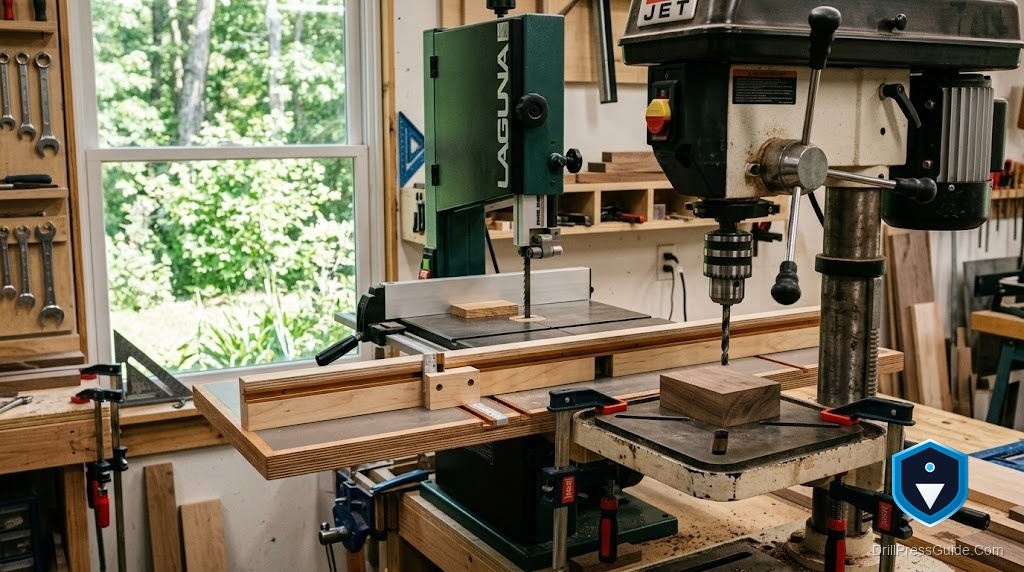
Small shops run out of floor before they run out of ideas, which is why the band saw and drill press so often end up sharing a stand, a bench, or a flip-top cart. Pairing them is a smart use of space, but it raises real questions: can one table serve both, how do you keep each machine stable, and what do you give up by combining them? Answer those honestly and you can set up a compact station that works, instead of a cramped corner where neither tool does its best.
A band saw and drill press table setup means the two machines sharing a bench, stand, or flip-top cart, sometimes with a work surface serving each. The drill press still needs its own table for clamping and a replaceable insert; the band saw needs its own throat clearance and table. Fit is about giving each machine stable mounting and working room.
Short answer: a band saw and a drill press can share a stand or a flip-top cart to save space, but each needs its own proper table, the drill press a clamping surface with an insert, the band saw its own table and clearance. Give each stable mounting and room to work rather than forcing one table to serve both.
Why one table rarely serves both
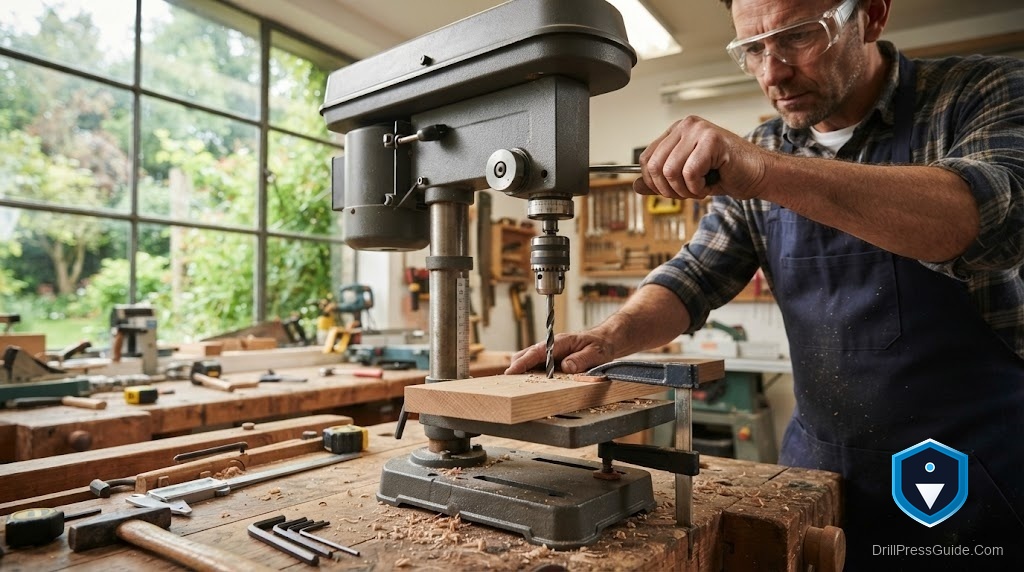
The two machines want different things from a table. A drill press table sits under a vertical spindle and wants slots or a fence for clamping and a replaceable insert where the bit exits. A band saw table sits around a moving blade and needs throat clearance, a slot for the blade, and room to feed stock past it. Their geometries do not overlap, so a single shared surface compromises both. Better to give each its own table and share only the stand or bench beneath.
Sharing space without losing stability
The real win is sharing the footprint, not the tabletop. A sturdy shared stand, or a flip-top cart that presents one machine at a time, lets a small shop keep both without either wobbling. Whatever the arrangement, each machine must be bolted down solid, because a drill press that rocks or a band saw that walks is both inaccurate and unsafe. A flip-top especially must lock firmly in each position.
Check before you build or buy
- Stable mounting. Each machine bolted solid to the shared stand or cart.
- Own tables. The drill press its clamping table with an insert; the band saw its own table and clearance.
- Working room. Space to feed stock on the band saw and to clamp on the press.
- Flip-top locking. If using a flip-top, it must lock firmly in each position.
Shared stand versus separate stations
Against separate stations, a shared stand or flip-top wins on floor space in a small shop and loses on having both tools ready at once and on ultimate rigidity. Separate stations are steadier and always available; a shared cart reclaims space but means switching. For a tight shop, share the footprint; for a busy one, keep them separate. For the drill press side, you can compare a drill press table with fence with T-track hardware to build one.
Setting it up
- Choose a shared stand or a flip-top cart rated for both machines’ weight.
- Bolt each machine down solid; if a flip-top, confirm it locks firmly in each position.
- Fit the drill press with its own clamping table, fence, and a replaceable insert.
- Give the band saw its own table and clearance to feed stock.
- Clamp work on the press, guide stock on the saw, wear eye protection, and keep clear of the moving parts, per OSHA and CCOHS.
Who should read this
If your shop is tight on floor space, pairing a band saw and drill press on a shared stand or flip-top is a smart move, just give each its own table. If you use both heavily at once, separate, well-mounted stations serve you better.
Bottom line
A band saw and drill press can share a footprint to save space, but not a single table, each needs its own surface: the drill press a clamping table with an insert, the band saw its own table and clearance. Share the stand or use a locking flip-top, bolt each machine solid, and give both room to work. Space saved, accuracy kept.
- Share the stand or a flip-top cart, not a single tabletop.
- Give the drill press a clamping table with an insert and the band saw its own table.
- Bolt each machine solid; a flip-top must lock firmly in each position.
FAQ
Can one table serve both a band saw and a drill press? Rarely well. Their geometries differ, so give each its own table and share only the stand or bench beneath.
How do I save space with both machines? Share the footprint with a sturdy stand or a flip-top cart that presents one machine at a time, while keeping each machine’s own table.
Is a flip-top cart stable enough? Only if it is rated for both machines and locks firmly in each position. A flip-top that does not lock is unsafe for either tool.
What does the drill press side need? Its own clamping table with a fence and a replaceable insert where the bit exits, plus room to clamp the work.
What does the band saw side need? Its own table with throat clearance and a blade slot, plus room to feed stock past the blade.
Shared stand or separate stations? Share for a tight shop where space is scarce; keep separate stations if you use both heavily and want them always ready.
References
- WEN DPA2412T Drill Press Table: https://wenproducts.com/products/24-by-12-inch-drill-press-table-with-an-adjustable-fence-and-stop-block-t
- IBUILDIT Drill Press Table Plans: https://ibuildit.ca/plans/drill-press-table/
- Woodsmith Drill Press Table Plan: https://www.woodsmithplans.com/plan/pw-drill-press-table/