
80 Percent Lower Drill Press Jig: Fit, Limits, and Safe Setup
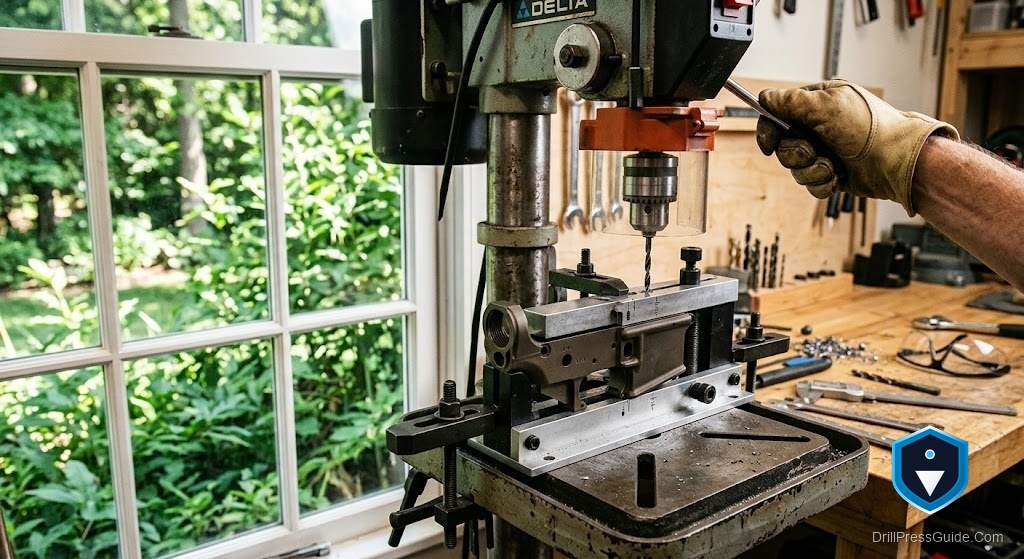
An 80 percent lower jig turns a fixed reference into precise holes and pockets, and a drill press is the machine many people reach for to run one. It can work, within strict limits, and it can also destroy a bit and endanger you if you ask the press to do a job it is not built for. Before anything else: follow all applicable federal, state, and local laws for your project. With that settled, here is how a drill press actually fits into using such a jig, and the one hard rule that keeps the machine, and you, intact.
An 80 percent lower drill press jig is a fixture that clamps the workpiece and guides tooling to located points so holes land accurately. On a drill press, the jig locates the work under the vertical spindle for straight-down drilling. The critical fact is that a drill press drills; it does not mill, and the difference decides what the jig-and-press combination can safely do.
Short answer: a rigid press with the jig clamped solid can drill the located vertical holes, but it must not perform side-cutting or milling, because the quill is built for downward thrust only. Confirm your laws, use a rigid press, clamp everything, and drill straight down.
Where a drill press fits
The jig’s value is location: it fixes the work and defines where tooling goes so holes are accurate and repeatable. For the strictly vertical drilling operations a jig calls out, a rigid drill press with the work clamped and located can do that job, straight down, one hole at a time.
That is the safe lane: the press supplies vertical thrust and the jig supplies the locations. Stay in that lane and the tool behaves.
The hard rule
Here is the honest, non-negotiable limit. A drill press quill and its bearings carry downward thrust, not side load. Milling, any operation that feeds a spinning cutter sideways to remove material, puts lateral force on the spindle that it is not built to take. Do that on a drill press and the quill flexes, the cutter can grab and shatter, and the work can wrench loose. It is a genuine hazard, not a fussy caution.
So the rule is simple: use the press for the vertical drilling the jig locates, and do not use it to mill a pocket by moving the work against the bit. Pocketing is a milling operation and belongs on a mill, not a drill press.
Set it up safely
- Laws first. Follow all applicable federal, state, and local regulations for your project.
- Rigid press. Use a solid press with minimal quill slop for accurate vertical holes.
- Clamp everything. The jig to the table and the work in the jig, so nothing shifts.
- Vertical only. Drill straight down at located points; do not feed sideways.
Drill press versus a mill for this work
Against a milling machine, using a jig on a drill press wins only for the strictly vertical drilling operations and on using a tool you own, and loses on any lateral operation, because a mill has a spindle built to take side loads and a drill press does not. For vertical, jig-located drilling on a rigid press, the press can serve; for anything involving sideways cutting, the mill is the correct tool. You can compare a drill press vise for secure holding and a drill press hold down clamp to anchor a jig.
Working through it
- Confirm your project complies with all applicable laws before starting.
- Clamp the jig to the table and the work in the jig so nothing can move.
- Set the correct speed for the bit and material.
- Drill the located holes straight down, one at a time, clearing chips.
- Do not mill or cut sideways; wear eye protection and keep clear of the chuck, per OSHA and CCOHS.
Who should skip it
If your project needs milling or pocketing, use a mill, not a drill press, no jig changes that. If the operation is strictly vertical drilling at located points and you have a rigid press, the jig-and-press combination can do it, clamped solid and drilled straight down.
Bottom line
An 80 percent lower drill press jig can guide accurate vertical holes on a rigid, well-clamped press, and it must never be used to mill, because the quill takes downward thrust only. Follow all applicable laws, clamp everything, drill straight down, and send any lateral cutting to a mill. Respect the machine’s limits and both the tool and you stay safe.
- Follow all applicable federal, state, and local laws for your project.
- A rigid, clamped press can drill the strictly vertical, jig-located holes.
- Never mill or cut sideways on a drill press; that belongs on a mill.
FAQ
Can I use a drill press with an 80 percent lower jig? For the strictly vertical drilling the jig locates, a rigid, well-clamped press can serve. It must not be used for milling or side cutting.
Why can’t a drill press mill the pocket? The quill carries downward thrust, not side load. Milling forces flex the quill, and the cutter can grab and break. Use a mill for that.
What about the law? Follow all applicable federal, state, and local regulations for your project. Legal compliance is your responsibility before any work.
How do I keep it accurate? Use a rigid press with little quill slop, clamp the jig to the table and the work in the jig, and drill straight down at each located point.
Is a drill press or a mill better for this? A mill for any lateral cutting; a drill press only for strictly vertical, jig-located drilling on a rigid, clamped setup.
What holds the jig steady? Clamp the jig to the table with hold-down clamps and secure the work in the jig, so nothing shifts as the bit engages.
References
- WEN Drill Press FAQs: https://wenproducts.com/pages/drill-press-faqs
- WEN 4214T 12-Inch Variable-Speed Drill Press: https://wenproducts.com/collections/power-tools/products/wen-4214t-12-in-variable-speed-drill-press
- OSHA Woodworking eTool, Drill Press: https://www.osha.gov/etools/woodworking/production/machines-tools/drill-press
- CCOHS, Metalworking Machines - Drill Presses: https://www.ccohs.ca/oshanswers/safety_haz/metalworking/drillpresses.html


