
Choosing a Drill Press Stand for DeWalt Cordless Drill That Fits the Work and the Table
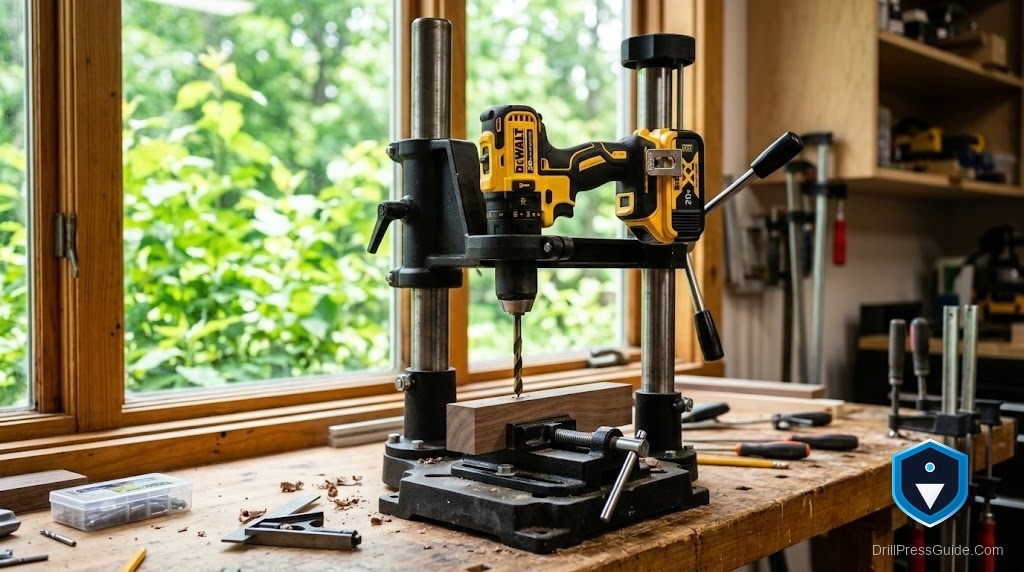
You already own a good DeWalt cordless drill, so the pitch is tempting: drop it into a stand and get drill press accuracy without buying a press. Sometimes that works nicely. Other times the stand fights the drill, the holes wander, and you wish you had just bought a press. The difference is entirely in the fit and in honest expectations. Here is how to choose a stand that actually holds your DeWalt straight, and where a stand simply cannot match a real press.
A drill press stand for a DeWalt cordless drill is a column-and-lever frame that clamps your handheld drill and plunges it vertically like a press. The fit hinges on how the stand grips the drill, usually by the collar or body, and how solid the column and plunge are. Understanding both keeps you from buying a stand that wobbles.
Short answer: a stand works when it clamps your DeWalt securely by a matching collar or body size and its column plunges without slop, and it disappoints when the grip is loose or the column flexes. Confirm how it holds the drill and how rigid it is before buying.
How the stand holds the drill matters most
Stands grip a handheld drill in one of two ways: by the threaded collar behind the chuck, which many drills share as a standard, or by clamping the drill body. A collar grip is generally more repeatable; a body clamp fits more drills but can shift if it is not snug. Check which your DeWalt suits and how the stand secures it, because a drill that rocks in the clamp will never drill straight.
That grip is the single biggest predictor of whether the stand is worth owning.
The honest limits
A stand is a frame, not a press built as one. Compared to a drill press with a heavy column, a steady quill, and an induction motor, a cordless drill in a stand flexes more, plunges shorter, and depends on the drill’s own trigger and speed. The result is fine for straighter holes in wood and light material, but it is not the rigid, precise, high-torque tool a real press is.
So set expectations. A stand improves on freehand drilling and helps with repeatable-ish holes. It does not turn a cordless drill into a machine-tool-grade press.
Check before buying
- Grip type. Collar or body clamp, and whether it matches your DeWalt.
- Column rigidity. A solid column with little plunge slop drills straighter.
- Plunge travel. Enough depth for your parts.
- Base and clamping. A stable base and a way to clamp the work to it.
Stand versus a dedicated benchtop press
Against a benchtop drill press, a stand for your DeWalt wins on using a drill you own and packing away small, and loses on rigidity, torque, precision, and travel. A benchtop press is steadier and stronger, with a real table and chuck; the stand is convenient and light. For occasional straighter holes, the stand serves; for accuracy and metal, the press wins. You can compare a drill press stand for handheld drill with a benchtop drill press.
Setting it up
- Confirm the stand grips your DeWalt by a matching collar or a secure body clamp.
- Mount or clamp the stand’s base to the bench so it cannot shift.
- Seat the drill and check it plunges square with minimal column slop.
- Clamp the work to the base and set the drill to a suitable speed.
- Wear eye protection and keep hands clear of the bit, per OSHA and CCOHS.
Who should skip it
If you need accurate holes, metal drilling, or heavy use, buy a benchtop press rather than a stand. If you drill wood occasionally and want to use the DeWalt you already own, a well-fitting stand is a reasonable, packable option.
Bottom line
A drill press stand for a DeWalt cordless drill is only as good as its grip and its column. Confirm it clamps your drill securely and plunges without slop, and hold honest expectations: it beats freehand but does not match a real press. Choose the fit carefully and it is a handy way to get straighter holes from a drill you already trust.
- The stand’s grip on the drill matters most; collar grips are more repeatable.
- A rigid column with little slop drills straighter; check plunge travel too.
- It beats freehand drilling but does not match a dedicated benchtop press.
FAQ
Will a stand fit my DeWalt cordless drill? If the stand grips by a collar your drill shares or by a body clamp that fits it snugly. Confirm the grip type before buying.
Is a drill stand as good as a drill press? No. It beats freehand drilling but flexes more and plunges shorter than a dedicated press, with less torque and precision.
Collar grip or body clamp? A collar grip is usually more repeatable; a body clamp fits more drills but must be snug or the drill can shift.
What can I drill with it? Straighter holes in wood and light material. For metal, precision, or heavy use, a benchtop press is the better tool.
Does the column matter that much? Yes. A solid column with little plunge slop is what keeps holes straight. Flex is the main reason cheap stands disappoint.
Do I clamp the work? Yes. Clamp the work to the stand’s base so it cannot move, and keep hands clear of the bit.
References
- WEN Drill Press FAQs: https://wenproducts.com/pages/drill-press-faqs
- WEN 4214T 12-Inch Variable-Speed Drill Press: https://wenproducts.com/collections/power-tools/products/wen-4214t-12-in-variable-speed-drill-press
- OSHA Woodworking eTool, Drill Press: https://www.osha.gov/etools/woodworking/production/machines-tools/drill-press
- CCOHS, Metalworking Machines - Drill Presses: https://www.ccohs.ca/oshanswers/safety_haz/metalworking/drillpresses.html


