
Dremel Drill Press Rotary Tool Workstation Stand: Fit, Capacity, and Setup Explained
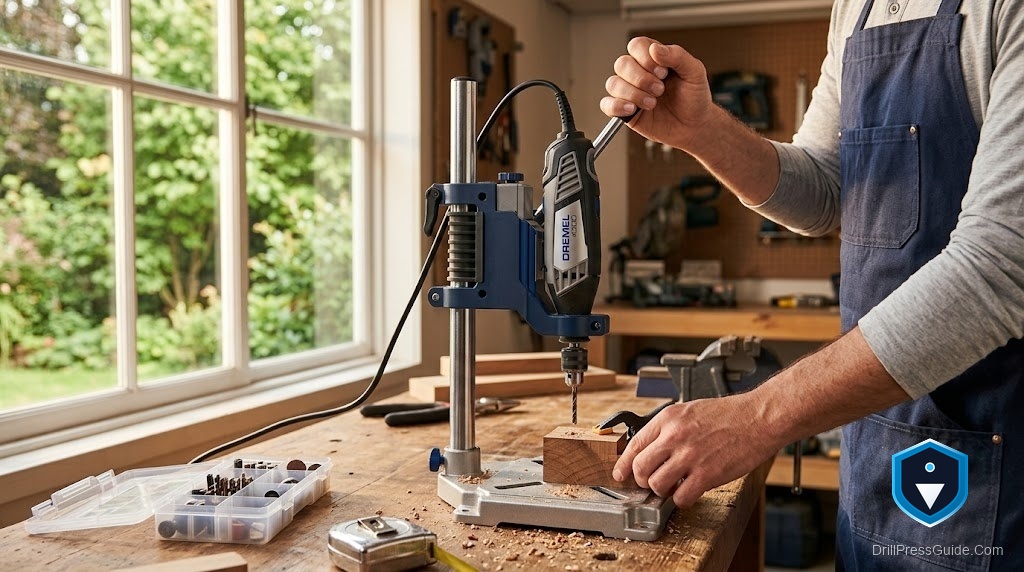
A rotary tool is a marvel of small work, and the moment you try to drill a straight hole freehand with one, you understand why the Dremel workstation stand exists. Turning that buzzing wand into something that plunges straight down is genuinely useful for tiny, delicate jobs. What trips people up is expecting it to behave like a drill press. It looks like one and it works like a light-duty relative of one, and knowing exactly where that line falls is what keeps you from asking too much of it.
The Dremel drill press rotary tool workstation stand is a compact stand that holds a Dremel-style rotary tool vertically and lets you plunge it like a small drill press. It fits rotary tools with the standard threaded nose, and it excels at precise, small-scale drilling. Its limits are rigidity, travel, and torque, so understanding capacity before you buy prevents disappointment.
Short answer: the workstation fits rotary tools with the standard threaded collar, and it works well for small, light drilling with tiny bits. It is not a substitute for a benchtop drill press on wood or metal, because it flexes under load and its plunge travel is short.
What it does well
The workstation clamps a compatible rotary tool upright and gives it a plunge lever, so instead of wobbling a hole freehand you get a straight, controlled plunge. For small bits, delicate materials, hobby parts, circuit boards, model work, and light detail drilling, that control is exactly what you need. The rotary tool’s high speed suits the tiny bits a full press turns too slowly to use well.
Within that small-work lane, it is a precise, handy tool that stores easily.
Where the limits are
The honest limitation: this is a light assembly. Compared to a drill press built around a stout column, a steady quill, an induction motor, and a keyed chuck, the workstation flexes under load and its plunge travel is short. Push a large bit or hard material and it deflects, so the hole wanders and the tool strains. It is a precision tool for small work, not a general-purpose press.
So match the job to the machine. Tiny bits and light materials, yes. Larger holes in hardwood or metal, no.
Fit and check before buying
- Tool compatibility. Confirm your rotary tool has the standard threaded nose the stand accepts.
- Bit size and material. Keep to small bits and light materials the stand can handle.
- Plunge travel. Check the short travel covers your part thickness.
- Work holding. Plan to clamp small parts, since they are easy to lose control of.
Workstation versus a benchtop press
Against a benchtop drill press, the workstation wins on small size and high-speed tiny bits, and loses on rigidity, torque, and capacity. A benchtop press with variable speed, a real table, and a keyed chuck handles wood and metal the Dremel cannot, but it turns too slowly and grips too coarsely for the smallest bits a rotary tool spins effortlessly. The two are complementary. You can compare a Dremel drill press workstation with a benchtop drill press for larger work.
Setting it up
- Confirm your rotary tool’s threaded nose fits the workstation’s collar.
- Mount the stand to a solid surface or clamp it down so it cannot shift.
- Secure the rotary tool upright and check it plunges square.
- Clamp the small workpiece so it cannot move, and keep bits small.
- Wear eye protection and keep hands clear of the bit, per CCOHS and OSHA.
Who should skip it
If your work is larger holes in wood or metal, buy a benchtop drill press instead; the workstation will flex and frustrate you. If your work is tiny, delicate, and high-speed, the Dremel workstation is the right tool, as long as you keep within its light-duty lane.
Bottom line
The Dremel drill press rotary tool workstation stand turns a rotary tool into a precise little plunge drill for small work. It fits standard-nose rotary tools and shines on tiny bits and delicate materials, but it flexes under load and offers short travel. Match small jobs to it, keep a real press for everything bigger, and it earns its spot on the bench.
- The workstation fits standard-nose rotary tools for precise small drilling.
- It flexes under load and has short travel; keep to tiny bits and light material.
- For wood and metal holes, use a benchtop drill press instead.
FAQ
What tools fit the Dremel workstation? Rotary tools with the standard threaded nose collar. Confirm your tool matches before buying.
Can it replace a drill press? No. It is a light-duty plunge stand for small, high-speed work. A benchtop press handles wood and metal it cannot.
What can I drill with it? Small bits in light materials, hobby parts, model work, circuit boards, and detail drilling where high speed and control matter.
Why does the hole wander on bigger bits? The stand flexes under load. Keep bits small and materials light, and the plunge stays straight.
How much plunge travel does it have? Short, suited to thin parts. Check the travel against your part thickness before buying.
Do I still need to clamp small parts? Yes. Small parts spin easily when a bit grabs. Clamp them and keep hands clear.
References
- WEN Drill Press FAQs: https://wenproducts.com/pages/drill-press-faqs
- WEN 4214T 12-Inch Variable-Speed Drill Press: https://wenproducts.com/collections/power-tools/products/wen-4214t-12-in-variable-speed-drill-press
- OSHA Woodworking eTool, Drill Press: https://www.osha.gov/etools/woodworking/production/machines-tools/drill-press
- CCOHS, Metalworking Machines - Drill Presses: https://www.ccohs.ca/oshanswers/safety_haz/metalworking/drillpresses.html


