
Milling Table for Drill Press Harbor Freight: What to Measure Before You Buy
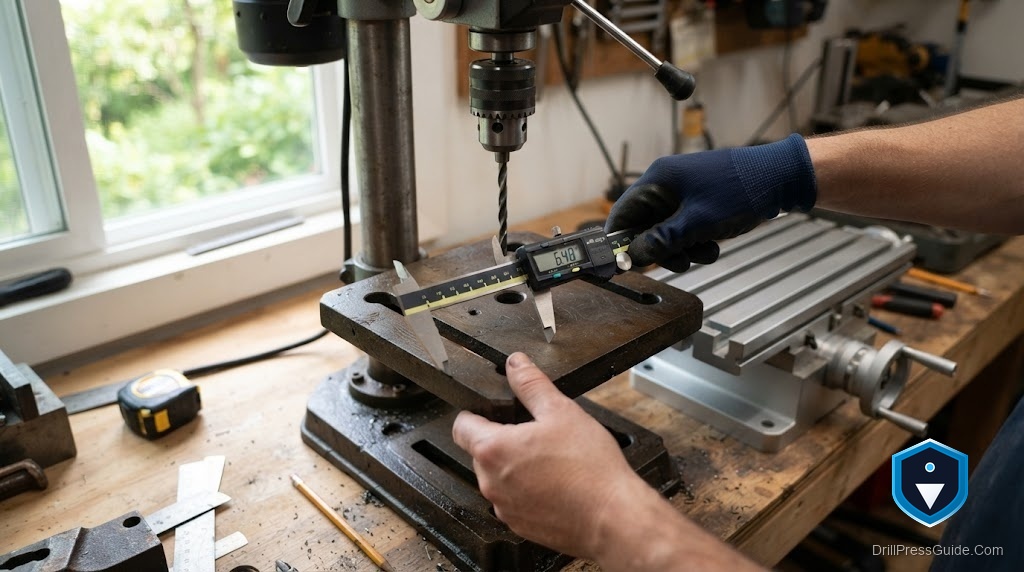
The words “milling table” on a drill press listing set a trap for the hopeful. You picture a cross-slide table turning your Harbor Freight press into a little mill, dialing in cuts on two axes. What you actually get is a positioning table, and the difference matters for your safety and your bits. Before you buy one for a Harbor Freight press, it pays to know what the table really does, what it fits, and the one rule that keeps a drill press from destroying itself trying to mill.
A milling table, or X-Y table, for a drill press is a table with two lead screws that move the mounted work along two axes for precise hole placement. On a Harbor Freight press, the fit question is the same as for any table: it must mount to your model’s slots and leave you working spindle travel. The critical rule is that it positions between holes; it does not mill sideways.
Short answer: a milling table for a Harbor Freight drill press mounts to your model’s table slots and lets you position work precisely on two axes, but you must position between holes and drill straight down, never feed sideways into the bit. Measure your slots and spindle travel before buying.
What the table actually does
The two lead screws move the work left-right and front-back, so you can dial a hole location by the dials instead of nudging the part by hand. That is genuinely useful for grids of holes and repeatable layouts. The screws also hold position under the bit, so a hand-fed part cannot creep as the bit bites.
What it is not is a milling machine. The name misleads. A drill press spindle and quill are built for downward thrust, not the sideways force of milling.
The rule that protects your press
Here is the honest and important limit. A drill press quill and its bearings are designed for downward thrust. Milling puts side load on the spindle, which the quill is not built to take. Feed a spinning bit sideways into work on an X-Y table and the quill flexes, the bit can grab and shatter, and the work can tear loose. That is a real hazard, not a nicety.
So use the table the safe way: move the work to a location with the power off or the bit clear, lock or hold position, then drill straight down. Position between holes, drill vertically, repeat. Never turn the dials to cut sideways while the bit is engaged.
Measure before you buy
- Table slots. Match the X-Y table’s mounting to your Harbor Freight model’s slot pattern.
- Spindle travel. The table adds height; confirm the quill still reaches your parts.
- Table size and load. Match the working surface to your parts and the table’s capacity.
- Rigidity. A solid table that locks well drills more accurately.
X-Y table versus a fence and stop
Against a fence and stop block, the X-Y table wins on true two-direction positioning and loses on simplicity and height. A fence with a stop, as on the WEN 24-by-12-inch table or the IBUILDIT and Woodsmith plans, handles a straight line of holes and adds little height. Choose the X-Y table only when you genuinely need a grid in both directions. You can compare a cross slide drill press table with a simpler drill press table with fence and stop.
Setting it up safely
- Match the table’s mounting to your Harbor Freight model’s slots and confirm spindle travel.
- Bolt the table down flat so it cannot rock, and square it to the bit.
- Clamp the work to the table so it cannot shift.
- Position with the dials while the bit is clear, then lock and drill straight down.
- Wear eye protection and keep clear of the chuck, per OSHA and CCOHS.
Who should skip it
If your holes fall in a straight line, a fence and stop are simpler and add less height than an X-Y table. If you drill true grids and want to dial each location, the milling table earns its place, as long as you position rather than mill.
Bottom line
A milling table for a Harbor Freight drill press is really a precise positioning table, and it is excellent for grids of holes. Measure your slots and spindle travel before buying, mount it solid, and follow the one rule that matters: position between holes and drill straight down, never feed the bit sideways. Respect that and the table is a genuine upgrade.
- An X-Y table positions on two axes; it does not mill.
- Match its mounting to your Harbor Freight model’s slots and check spindle travel.
- Position between holes and drill straight down; never feed sideways.
FAQ
Can I mill with an X-Y table on a Harbor Freight drill press? No. The quill is built for downward thrust, not side load. Use the table to position between holes and drill straight down only.
Will it fit my Harbor Freight press? Only if its mounting matches your model’s table slots. Measure the slot pattern and confirm before buying.
Does the table reduce drilling depth? Yes. It raises the work, so confirm your spindle travel still reaches your tallest parts.
What happens if I feed sideways? The quill flexes, the bit can grab and shatter, and the work can tear loose. It is a real hazard, so position, then drill down.
Do I need an X-Y table or just a fence? A fence and stop suit a straight line of holes. Choose the X-Y table only for true two-direction grids.
How do I keep it accurate? Mount it flat and solid, square it to the bit, clamp the work, and lock the axes before drilling each hole.
References
- WEN 24 x 12-Inch Drill Press Table with Adjustable Fence and Stop Block: https://wenproducts.com/products/24-by-12-inch-drill-press-table-with-an-adjustable-fence-and-stop-block-t
- IBUILDIT Drill Press Table Plans: https://ibuildit.ca/plans/drill-press-table/
- Woodsmith Drill Press Table Plan: https://www.woodsmithplans.com/plan/pw-drill-press-table/


