Drill Press Table Dimensions: Compatibility and Setup Guide
Before you buy an upgrade table, build one from plans, or replace a broken casting, one thing decides whether it works: dimensions. The size of the table, where its mounting holes fall, how thick it is, and how much column it swallows all determine whether the result helps or gets in the way. People skip the tape measure and end up with a table that overhangs, blocks the fence, or eats so much travel the bit will not reach the work. Getting the dimensions right first is the whole game.
Drill press table dimensions are the measurements that govern fit and function: the top’s length and width, its thickness, the mounting-hole or slot pattern, and the resulting height above the cast table. Whether you buy or build, these numbers decide compatibility with your machine and your work. Measuring them beats guessing every time.
Short answer: match the table’s top size to your parts and machine, its mounting pattern to your cast table’s slots, and its thickness against your spindle travel. Get those dimensions right and the table supports your work without overhanging, blocking, or stealing the depth you need.
Which dimensions actually matter
Four measurements do the real work.
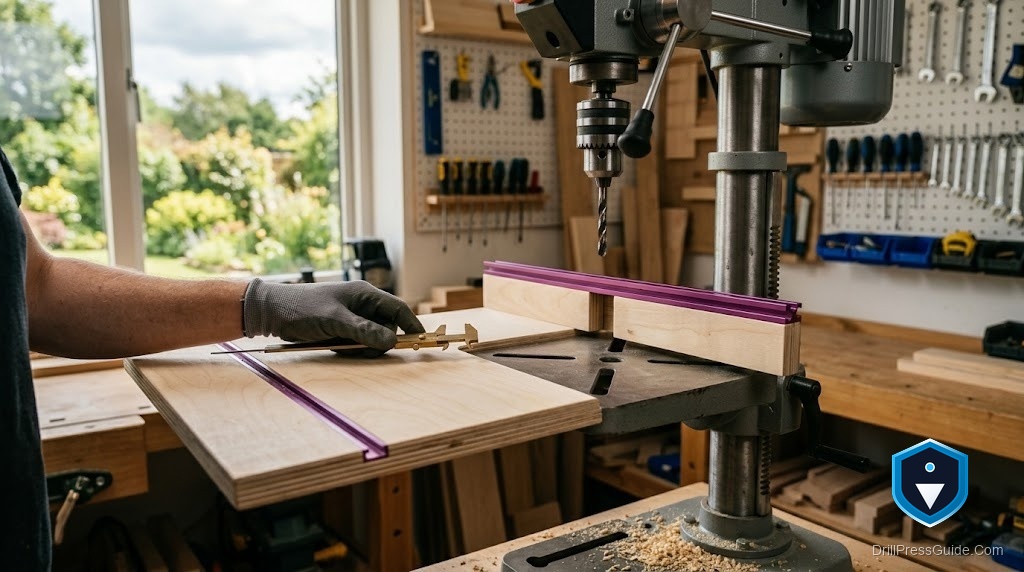
Top length and width decide how much support you get. Bigger holds larger panels but can overhang a small press and get in the way. Thickness adds height, which eats spindle travel. Mounting pattern, the slots or holes that anchor the top, must line up with your cast table. Column clearance, the distance from the bit to the column, limits how far a workpiece or fence can sit back.
None of these is a guess. Caliper or tape each one on your machine before choosing a table.
The dimension that catches people out
The honest trap is height versus spindle travel. Every bit of table thickness raises the work surface, and your quill only travels so far. Stack a thick table plus a tall workpiece plus the bit length, and on a short-travel press you can run out of quill before the bit reaches the work.
So measure your spindle travel and subtract the table thickness and your tallest workpiece. If what is left is less than the hole depth you need, choose a thinner table or a different setup. This single check prevents the most common upgrade disappointment.
Measure these before you buy or build
- Cast table size and slots. So the new top sits supported and its mounting pattern lines up.
- Spindle travel. So the added thickness still leaves depth to drill.
- Column clearance. So your fence and longest stock fit between the bit and the column.
- Your typical parts. So the top is big enough to support them without needless overhang.
Buy versus build, by the numbers
Against a shop-built table, a commercial top like the WEN 24-by-12-inch comes with published dimensions and a matched mounting pattern, while building from IBUILDIT or Woodsmith plans lets you set every dimension, size, thickness, and hole placement, to your exact machine. Build when your press is unusual or space is tight; buy when a stock size fits. You can compare a ready-made drill press table with fence against drill press table plans and hardware for a build.
Setting it up to fit
- Measure your cast table, slot pattern, spindle travel, and column clearance.
- Choose or build a top whose dimensions fit all four.
- Mount it flat, aligning the pattern with the cast table slots.
- Square the table to the bit and confirm you still have working spindle travel.
- Clamp the work and wear eye protection, keeping clear of the chuck per OSHA and CCOHS.
Who should read this
If your press has short spindle travel or a small cast table, dimensions matter most, since the wrong size will overhang or run out of depth. If your press is generous, you have more freedom, but the mounting pattern still has to match.
Bottom line
Drill press table dimensions decide fit before anything else. Measure your cast table, slots, spindle travel, and column clearance, then choose or build a top that satisfies all four, especially the height-versus-travel check that catches so many people. Get the numbers right and the table helps; get them wrong and it just gets in the way.
- Four dimensions matter: top size, thickness, mounting pattern, and column clearance.
- The key check is table thickness plus workpiece against spindle travel.
- Match the mounting pattern to your cast table’s slots before buying or building.
FAQ
What dimensions matter most on a drill press table? Top length and width, thickness, the mounting pattern, and column clearance. Together they decide fit and how much your work is supported.
How does table thickness affect drilling? It raises the work surface and eats spindle travel. A thick table plus a tall part can run you out of quill on a short-travel press.
How do I know a top will fit my press? Measure your cast table size, slot pattern, spindle travel, and column clearance, then match a top that satisfies all four.
Is a bigger table always better? No. A large top supports panels but can overhang a small press and get in the way. Size it to your work and machine.
What is column clearance? The distance from the bit to the column. It limits how far back a fence or long workpiece can sit, so measure it before buying.
Should I buy or build for an odd-size press? Build from plans, so you can set every dimension to your machine. Buy a stock top only if its published size fits.
References
- WEN 24 x 12-Inch Drill Press Table with Adjustable Fence and Stop Block: https://wenproducts.com/products/24-by-12-inch-drill-press-table-with-an-adjustable-fence-and-stop-block-t
- IBUILDIT Drill Press Table Plans: https://ibuildit.ca/plans/drill-press-table/
- Woodsmith Drill Press Table Plan: https://www.woodsmithplans.com/plan/pw-drill-press-table/