Multi Purpose Drill Press Stand with Tilt Table: Fit, Capacity, and Setup Explained
The pitch behind a multi-purpose stand with a tilt table is do-it-all versatility: hold the tool, tilt the work for angled holes, adjust for different jobs, all from one accessory. Versatility is real, but so is the tradeoff that comes with it. Every added joint and pivot is another place for flex to creep in. Knowing what this kind of stand does well, and where its adjustability costs you rigidity, is what lets you use it without frustration.
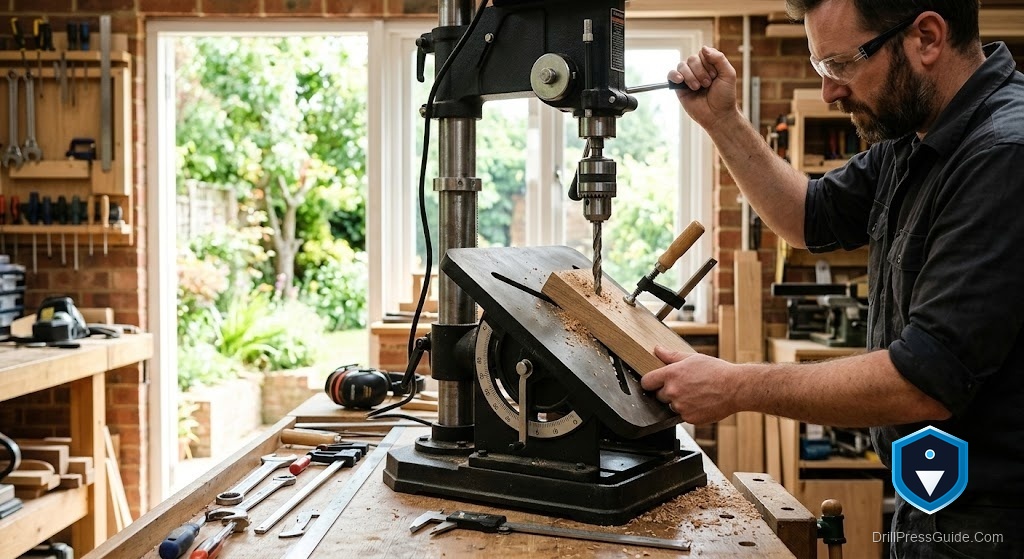
A multi-purpose drill press stand with a tilt table is a base and column, or a table accessory, that holds the drilling tool and provides a work surface that tilts to a set angle for drilling holes off vertical. The tilt is the headline feature. It lets you drill angled holes without shimming the work, which is genuinely handy for many projects.
Short answer: this stand fits when it holds your tool or mounts to your press, its tilt range covers the angles you need, and it locks rigidly enough that the table does not creep under load. It excels at angled and varied drilling; its weak point is the flex that any tilting, multi-jointed surface introduces.
The strength: angled and adjustable holes
The tilt table earns its keep when you need a hole that is not straight down. Set the angle, lock it, and drill, no fiddly shims, no propping the workpiece on wedges. For chair legs, brackets, and joinery that meets at an angle, that is a real convenience.
The multi-purpose design adds flexibility on top: a surface that adjusts for different tools and tasks, so one accessory covers several jobs.
The tradeoff: rigidity
Here is the honest limitation. Every pivot, hinge, and adjustment is a joint, and joints flex. Compared to a fixed cast table bolted solid, a tilt table can deflect under drilling pressure, especially at steep angles or with a big bit. The fix is not to avoid the feature but to respect it: lock every adjustment firmly, take lighter cuts at angle, and clamp the work hard so nothing shifts.
A drill press quill is built for straight-down thrust, so at a tilt the geometry already asks more of the setup. Add flex from an unlocked joint and accuracy suffers. Lock it all down and it holds.
Check these before you buy
- Tool or press fit. Confirm it holds your tool or mounts to your press’s table or column.
- Tilt range. Match the angles it reaches to the angled holes you actually drill.
- Locking rigidity. Look for firm, positive locks on every joint; loose adjustments mean flex.
- Added height. As with any accessory, confirm the added height leaves spindle travel for your work.
Multi-purpose tilt stand versus a fixed table
Against a fixed woodworking table, the multi-purpose tilt stand wins on angled holes and adjustability and loses on rigidity and dead-flat accuracy. If most of your drilling is straight down, a fixed table like the WEN 24-by-12-inch or a shop build from IBUILDIT or Woodsmith plans is more solid and repeatable. If you regularly drill at angles, the tilt table saves real fuss. You can compare a drill press tilting table against a fixed drill press table with fence.
Setting it up so it holds angle
- Mount the stand to your press or bench so the base cannot move.
- Set the tilt to your angle and lock every joint firmly, then test by hand for creep.
- Clamp the workpiece hard, since a tilted surface wants to let gravity slide it.
- Take lighter cuts at angle and let the bit work rather than forcing it.
- Wear eye protection and keep hands clear of the chuck, per CCOHS and OSHA.
Who should skip it
If nearly all your holes are straight down and accuracy is paramount, a fixed table serves you better with less flex. If angled holes are a regular part of your work, the tilt table’s convenience outweighs the modest rigidity tradeoff, as long as you lock everything down.
Bottom line
A multi-purpose drill press stand with a tilt table trades some rigidity for the real convenience of angled, adjustable drilling. Confirm it fits your tool and press, that its tilt range covers your angles, and that every joint locks firmly. Lock it all down, clamp hard, and cut lighter at angle, and it does its varied jobs well.
- The tilt table’s strength is easy angled holes without shims.
- Its weak point is flex; every joint must lock firmly.
- Clamp hard and cut lighter at angle to keep accuracy.
FAQ
What is a tilt table on a drill press stand for? Drilling holes at an angle. You set and lock the tilt, so you can drill off-vertical without shimming or propping the workpiece.
Does a tilt table flex? It can. Every pivot and adjustment is a joint that can deflect under load. Lock all joints firmly and clamp the work to minimize it.
Will this stand fit my drill press? If it holds your tool or mounts to your press’s table or column and its added height leaves spindle travel, yes.
Is a tilt table as accurate as a fixed table? For straight-down holes, a fixed table is more rigid and repeatable. The tilt table trades some of that for angled-hole convenience.
How do I keep the work from sliding at an angle? Clamp it hard. A tilted surface lets gravity pull the part, so a firm clamp or vise is essential.
Should I cut differently at an angle? Yes. Take lighter cuts and let the bit work, since the tilted geometry and any joint flex ask more of the setup.
References
- WEN 24 x 12-Inch Drill Press Table with Adjustable Fence and Stop Block: https://wenproducts.com/products/24-by-12-inch-drill-press-table-with-an-adjustable-fence-and-stop-block-t
- IBUILDIT Drill Press Table Plans: https://ibuildit.ca/plans/drill-press-table/
- Woodsmith Drill Press Table Plan: https://www.woodsmithplans.com/plan/pw-drill-press-table/