
Drill Press Table with X and Y Axis: Compatibility and Setup Guide
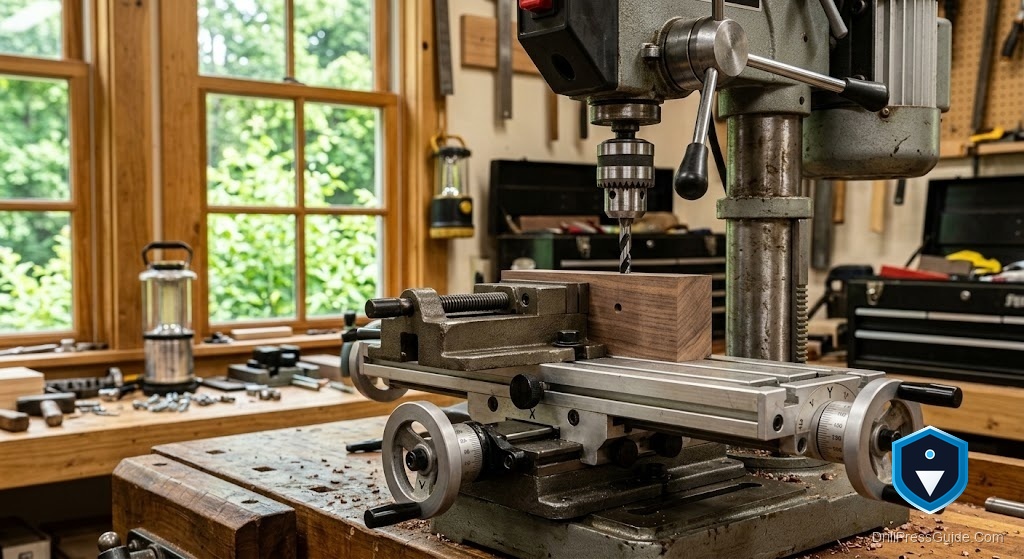
The fantasy is a poor man’s milling machine: a drill press with an X-Y table that slides the work in two directions so you can dial in any hole and, maybe, cut a slot or two. The first half of that fantasy is real and genuinely useful. The second half gets people into trouble. An X and Y axis table makes a drill press far better at positioned drilling, and understanding where its usefulness stops is what keeps the setup safe and the machine intact.
A drill press table with X and Y axis, a cross-slide table, mounts on the cast table and moves the workpiece in two perpendicular directions on lead screws with hand cranks. Instead of nudging the part by hand, you turn dials to place each hole. That two-direction positioning is exactly what the fantasy gets right.
Short answer: an X-Y table is compatible when it bolts to your cast table, its travel covers your hole pattern, and the added height leaves you spindle travel. Use it to position holes, never to feed sideways and mill, because a drill press quill is built for downward thrust, not side loads.
What the two axes are good for
The payoff is repeatable positioning in a grid. Clamp the work, zero the dials, move a known distance in X and drill, then move in Y and drill. Bolt patterns, hole grids, and evenly spaced rows come out placed exactly where the dials say, without marking each one by hand.
The lead screws also hold position under the bit. A hand-fed part can creep as the bit bites; the screws resist that, so the hole stays put.
Where compatibility and safety meet
Here is the line that matters. A milling machine has a rigid spindle built to take sideways cutting force. A drill press has a quill built for straight-down thrust and nothing else. Put an X-Y table on a drill press and try to feed sideways into a spinning bit, and the quill flexes, the bit can grab and shatter, and the work can tear loose. That is the honest limitation: the table positions between holes; it does not turn a drill press into a mill.
Use it inside that limit and it is safe and accurate. Push past it and you risk the machine and yourself.
Confirm compatibility before you buy
- Mounting. The base must bolt to your cast table’s slots or holes.
- X and Y travel. Compare the travel to your largest hole pattern; short travel caps your grid.
- Added height versus spindle travel. Stack the table and workpiece height and confirm the quill reaches.
- Table strength. A heavy cross-slide needs a cast table large and strong enough to carry it without overhang.
X-Y table versus a fence and stop
Against a fence and stop block, the X-Y table wins on true two-direction positioning and loses on simplicity and added height. A fence with a stop, as on the WEN 24-by-12-inch table or the IBUILDIT and Woodsmith plans, handles a straight line of holes cheaply and adds little height. Choose the X-Y table only when you genuinely need a grid in both directions. You can compare a cross slide drill press table with a simpler drill press table with fence.
Setting it up safely
- Square the cast table to the bit before mounting the X-Y table.
- Bolt the cross-slide table down so it cannot shift.
- Clamp the workpiece to the table, not just resting it there.
- Zero the dials on a reference edge and drill a test grid in scrap.
- Position between holes only; never feed sideways into the bit. Wear eye protection and keep clear of the chuck, per OSHA and CCOHS.
Who should skip it
If you only drill straight rows, a fence and stop does the job for less money and height. If you regularly drill true two-direction patterns and want to dial each hole in, an X-Y table is the right tool, as long as you use it to position, not to mill.
Bottom line
A drill press table with X and Y axis makes positioned, grid-pattern drilling fast and repeatable, provided it bolts on, its travel fits your work, and you keep spindle travel. The one rule that keeps it safe: position between holes, never feed sideways into a spinning bit. A drill press is not a mill, and the quill will remind you if you forget.
- Confirm mounting, X-Y travel, and remaining spindle travel before buying.
- Use the table to position holes, never to mill by feeding sideways.
- Square the cast table and clamp the work for accurate grids.
FAQ
Can I mill with an X-Y table on a drill press? No. The quill is built for downward thrust, not sideways cutting force. Use the table to position between holes, not to mill slots.
What is an X and Y axis drill press table for? Moving the workpiece in two perpendicular directions on lead screws so you can dial each hole into position for grids and bolt patterns.
Will it fit my drill press? If it bolts to your cast table, its travel covers your pattern, and the added height leaves spindle travel for your work, yes.
Why is feeding sideways dangerous? The quill flexes under side load, so the bit can grab and shatter and the work can tear loose. Position between holes instead.
How is it different from a fence and stop? A fence and stop handle a straight line of holes cheaply. An X-Y table positions in both directions for true grids.
Does it cut into drilling depth? Yes. It raises the work, so a tall part plus the table can run out of quill on a short-travel press.
References
- WEN 24 x 12-Inch Drill Press Table with Adjustable Fence and Stop Block: https://wenproducts.com/products/24-by-12-inch-drill-press-table-with-an-adjustable-fence-and-stop-block-t
- IBUILDIT Drill Press Table Plans: https://ibuildit.ca/plans/drill-press-table/
- Woodsmith Drill Press Table Plan: https://www.woodsmithplans.com/plan/pw-drill-press-table/


