2 Axis Table for Drill Press: Fit, Capacity, and Setup Explained
Drilling a precise grid of holes by hand is a test of patience: mark, clamp, drill, unclamp, measure, repeat, and hope nothing crept. A 2 axis table for a drill press replaces most of that with two hand cranks. Slide the work along one axis, then the other, and the hole lands exactly where the dials say. It is a genuine upgrade for repeatable, positioned drilling, provided the table fits your machine and you accept what a hand-cranked table can and cannot do.
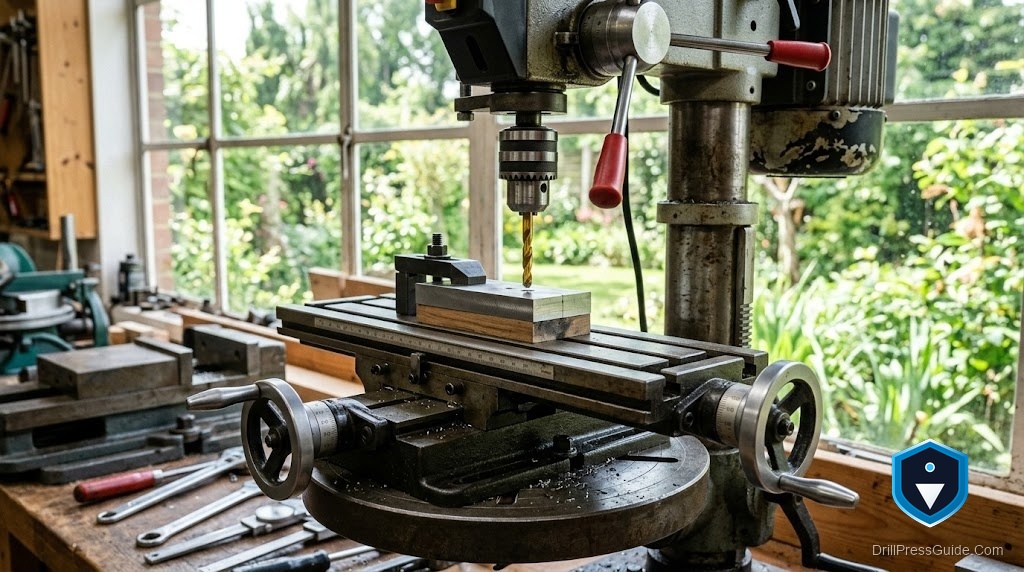
A 2 axis table, often called a cross-slide or X-Y table, mounts on the drill press table and moves the workpiece in two perpendicular directions on lead screws. Instead of nudging the whole workpiece, you dial it into position. That controlled positioning is the reason to own one.
Short answer: a 2 axis table fits when it bolts to your drill press table, its travel covers the hole pattern you drill, and the added height still leaves you spindle travel to reach the work. Confirm those three and it turns scattered hand-marked holes into a dialed-in grid.
What a 2 axis table actually buys you
The value is repeatable positioning. With the work clamped to the table and the dials zeroed, you can move a known distance in X, drill, move in Y, drill, and every hole sits where you intended. For a row of shelf-pin holes or a bolt pattern, that is faster and truer than marking each one.
It also lets you hold position under the bit. A hand-fed workpiece can shift as the bit bites; a lead-screw table resists that drift because the screws hold it.
The honest limitation: a drill press is not a milling machine, and a 2 axis table does not make it one. The spindle and quill are built for straight-down thrust, so you must not feed sideways into a spinning bit to cut like a mill. Use the table to position between holes, not to mill slots. Do that and the quill flex that ruins such attempts never becomes a problem.
Measure before you buy
- Mounting. The table base must bolt to your drill press table’s slots or holes. Measure them.
- X and Y travel. Compare the table’s travel to the largest hole pattern you drill; short travel limits your grid.
- Added height versus spindle travel. Stack the table height and your workpiece and confirm the quill still reaches.
- Load and size. A heavy cross-slide table needs a press table big and strong enough to carry it without overhang.
2 axis table versus a fence and stop block
Against a fence and stop block setup, the 2 axis table wins on true two-direction positioning and loses on simplicity and height. A fence with a stop, like the arrangement on the WEN 24-by-12-inch table or the shop-built plans from IBUILDIT and Woodsmith, handles a straight line of holes cheaply and adds little height. The 2 axis table shines when you need a real grid in both directions.
Against a plain vise, the cross-slide table is a positioning tool, not just a clamp, so they serve different jobs and often work together. You can compare a cross slide drill press table against a simpler drill press table with fence to match your work.
Setting it up so it stays accurate
- Square the drill press table to the bit first, so the positioned holes go in straight.
- Bolt the 2 axis table to the drill press table so it cannot shift.
- Clamp the workpiece to the cross-slide table, not just resting it there.
- Zero your dials on a reference edge and drill a test grid in scrap.
- Position between holes only; never feed sideways into the spinning bit. Wear eye protection and keep hands clear of the rotating chuck, per CCOHS and OSHA.
Who should skip it
If you only drill straight rows of holes, a fence and stop block does the job for far less money and height. If you drill true two-direction patterns, bolt circles, or grids and want to dial each hole in, a 2 axis table is the right tool, as long as you respect that it positions rather than mills.
Bottom line
A 2 axis table for a drill press turns hand-marked grids into dialed-in positioning, provided it bolts to your table, its travel covers your work, and you keep spindle travel. Use it to place holes, not to mill, and it delivers repeatable accuracy a fence alone cannot.
- Confirm mounting, X-Y travel, and remaining spindle travel before buying.
- Use it to position between holes, never to feed sideways into the bit.
- Square the base table and clamp the work for accurate results.
FAQ
What is a 2 axis table for a drill press? A cross-slide table that moves the workpiece in two perpendicular directions on lead screws, so you can dial each hole into position.
Can I mill with a 2 axis table on a drill press? No. The quill is built for downward thrust, not sideways cutting loads. Use the table to position between holes, not to mill slots.
Will it fit my drill press? If it bolts to your table, its travel covers your hole pattern, and the added height leaves spindle travel for your work, yes.
How is it different from a fence and stop block? A fence and stop handle a straight line of holes cheaply. A 2 axis table positions in both directions for true grids.
Does it reduce drilling depth? Yes, it raises the work, so a tall part plus the table can run out of quill on a short-travel press.
Do I still clamp the work? Yes. Clamp the workpiece to the cross-slide table and keep hands clear of the chuck, as OSHA and CCOHS advise.
References
- WEN 24 x 12-Inch Drill Press Table with Adjustable Fence and Stop Block: https://wenproducts.com/products/24-by-12-inch-drill-press-table-with-an-adjustable-fence-and-stop-block-t
- IBUILDIT Drill Press Table Plans: https://ibuildit.ca/plans/drill-press-table/
- Woodsmith Drill Press Table Plan: https://www.woodsmithplans.com/plan/pw-drill-press-table/