
Drill Press Table with an Adjustable Fence and Stop Block: What to Measure Before You Buy
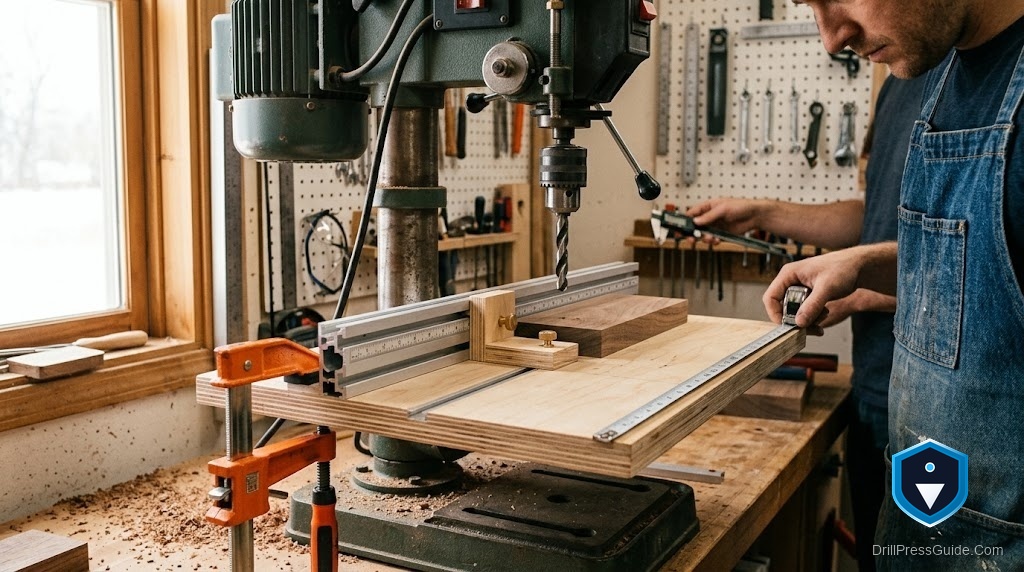
The stock table on most drill presses is a small cast plate with a hole in the middle and maybe a couple of slots. It works, barely. The moment you drill a row of evenly spaced holes or need a workpiece to stop at the same spot every time, you feel its limits. A drill press table with an adjustable fence and stop block turns that fussy work into a repeatable setup, and choosing one comes down to a few measurements against your machine.
An upgrade table is a flat top, usually MDF or a composite, that mounts over your cast table and adds an adjustable fence, a stop block, a removable insert, and often onboard rulers. It gives you a reference edge and a repeatable stop, which is what turns one-off drilling into production drilling. That repeatability is the reason to buy one.
Short answer: measure your cast table so the upgrade top mounts to it, confirm the fence and stop travel cover your work, and check that the added height still leaves you spindle travel. A well-known reference point is the WEN 24-by-12-inch table with an adjustable fence and stop block, and shop-built plans from IBUILDIT and Woodsmith show the same features you are paying for.
What the fence and stop actually give you
The fence is a straight reference the workpiece rides against, so a row of holes lines up perfectly. The stop block clamps to the fence and stops the work at a set point, so every part gets its hole in the same place without measuring twice.
Add a removable insert, a sacrificial piece around the bit that prevents blowout on the underside and can be replaced when chewed up, and onboard rulers for quick setup, and you have a table that does the measuring for you.
The honest limitation: an upgrade table raises the work surface. On a press with short spindle travel, the added thickness plus a tall workpiece can run you out of quill. And a fence steals a little column clearance, so very long stock may not fit between the fence and the column.
Measure these before buying
- Cast table size and mounting. The top must bolt to your existing table’s slots or holes. Measure them.
- Added height versus spindle travel. Add the table thickness to your workpiece height and confirm the quill still reaches.
- Fence and stop travel. Make sure the fence adjusts across the range you drill and the stop covers your part lengths.
- Column clearance. Check the distance from the bit to the column against your longest workpiece with the fence in place.
Buy versus build
Against a shop-built table, a commercial top wins on ready-made accuracy and loses on custom fit and cost. Plans from IBUILDIT and Woodsmith let you size the table and fence exactly to your press and your work, and building one is a satisfying weekend project if you have the tools.
Against the bare cast table, either upgrade wins the moment you need repeatable holes; the bare table only makes sense for pure one-off drilling. You can compare a ready-made drill press table with fence against the hardware for a build, like a drill press table clamp set.
Setting it up so it earns its keep
- Square your cast table to the bit first; the upgrade top is only as square as what it sits on.
- Mount the top flat and bolt it to the cast table’s slots or holes.
- Set the fence parallel to a reference and confirm the insert sits flush.
- Clamp the stop block for repeated holes and test on scrap before the real parts.
- Keep the work against the fence and clamped, and wear eye protection, per CCOHS and OSHA.
Who should skip it
If you only ever drill a single hole here and there, the bare table is fine and the upgrade is clutter. If you drill rows, repeat parts, or want clean exit holes without blowout, a table with a fence and stop block is one of the highest-value additions to a drill press.
Bottom line
A drill press table with an adjustable fence and stop block turns fussy, measured drilling into fast, repeatable work, as long as it mounts to your cast table and leaves you spindle travel. Measure the fit, square the base first, and set the stop for parts that come out identical every time.
- The fence gives a reference edge; the stop block gives repeatable placement.
- Watch that added height does not eat your spindle travel.
- Square the cast table first, because the upgrade top inherits its angle.
FAQ
What does an adjustable fence and stop block add? The fence lines up rows of holes against a straight edge, and the stop block places each hole in the same spot for repeatable parts.
Will an upgrade table fit my drill press? If it bolts to your cast table’s slots or holes and the added height still leaves spindle travel for your work, yes. Measure both.
Does the table reduce my drilling depth? Yes, slightly. It raises the work surface, so a tall part plus the table can run out of quill on a short-travel press.
What is the removable insert for? It sits around the bit as a sacrificial surface to prevent blowout on the underside, and you replace it when it wears.
Should I buy or build one? Buy for ready-made accuracy; build from plans like IBUILDIT or Woodsmith if you want a custom fit and enjoy the project.
Do I still square the table? Yes. Square the cast table to the bit first, because the upgrade top inherits whatever angle it sits on.
References
- WEN 24 x 12-Inch Drill Press Table with Adjustable Fence and Stop Block: https://wenproducts.com/products/24-by-12-inch-drill-press-table-with-an-adjustable-fence-and-stop-block-t
- IBUILDIT Drill Press Table Plans: https://ibuildit.ca/plans/drill-press-table/
- Woodsmith Drill Press Table Plan: https://www.woodsmithplans.com/plan/pw-drill-press-table/


