Drill Press Stand Ideas That Actually Improve Your Drilling
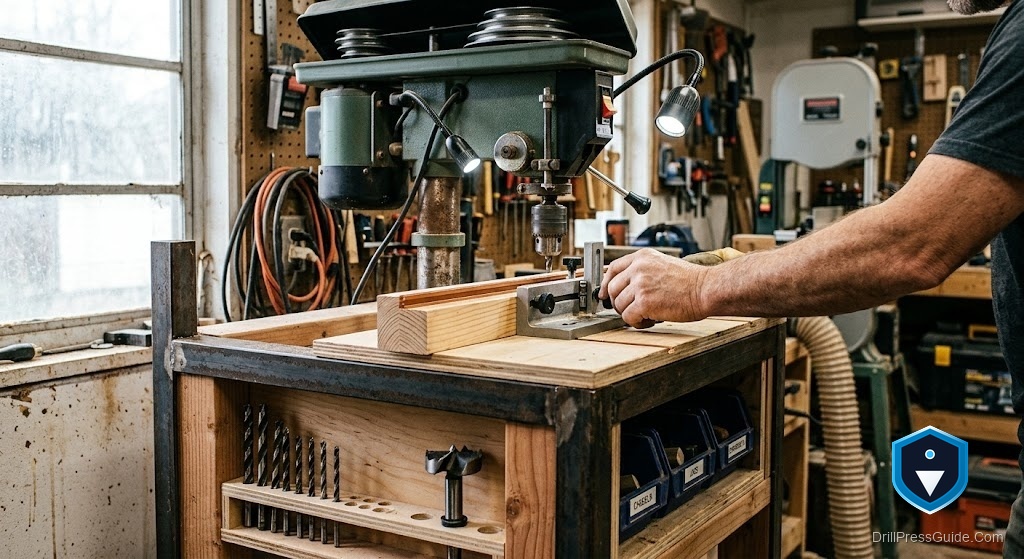
Search for drill press stand ideas and you will drown in clever-looking builds, rolling carts, flip-top stations, towers with a dozen drawers. Most of them look great in a photo. Fewer of them make the drill press drill better. Before you copy a build, it helps to know which stand features actually improve results and which are just storage dressed up as an upgrade.
A drill press stand is the structure that holds the machine at working height and keeps it from moving while you drill. The good ideas all serve one master: keeping the spindle centerline steady over the work. Everything else, the drawers, the wheels, the outfeed, is convenience layered on top of that.
Short answer: the stand ideas worth building or buying are the ones that add rigidity, put the chuck at a comfortable height, and keep the machine dead still. Mobility and storage are nice, but never at the cost of a base that sways.
Start with what a stand must do
A drill press earns accuracy from a rigid path between the spindle and the table. A stand that flexes or rocks adds error at the bit, no matter how handsome it is.
So the first idea is not a feature, it is a principle: build or buy heavy and stiff, then anchor it. A benchtop press on a wobbly cart drills worse than the same press bolted to a solid bench. Get that right and the rest of the ideas are safe to add.
The honest limitation: every convenience you add, wheels, a flip-top, a tall tower, trades away a little rigidity. The best stands add those features without letting the machine move under load.
Stand ideas ranked by what they add
Rigidity first:
- A heavy base or a cabinet filled with weight to kill sway on a benchtop press.
- Bolting the press to the stand and the stand to the floor or wall.
Ergonomics next:
- Setting the chuck at a height where you can see the work and reach the start/stop button and the feed handles without stooping.
- A larger auxiliary table for support under long or wide stock.
Convenience last, done carefully:
- A mobile base with locking or retracting casters, so it moves but sits solid when parked.
- Drawers or shelves for bits, chuck keys, and a vise, keeping the work zone clear.
- A flip-top only if the mechanism locks rock-solid.
Buy versus build
Against a store-bought stand, a shop-built one wins on custom height and storage and loses on guaranteed rigidity unless you build it stout. A commercial mobile base or steel stand is engineered for the load; a DIY build is only as good as your joinery.
Be honest about your woodworking before committing to a build. A shaky homemade tower is worse than a simple bolted bench. You can compare ready-made drill press stand and drill press mobile base options if you would rather buy the rigidity than build it.
Putting an idea into practice
- Decide whether you truly need mobility; if not, bolt the press to a solid bench and stop there.
- Set the chuck height so the work sits at a comfortable, visible level with controls in reach.
- Add support for long stock, an auxiliary table or an outfeed at the same height.
- If mobile, choose locking casters and confirm the machine does not sway when parked.
- Keep the drilling area clear and the work clamped, per CCOHS housekeeping guidance.
Who should keep it simple
If you have a small shop and a benchtop press, the best idea is often the plainest: a heavy, bolted bench at the right height. If you juggle floor space or move tools between zones, a well-built mobile base is the idea worth your time. Elaborate towers are for people who need the storage and can build them stiff.
Bottom line
The drill press stand ideas that matter are the ones that keep the machine still and the work at a comfortable height. Add mobility and storage only after rigidity is locked in. A plain, solid stand beats a clever, shaky one every time.
- Rigidity and a steady spindle path come before every other feature.
- Set chuck height for comfort and control reach.
- Add mobility and storage only if they do not introduce sway.
FAQ
What makes a good drill press stand? Rigidity first, a comfortable chuck height second, and convenience features third. The stand must keep the machine from moving under load.
Should I build or buy a drill press stand? Buy if you want guaranteed rigidity with less effort; build if you need custom height or storage and can make it stout.
How tall should the stand be? Tall enough that the work sits at a comfortable, visible level and the feed handles and start/stop button are easy to reach.
Are rolling drill press stands a good idea? Yes, if the casters lock or retract so the machine sits solid when parked. Avoid designs that sway.
Does the stand affect drilling accuracy? Yes. A flexing or rocking stand adds error at the bit, so stiffness is the priority.
What is the simplest good option? A heavy bench with the press bolted down at the right height. Plain and solid beats clever and shaky.
References
- WEN Drill Press FAQs: https://wenproducts.com/pages/drill-press-faqs
- WEN 4214T 12-Inch Variable-Speed Drill Press: https://wenproducts.com/collections/power-tools/products/wen-4214t-12-in-variable-speed-drill-press
- CCOHS, Metalworking Machines - Drill Presses: https://www.ccohs.ca/oshanswers/safety_haz/metalworking/drillpresses.html
- OSHA Woodworking eTool, Drill Press: https://www.osha.gov/etools/woodworking/production/machines-tools/drill-press