Choosing a Dremel Drill Press Stand That Fits the Work and the Table
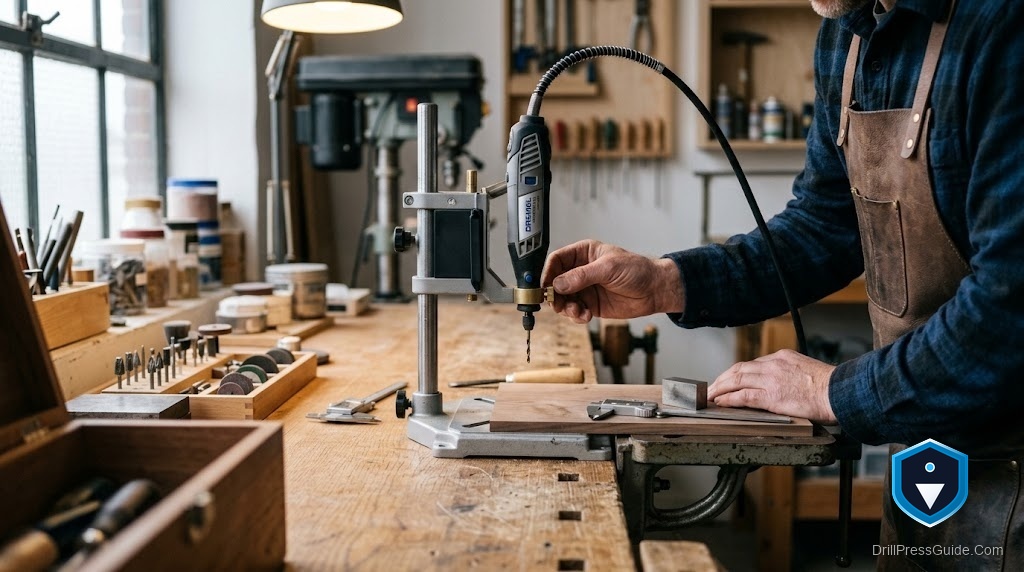
A Dremel is a wonderful tool for the wrong job here: freehand, it wanders, and drilling a straight, repeatable hole with one in your hand is nearly impossible. A drill press stand fixes that by turning the rotary tool into a plunge-capable mini drill press. The trap people fall into is expecting it to behave like a full cast-iron machine. Set your expectations right, and a Dremel drill press stand is one of the more useful few-dollar accessories for small, delicate work.
A Dremel drill press stand is a base and column that clamps the rotary tool and adds a plunge lever, so the tool moves straight up and down along a fixed axis instead of wherever your hand drifts. It gives you a controlled spindle path and depth control for tiny bits. Within its size class, that control is exactly what you need.
Short answer: a Dremel stand fits when it accepts your tool’s collar, offers enough plunge travel for your parts, and sits on a base stable enough for the light work you do. It will never match a benchtop drill press for rigidity or capacity, and it does not need to for the jobs it is meant for.
What a Dremel stand is for, and what it is not
The stand shines on small, precise work: drilling circuit boards, pen blanks, model parts, jewelry, thin plastic and soft metal. It gives you a straight plunge and a repeatable depth stop, which a handheld rotary tool cannot.
What it is not is a substitute for a real drill press. Compared to a machine built around a stout column, a steady quill, and an induction motor, a Dremel stand is light and its column can flex. Push a large bit or hard steel and you will feel it deflect.
The honest limitation: the plunge travel is short and the whole assembly is small. Anything beyond delicate work will overwhelm it, and the base often needs clamping to a bench to stay put.
Check these before you buy
- Tool fit. Confirm the stand accepts your specific Dremel’s threaded nose or collar diameter. Not every stand fits every model.
- Plunge travel. Check the vertical travel against the depth of holes you drill; it is short by full-press standards.
- Base stability. A wider, heavier base or one you can bolt down keeps the light column from wandering.
- Work holding. Plan for a small vise or clamp, because the stand holds the tool, not the workpiece.
Dremel stand versus a benchtop drill press
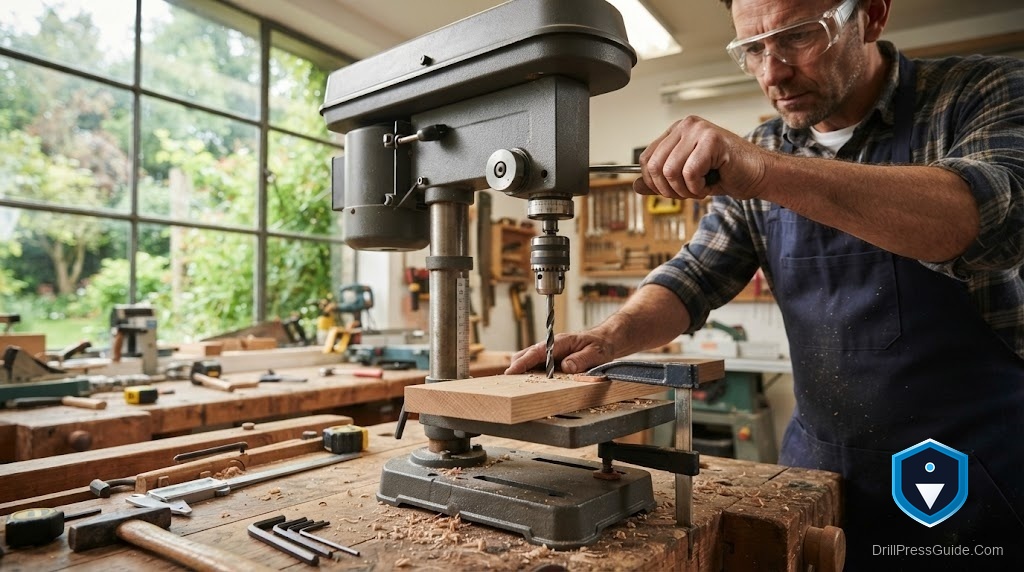
Against a benchtop drill press, the Dremel stand wins on price, size, and high-speed small bits, and loses on rigidity, torque, and capacity. A benchtop press with variable speed, a real work table, and a keyed chuck handles wood and metal the Dremel cannot touch. But it also spins too slowly and grips too coarsely for the tiniest bits that a rotary tool eats up.
Think of them as complementary. Many benches hold both. You can compare dremel drill press stand and rotary-tool drill press workstation options to match your tool.
Setting it up for clean small holes
- Confirm the stand clamps your tool’s collar securely with no wobble.
- Bolt or clamp the base to a solid bench so the light column cannot shift.
- Hold the workpiece in a small vise or clamp, never by hand.
- Set the depth stop for repeatable holes and plunge slowly with light pressure.
- Wear eye protection; small high-speed bits throw fine chips, and CCOHS lists eye protection as basic practice.
Who should skip it
If you drill wood or metal parts of any real size, skip the Dremel stand and buy a benchtop drill press instead. If your work is small and fine, hobby electronics, models, jewelry, pen turning, the stand gives you controlled, repeatable holes that a handheld tool cannot.
Bottom line
A Dremel drill press stand is a precision tool for small work, not a shrunken drill press. Match it to your tool, give it a stable base, hold the work in a clamp, and keep the jobs light. Within that lane it is excellent; ask it to do a benchtop press’s work and it disappoints.
- Confirm the stand fits your specific Dremel’s collar.
- Plunge travel is short; plan for small parts and shallow holes.
- Clamp the base and the workpiece; the stand only holds the tool.
FAQ
What is a Dremel drill press stand good for? Small, precise drilling, circuit boards, models, jewelry, pen blanks, where controlled plunge and depth matter more than power.
Will any Dremel fit any stand? No. Confirm the stand accepts your model’s threaded nose or collar diameter before buying.
Can it replace a drill press? No. It lacks the rigidity, torque, and capacity of a benchtop press. For wood or metal of any size, use a real drill press.
How deep can it drill? Only as deep as its short plunge travel allows, which is modest. Check the travel against your parts.
Do I hold the workpiece by hand? No. Hold it in a small vise or clamp, per OSHA and CCOHS practice, and keep hands clear.
Why does my stand wobble? Usually an unsecured base or a loose tool clamp. Bolt the base down and confirm the tool seats without play.
References
- WEN Drill Press FAQs: https://wenproducts.com/pages/drill-press-faqs
- WEN 4214T 12-Inch Variable-Speed Drill Press: https://wenproducts.com/collections/power-tools/products/wen-4214t-12-in-variable-speed-drill-press
- CCOHS, Metalworking Machines - Drill Presses: https://www.ccohs.ca/oshanswers/safety_haz/metalworking/drillpresses.html
- OSHA Woodworking eTool, Drill Press: https://www.osha.gov/etools/woodworking/production/machines-tools/drill-press