
Drill Press Table Lift: Fit, Capacity, and Setup Explained
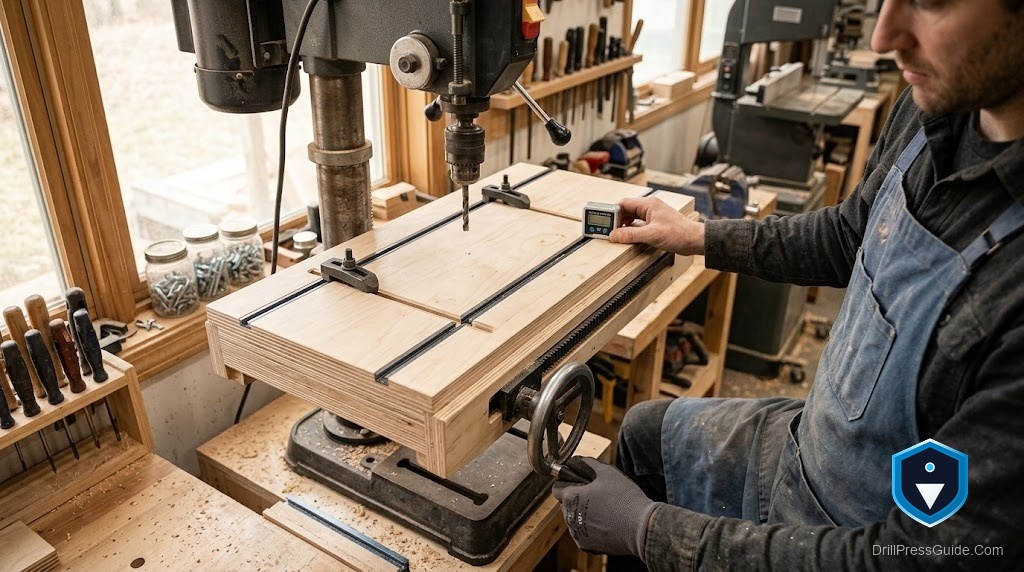
If you have ever drilled a mortise on a long board and run out of clearance between your workpiece and the column, you already understand why table height adjustment matters more than most new drill press owners expect. The lift mechanism is not just a convenience feature. It determines what you can actually drill, how fast you can change setups, and whether your back survives a long session of repositioning stock.
This guide breaks down how drill press table lift systems work, what separates rack-and-pinion from pin-lock designs, how Delta, Clausing, JET, and General machines compare, and when buying an aftermarket table with a built-in adjustment system makes more sense than fighting with your stock setup.
How a Drill Press Table Lift Works
There are two main approaches to raising and lowering a drill press table, and they behave very differently in practice.
Rack-and-Pinion Lift
A rack-and-pinion system uses a toothed rack machined into or bolted along the column. A pinion gear on the table casting engages the rack. You crank a handle or lever to raise or lower the table smoothly without loosening any clamp collar.
The advantages are real:
- One-handed height changes while keeping the other hand on your workpiece
- Fine height increments for precise depth positioning
- No sudden drops when the lock collar slips
JET and Grizzly floor presses use this style on their higher-end models. Delta drill presses historically used rack-and-pinion on their 17-inch and larger column machines, including the classic Delta 17-900L series. Clausing industrial machines use a full rack mechanism with a table that clocks around the column with minimal slop.
Pin-Lock (Bevel-Gear Lock Collar) Design
Most benchtop machines use a simpler pin or split-collar system. You loosen a collar nut, slide the table to the height you want, and retighten. It works, but it requires two hands, the table can drop unexpectedly if you do not hold it while loosening, and precise micro-adjustments are nearly impossible.
General International machines in the 75-series range use a geared rack on some models, but their smaller benchtop offerings rely on the manual collar. Atlas drill presses, mostly vintage at this point, used a simple lock-collar approach with no rack at all.
When Does a Table Lift Add-On Actually Make Sense?
If your drill press already has a smooth rack-and-pinion column, an aftermarket table will not fix your lift mechanism - it just changes your work surface. But if you have a budget benchtop with a stiff collar lock, an aftermarket table with its own integrated positioning system adds real workflow value.
The honest answer: an aftermarket table makes the biggest difference when you need:
- An MDF top that you can clamp into and sacrifice without damaging a cast-iron surface
- An adjustable fence for repetitive hole rows
- T-slots to mount stop blocks and hold-down clamps without drilling into the table
- A removable insert that lets you drill through without blowing out the bottom of the table
- Onboard rulers for quick fence positioning
If your work is mostly one-off holes in metal or casual woodworking, the stock table is fine. If you do production woodworking, cabinetry, or jig-heavy work, an aftermarket table is worth every penny you put into it.
Delta Drill Press Table Lift - What You Actually Get
Delta machines have a reputation that sometimes runs ahead of their current reality. The older Delta 11-990 and 17-900L machines had genuinely well-machined rack-and-pinion systems with solid cast-iron tables and positive lock collars. The newer Delta consumer-grade machines (the 18-900L and the current 18-100L floor press) still use rack-and-pinion, which is their main competitive advantage over budget imports.
If you are retrofitting an older Delta with an aftermarket table, measure your column diameter before ordering anything. Delta floor presses typically run a 3-3/4 inch column. Benchtop models can be smaller.
JET and Clausing Table Lift Mechanisms
JET’s JDP series of floor-standing presses uses a full rack-and-pinion table elevation with a bevel-gear table lock. The table rotates 360 degrees around the column, which matters when you are centering the spindle over a T-slot or aligning to an L-fence.
Clausing machines, especially the 2286 series, are built to a different standard than the consumer machines you find at big-box stores. The table lift is smooth enough that you can adjust height mid-drilling session without stopping the spindle. Clausing replacement parts are still available but the machines themselves mostly circulate used.
Comparing Table Lift Mechanisms
| Machine Type | Lift System | Column Diameter | T-Slots on Stock Table |
|---|---|---|---|
| JET JDP-20MF floor press | Rack-and-pinion | 3-3/4 in | Yes |
| Delta 18-900L floor press | Rack-and-pinion | 3-3/4 in | No |
| Grizzly G7948 20-in floor press | Rack-and-pinion | 3-3/4 in | Yes |
| WEN 4214T 12-in benchtop | Pin-lock collar | 2-1/2 in | No |
| Clausing 2286 floor press | Full rack | 3-1/2 in | Yes |
| Budget benchtop (8-10 in) | Pin-lock collar | 2 to 2-1/2 in | No |
Recommended Aftermarket Tables with Adjustment Systems
WEN DPA2412T 24x12 Drill Press Table with Adjustable Fence
This is one of the most widely compatible aftermarket tables on the market. The MDF top accepts hold-down clamps, the adjustable fence slides and locks with a single knob, and the left stop and right stop blocks are included. It fits any drill press table between 5 and 16 inches wide, which covers virtually every benchtop machine sold today. The removable insert in the center prevents tearout on the exit side of through-holes.
WEN DPA2412T 24 in. x 12 in. Drill Press Table with Adjustable Fence and Stop Block
WEN DPA2513 Drill Press Table
The DPA2513 is an updated version with similar dimensions but a revised fence design. It is compatible with the full WEN drill press lineup and works on most other machines in the 8-to-12-inch benchtop range. The sliding fence locks parallel to the T-slot tracks, and the onboard rulers let you set the fence without measuring tape.
WEN DPA2513 24-by-12-Inch Drill Press Table with Adjustable Fence and Stop Block
POWERTEC Drill Press Fence Set with T-Slot Hardware
If your machine already has T-slots and you only need the fence system, the POWERTEC kit gives you a 24-inch T-slot fence, two hold-down clamps, a fence flip stop, and the mounting hardware. This is the right buy when you want to upgrade an existing cast-iron table rather than replace it entirely.
POWERTEC Drill Press Fence Set with T-Slot 24 Inch and Hardware Kit
VEVOR Drill Press Table 24x12 with Adjustable Fence and Stop Block
VEVOR has entered the drill press table market with a competitive option. The MDF top, T-slots, built-in scale, and adjustable fence cover the bases. It fits most drill presses and supports multiple clamp styles. A good value-tier option for builders who want a table that works without a premium price.
VEVOR Drill Press Table 23.63 x 11.73 in with Adjustable Fence and Stop Block
DIY Drill Press Table - When It Makes More Sense to Build
If your column clearance is unusual, your stock table is non-standard, or you want specific features like a dust port, dado-routed T-tracks at custom spacing, or a torsion-box top, building your own table is genuinely viable. You can find printable drawings and materials lists for MDF-top shop tables with assembly drawings in both imperial dimensions and metric dimensions from several woodworking communities.
A basic shop-made table needs:
- 3/4-inch MDF or Baltic birch for the top
- A replaceable MDF insert for the center cutout
- Two strips of T-track routed flush into the surface
- A sliding fence made from aluminum extrusion or hard maple
- A mounting system that clamps to your existing stock table or column
Screw sizes for the insert retainer strips are typically 1-1/4 inch #8 wood screws. Mount them flush so they do not interfere with fence travel. Mounting hardware for attaching the table to a column clamp varies by machine but typically uses 5/16-18 or M8 hardware.
Verdict
If your drill press has a rough pin-lock table system and you are doing anything beyond casual use, the single best improvement you can make is adding an aftermarket table with an adjustable fence, stop blocks, and a removable insert. The WEN DPA2412T is the easiest recommendation for most benchtop owners - it fits nearly everything, costs less than a drill press vise, and doubles your effective work surface.
If you own a floor press with a decent rack-and-pinion table, skip the aftermarket table and put that money into a quality fence system like the POWERTEC T-slot kit instead.
Column clearance and table lift mechanism are not the same thing. You can have a good lift and still have a small table. You can have a large aftermarket table and still have a sticky pin-lock column. Address each separately.
FAQ
What is the difference between rack-and-pinion and pin-lock table lift? Rack-and-pinion uses a geared mechanism for smooth, controlled height changes with one hand. Pin-lock uses a manual collar that you loosen, slide, and retighten - it requires two hands and is prone to sudden table drops if the collar is not held while loosening.
Will a WEN aftermarket drill press table fit my non-WEN drill press? The WEN DPA2412T fits any drill press whose stock table measures between 5 and 16 inches wide. Most 8-inch to 12-inch benchtop presses fall in that range. Check your stock table width before ordering.
Can I add a rack-and-pinion lift to a benchtop drill press that does not have one? Not practically. The rack mechanism requires machined engagement with the column, which is built into the casting at the factory. You can add a better table, fence, and stop blocks, but the column lift mechanism is not a field upgrade on budget machines.
What is a removable table insert for? The insert sits in a cutout at the center of the table directly below the spindle. You drill through it as a sacrificial surface, protecting the main table. When the insert gets chewed up, you flip it or replace it instead of ruining the full table surface.
Do I need T-slots if I am just drilling wood? Not strictly. But T-slots let you mount hold-down clamps without drilling into the table, which matters for small parts that would otherwise spin when the bit catches. If you have ever had a small workpiece spin and hit your hand, you already know why clamps are not optional.
References
- WEN Products, DPA2412T Product Listing, amazon.com
- WEN Products, DPA2513 Product Listing, amazon.com
- POWERTEC, Drill Press Fence Set, amazon.com
- VEVOR, Drill Press Table, amazon.com
- Delta Machinery, 18-900L Floor Drill Press Owner’s Manual
- JET Tools, JDP Series Drill Press Product Documentation


