
Getting Better Results from a Drill Press Jig
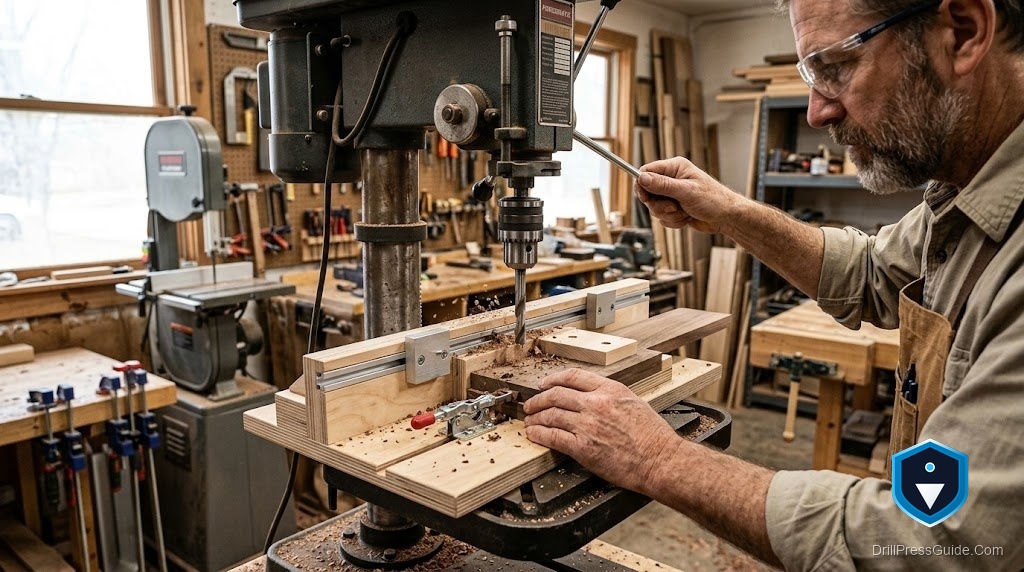
If you’ve ever held a cordless drill and tried to bore a perfectly perpendicular hole freehand, you already know the problem. You watch the bit wander, the hole exits slightly off-angle, and suddenly your dowel joint is a disaster. That’s exactly what a drill press jig is designed to prevent - and once you understand which jig does what, you’ll stop fighting your tools and start getting repeatable results.
This guide breaks down what a jig actually does at a drill press versus what it does on a hand drill, covers the best options on Amazon right now, and gives you a straight verdict on which setups are worth your time.
What a Drill Press Jig Actually Does
A drill press is already a precision machine. The spindle centerline is fixed, the quill travel is controlled, and the depth stop keeps every hole identical. So why add a jig at all?
The answer is workpiece control, not drill control. When you’re at a drill press, the jig’s job is to hold your material in a consistent position - dead-square to the quill, at a repeatable offset from a reference edge, or at a specific angle relative to the column. The rotating chuck and spindle do the precision work; the jig makes sure your wood doesn’t wander around the work table while you’re doing it.
Jigs on a Hand Drill Are a Different Animal
When you clamp a portable drill guide onto your cordless drill, you’re solving a completely different problem. Now the vertical guidance, the depth stop, the controlled quill travel - all of that is built into the jig itself. You’re essentially strapping a mini drill press frame around your drill. The induction motor, variable speed, and chuck capacity of your actual drill press back home on the bench are irrelevant; the jig is compensating for the fact that you’re holding the tool in your hand.
This distinction matters when you’re shopping, because the best jig for the drill press bench isn’t necessarily the best jig for a job site.
The Best Drill Press Jigs on Amazon
Best Portable Drill Guide: Milescraft 1318 DrillMate
Milescraft 1318 DrillMate Portable Drill Guide
The DrillMate accepts standard drills, includes a 3/8-inch keyed chuck, and lets you drill at 45, 60, 75, and 90 degrees. The metal guide head runs on ball bearings for smooth descent.
What I like: The self-centering base is genuinely useful. Drop it on the edge of a board and it aligns itself automatically. The V-groove on the base also lets you drill into round stock.
What I don’t like: The chuck capacity tops out at 3/8 inch, which rules out larger Forstner bits.
Verdict: This is the jig you grab when you can’t bring the work to the drill press.
Best Full-Column Drill Stand: Wolfcraft 5027000
A full rack-and-pinion column stand with a 40mm round steel shaft and a 420mm toothed rack. Accepts any drill with a 43mm Euronorm collar. The cast iron table has clamping grooves for vises and stop blocks, and the depth stop with quick adjuster gives you repeatable hole depths.
What I like: The column is rigid. The rack-and-pinion drive is smooth and precise, and the 3-arm feed lever feels like a real drill press.
What I don’t like: Designed for 43mm Euro-collar drills, so most North American cordless drills won’t fit without an adapter.
Verdict: If you own a compatible drill and want a near-full-featured drill press without a benchtop machine’s footprint, the Wolfcraft stand delivers.
Best Pocket Hole Jig: Kreg K4 Pocket Hole Jig
Kreg K4 Pocket Hole Jig System
Pocket hole joinery is one of the most practical applications for a drill press jig. The K4 is adjustable for material thicknesses from 1/2 inch to 1-1/2 inches and uses hardened steel drill guides.
What I like: The drill guides are hardened and won’t wear out the way cheaper aluminum jigs do. This system has been proven in real shop environments.
What I don’t like: At 1.5 inches maximum material thickness, it won’t cover heavy stock. Clamp the jig down to your work table when using at the drill press.
Verdict: For cabinetry, shop furniture, and face-frame joints, the Kreg K4 is the standard bearer.
Best Dowel Jig Set: Milescraft 1333 DowelJig Kit
Milescraft 1333 DowelJig Kit - Self-Centering
A self-centering body with three metal bushing sizes (1/4-inch, 5/16-inch, and 3/8-inch). The self-centering mechanism aligns the guide automatically to the center of your stock.
What I like: The metal bushings wear far better than plastic alternatives. Works just as well at a drill press table as in hand-drill use.
What I don’t like: Very thin stock under about 3/8 inch can be finicky.
Verdict: If your woodworking involves any edge-to-edge joinery, this belongs in your drawer.
Drill Press Jig vs. Hand Drill Jig: Key Differences
| Feature | Drill Press Jig | Hand Drill Jig |
|---|---|---|
| What it controls | Workpiece position | Drill angle and depth |
| Drill press needed? | Yes | No |
| Typical use | Dowel joints, pocket holes | On-site work |
| Depth stop | Drill press depth stop | Built into jig |
Pro Tips for Better Results
- Always set your depth stop first. Before you clamp anything, lower the quill manually to confirm the bit exits where you expect.
- Clamp the jig to the work table. A jig that shifts mid-drilling ruins the whole point.
- Match your bit to the jig bushing. Undersized bits wobble in metal guides.
- Use a backer board. Drill into a sacrificial scrap piece beneath your workpiece. Eliminates tearout on the exit side, every time.
FAQ
Can I use any drill press jig with any drill press? Most workpiece jigs are independent of the drill press model - they clamp to your work table. Portable drill guide jigs are specific to your drill’s collar size. Always check compatibility.
What’s the difference between a drill press jig and a drill press fence? A fence controls distance from an edge to a hole. A jig controls angle, hole pattern, centering, or multiple holes in sequence. Many setups use both.
Do I need a jig if my drill press already has a laser guide? A laser guide helps you position a single hole visually. A jig gives you mechanical repeatability for production work.
Can a pocket hole jig be used flat on a drill press table? Yes - clamp the Kreg K4 flat to your work table, set the drill press depth stop, and you can drill a stack of rails without repositioning.
References
- Milescraft DrillMate documentation: milescraft.com
- Wolfcraft technical specifications: wolfcraft.com
- Kreg Tool application guides: kregtool.com


