
Rolling Drill Press Stand: Compatibility and Setup Guide
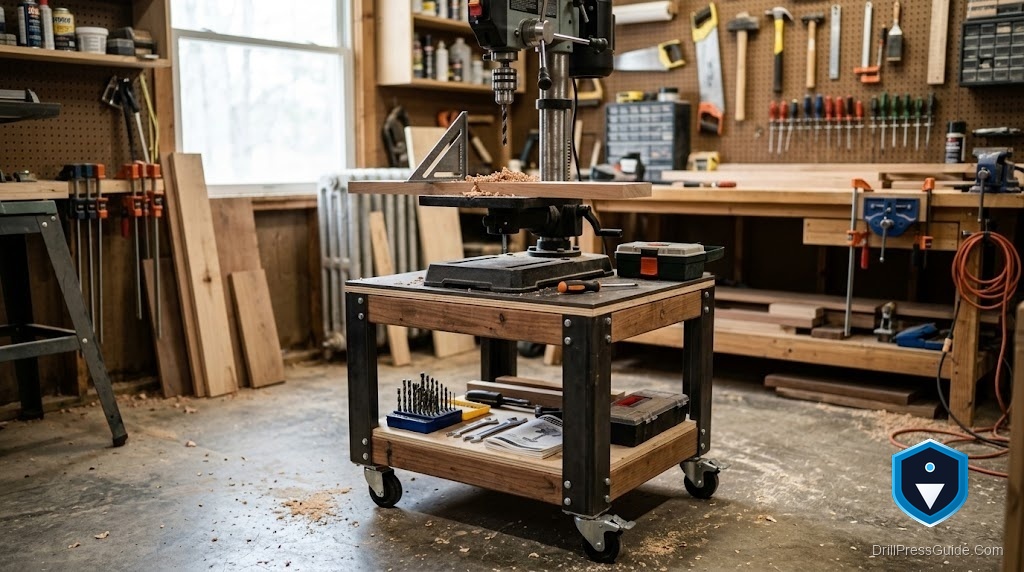
A floor-model drill press bolted to the concrete is the most stable drilling platform you can build. It is also the most immovable thing in your shop. In a small garage workshop where every square foot pulls double or triple duty, a drill press that cannot move is a drill press that gets worked around instead of worked with. A rolling drill press stand changes that equation.
The Stability Problem - and Why It Is Real
A floor-model drill press is top heavy. The induction motor, the head casting, and the work table all sit well above the base footprint. On a mobile base, this becomes a real consideration. This is not a reason to avoid a rolling base - it is a reason to choose one with a wide footprint, use the locking brakes every single time the machine is stationary, and never try to push a drill press across uneven floor seams at speed.
What to Measure Before You Buy a Rolling Base
- Column base footprint: Length and width of the cast iron foot that normally sits on the floor. Most benchtop machines have a footprint between 10 and 14 inches square. Floor models range from 12 to 18 inches or more.
- Swing and spindle centerline height: If building a rolling cabinet for a benchtop drill press, determine how tall the cabinet needs to be. Most woodworkers find a work table height of 36 to 40 inches comfortable.
- Chuck capacity and spindle taper: These do not directly affect rolling stand choice, but a machine with MT2 spindle taper and keyed chuck is worth the investment of a good base.
The Rolling Base Options Worth Considering
WEN MB500 Universal Heavy-Duty Mobile Base, 500 lb
Handles up to 500 pounds. Square configuration adjusts from 11.8 by 11.8 inches all the way up to 35.4 by 35.4 inches; rectangular footprints up to 51.2 by 19.7 inches. Two fixed wheels and two swivel wheels with foot-locking brakes. Ball-bearing wheels roll smoothly. Two-year warranty.
Pros: 500-lb capacity, wide adjustable range, ball-bearing wheels, foot-locking brakes. Cons: Flat arms can shift on uneven bases, assembly requires patience.
Delta 50-345 Universal Mobile Base (Wood Not Included)
Been in shops for decades and remains one of the most copied mobile base designs on the market. Capacity rated to 450 pounds. Ships without wood - you add your own hardwood or plywood strips to the frame arms, creating a custom-fit cradle for your machine’s specific base footprint. Heavy-gauge steel frame. Two fixed and two swivel casters with foot brakes.
Pros: Custom wood inserts create a tight, machine-specific fit, heavy-gauge steel frame, decades-proven design. Cons: Requires sourcing and cutting your own wood inserts, slightly lower capacity than WEN MB500.
The DIY Rolling Cabinet Approach
If you have a benchtop drill press and want rolling storage at the same time, building a rolling cabinet from 3/4-inch plywood is one of the most rewarding shop projects you can do. Torsion box top for rigidity, cabinet body with drawers for bit storage, four heavy-duty locking casters on the bottom corners. Key numbers: aim to put the drill press work table at 36 inches from the finished floor, and buy casters rated for at least 1.5 times your machine’s weight.
Setup and Safety Checklist
- Confirm all base hardware is tight.
- Test all four brakes under firm hand pressure.
- Check the column for plumb after any move.
- Keep the floor path clear before you move.
- Lock before you drill - every single time.
The Verdict
For most small-shop owners with a floor-model drill press, the WEN MB500 is the right first purchase. It adjusts to fit nearly any footprint, rolls smoothly, and locks reliably. If you want a tighter, more custom fit and have 30 minutes to cut wood strips, the Delta 50-345 gives you a more secure cradle.
Measure the base footprint first. Buy a base rated to twice your machine’s actual weight. Lock the brakes before you drill anything.
FAQ
Can any floor drill press go on a mobile base? Most can, but verify the base footprint falls within the mobile base’s adjustment range and that the combined machine weight is under the base’s capacity.
How do I know if my drill press is too top heavy for a mobile base? If the machine tips more than a few degrees before the casters lift off during a push, it is too top heavy. Use a wider-footprint base or bolt the column to a wall for lateral stability.
What caster size do I need for a DIY drill press rolling cart? Use at least 3-inch-diameter casters rated for 150 pounds each on a four-caster cart.
How do I keep a drill press from vibrating off a rolling cart? Rubber anti-vibration pads between the drill press base and the cart surface absorb vibration and prevent the machine from walking.
References
- WEN MB500: wenproducts.com
- Delta 50-345: amazon.com


