
Choosing a Stand for Benchtop Drill Press That Fits the Work and the Table
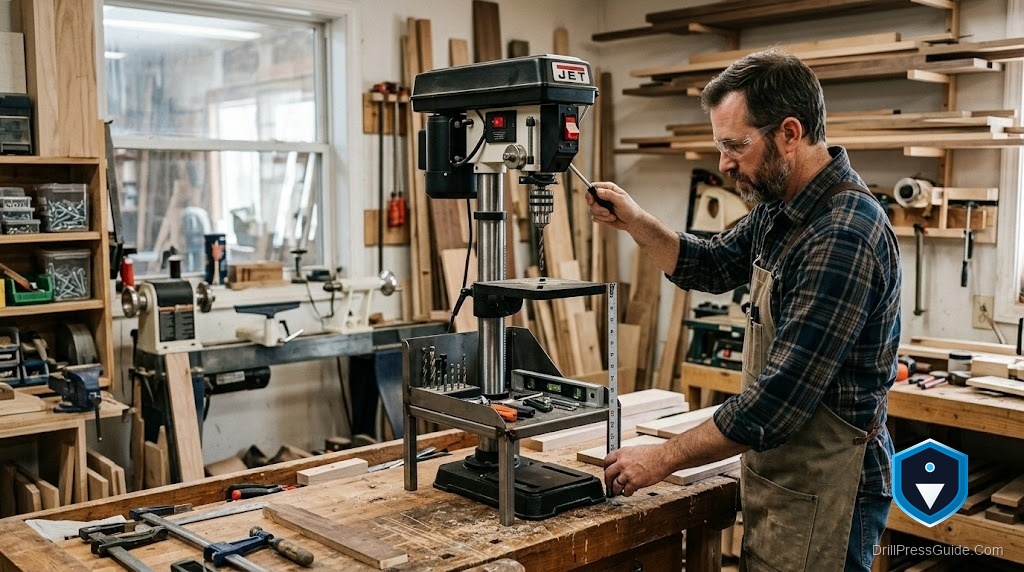
A benchtop drill press sitting on a folding table is one of the more precarious setups in a home shop. The machine vibrates. The table flexes. Your workpiece shifts. You end up with holes that wander, and you’re doing it in a setup that could tip if the drill press torques hard into dense stock. Getting the stand right fixes all of that at once - and it’s not nearly as complicated a decision as the drill press itself.
Here’s how to think through it, along with the real stands and combinations you can order on Amazon today.
Why the Stand Matters More Than People Expect
When your benchtop drill press is bolted to a solid, heavy stand, three things change:
- Vibration dampens. An induction motor running at 1,200 RPM transfers vibration into whatever it’s sitting on. A dense stand absorbs it; a thin-top workbench amplifies it.
- Working height improves. Most workbenches put the drill press table at roughly eye level, which is awkward for applying downward quill pressure. A dedicated stand at 32-34” working height puts your hands in a natural pushing position.
- You gain floor storage. Any stand worth buying has a lower shelf or a cabinet below the press. That’s where your chuck key, drill index, depth stop settings card, and hold-down clamps live.
The Key Measurements to Get Right First
Before you look at any stand, pull out a tape measure and write down three numbers.
Swing. Your drill press has a swing rating - 10”, 12”, 15” - which is twice the distance from the column centerline to the quill centerline. A 12” swing machine can drill to the center of a 12” wide board. The stand doesn’t affect this, but it’s the first number that tells you what class of machine you’re dealing with.
Column diameter. The stand’s mounting plate or top shelf must accommodate your machine’s column base. Most benchtop presses have a cast-iron base that’s 10” x 16” or smaller. The WEN JWDP-12 and WEN 4212T/4214T series both have bases that fit standard universal stands. The JET JWDP-12 has the same footprint.
Point of operation height. With the quill at full extension (full spindle travel down), where is the tip of the bit? That height minus your typical workpiece thickness tells you how tall your stand can be before you’re reaching overhead to push the quill. Most woodworkers find 32-34” to the drill press table comfortable.
Stand Types: What’s Actually Available
Universal Tool Stands
These are the most versatile option. A flat steel top, two shelves, and a bolt-down mounting pattern that works with virtually any benchtop tool.
POWERTEC UT1002 Universal Tool Stand - MDF Split Top, 32” Work Height
This is POWERTEC’s answer to the “I need something solid that works with any tool” problem. The MDF split top expands from 14” x 25” to 20” x 25”, giving you extra outfeed support for long stock. Working height is 32-1/8”. The frame is powder-coated steel with a 500-lb load capacity and two shelves for storage. It’s not a dedicated drill press cabinet, but it’s honest, inexpensive, and stiff.
Pros:
- Expandable top is genuinely useful when you’re drilling through long boards
- Works as a stand for a belt sander, scroll saw, or bench grinder if you ever relocate the press
- Low footprint - doesn’t eat up floor space
- Easy to assemble (typically under 30 minutes)
Cons:
- No enclosed cabinet, so dust and chips accumulate on the shelves
- MDF top will cup in a damp garage unless sealed
- 32” height is on the low end - add a 1.5” MDF riser if you’re tall
Dedicated Mobile Shop Carts
If your drill press moves around the shop, a mobile cart with locking casters is worth the upgrade.
Pohadr Drill Press Stand - 700 lb Capacity, Wheels, 27.6” x 13.8” Top
Heavy-duty steel construction, four rubber-tired casters (two locking), and a storage cabinet below. The top surface accommodates most benchtop drill presses in the 10-12” swing class. At 700-lb capacity you have significant overhead.
What to check before buying any mobile cart:
- Caster diameter matters for crossing garage floor expansion joints - 3” minimum
- Make sure the locking mechanism on the casters actually keeps the stand from rolling under load; cheap casters flex and allow creep
- Verify the bolt pattern on the top plate lines up with your machine’s base, or that there’s enough surface to bolt through a secondary MDF plate
The Drill Press Side of the Equation
You can’t choose a stand in isolation. The stand must match the machine. Here are the two most common benchtop presses people pair with these stands.
JET JWDP-12 - The Shop Standard
JET 12-Inch Benchtop Drill Press, Variable Speed, 1/2 HP, 115V (JWDP-12)
The JWDP-12 is a mechanical variable-speed press running 530-3,100 RPM with a digital speed readout, 1/2 HP induction motor, 3-1/8” spindle travel, LED work light, X-shaped laser, retractable roller extension, and a keyed chuck with 1/2” capacity. The MT2 spindle taper is standard and accepts a wide range of chuck upgrades.
The base is a 10” x 16-1/8” cast-iron footprint. It sits cleanly on either the POWERTEC UT1002 or any cart with a top surface wider than 17”.
What you give up: The factory work table is 6.5” x 6.5” - adequate for spot drilling, not great for repeat production work. You’ll want to add a WEN DPA2513 or POWERTEC 71539 auxiliary table to get a usable fence and stop system.
Why it’s worth the money vs. cheaper imports: The induction motor is smooth and doesn’t complain on repeated deep cuts in oak. The depth stop is precise. The digital readout is accurate. JET’s dealer support and parts availability are meaningfully better than no-name imports.
WEN 4214T - The Value Pick
WEN 4214T 12-Inch Variable Speed Benchtop Drill Press with Laser and Work Light
The WEN 4214T is the honest budget answer. Variable speed from 530 to 3,100 RPM, 6.2-amp motor (slightly more power than the 4212T), cast-iron construction, laser, LED work light, and a keyed 1/2” chuck. At roughly half the price of the JET, it handles 90% of the same tasks.
Where it shows its price: The quill return spring tension is stiffer than it needs to be, which tires your hand on repetitive work. The factory table has minimal T-slot engagement and benefits immediately from an auxiliary table. Build quality tolerances are wider than the JET - spindle runout is acceptable but not exceptional.
The pairing: WEN 4214T on a POWERTEC UT1002 stand, with a WEN DPA2513 auxiliary table bolted to the factory table, is a complete benchtop drilling station for a home shop at a fraction of what a floor-standing machine costs.
The DIY Shop Cart Option
If you’re comfortable with basic woodworking, building a torsion-box top shop cart for your drill press is genuinely worth considering. The basic formula:
- 3/4” Baltic birch plywood cabinet, 24” wide x 18” deep x 34” tall
- Lower shelf at 10” from the floor for drill index and accessories
- Enclosed cabinet with a door for bit storage
- Four 3” locking swivel casters
- 1.5” MDF top laminated face-down for flatness
- Bolt the press base directly through the top with 3/8” carriage bolts and fender washers
Total material cost is comparable to a commercial stand, and you get exactly the height, depth, and storage you want. The torsion-box top resists vibration better than anything you’ll buy at a comparable price point.
Comparison Table
| Option | Load Capacity | Mobility | Storage | Drill Press Ready |
|---|---|---|---|---|
| POWERTEC UT1002 | 500 lb | No wheels | 2 open shelves | Universal (any brand) |
| Pohadr Cart | 700 lb | 4 locking casters | Enclosed cabinet | Universal |
| DIY Shop Cart | As built | Optional casters | Fully custom | Universal |
| JET JWDP-12 combo | - | Depends on stand | - | JET machine |
FAQ
What is swing on a benchtop drill press? Swing is twice the distance from the column to the spindle centerline. A 12” swing press can drill to the center of a 12”-wide board. It’s the most common capacity measurement you’ll see in specs.
Do I need to bolt my drill press to the stand? Yes. Always. An unbolted drill press can topple if the quill catches on a workpiece or if you pull a long board sideways while it’s clamped. Four bolts through the base take five minutes and eliminate the hazard entirely.
What is MT2 spindle taper? MT2 (Morse Taper #2) is the standard interface between the quill and the chuck. Most benchtop drill presses in the 12” swing class use MT2. It means you can swap to a Jacobs chuck, a drill chuck with better runout specs, or certain specialty arbors without buying a new machine.
Can I use a benchtop drill press stand for a floor-standing model? No. Floor-standing drill presses (17” swing and larger) have a dedicated column-to-floor post and are not designed to sit on a stand. Benchtop models are the ones that need this type of support.
How do I reduce vibration from my drill press on a stand? A rubber anti-vibration mat between the machine base and the stand top makes a noticeable difference. Cut a piece of 1/4” rubber sheet to the footprint of the base. Some shops use a single layer of closed-cell foam, but rubber holds up better under bolt torque.
References
- JET JWDP-12 specifications: jettools.com
- WEN 4214T specifications: wenproducts.com
- POWERTEC UT1002 product page: powertecproducts.com


