
Getting Better Results from a Wood Drill Press Table
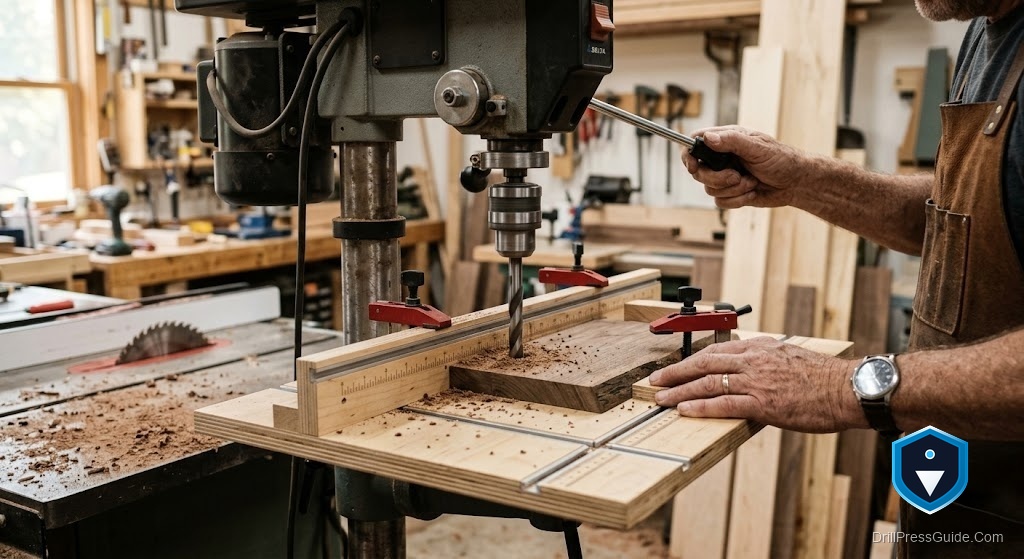
The board looked fine going in. Then you flipped it over and found a ragged crater where the bit punched through, the hole sat a whisker off your line, and the fifth hole in the row did not match the first four. None of that is your drilling. It is your table. A drill press is only as accurate as the surface holding the wood, and the factory top that came bolted to your machine was designed to be cheap, not to help you.
A wood drill press table is a flat auxiliary top, usually built from MDF or a laminate composite, that mounts over your machine’s small cast iron table to add work support, an adjustable fence, repeatable stops, and a replaceable center insert. The fastest way to get better results is not a new drill press. It is backing up your wood so it cannot tear out, registering it against a fence so every hole lands where you meant it, and locking it down so nothing shifts mid-cut.
Why your holes go wrong in the first place
Three culprits cause most bad drill press holes in wood, and a good table answers all three.
Tear-out on the exit happens because the bit has nothing to push against as it breaks through. Support the back of the board with a sacrificial surface and the fibers have nowhere to blow out. Wander and misplacement happen because a slick, small table lets the workpiece drift while you line up the point. A fence and a stop fix that. Inconsistent depth or spacing across a batch happens because you are eyeballing each one. Onboard rulers, a stop block, and flip stops turn guesswork into a setting you dial once.
Fix the surface and most of your “I need a better machine” problems disappear.
Build one or buy one
You can make a very good table from two layers of 3/4 inch MDF glued and screwed into a flat 1.5 inch top. A DIY wood drill press table lets you cut the T-track exactly where you want the sliding fence, place a removable insert dead under the chuck, and drill a mounting pattern that matches your machine. Plans with printable drawings, a materials list, assembly drawings, and both imperial dimensions and metric dimensions are easy to find, and they spell out screw sizes and mounting hardware so nothing is a guess.
The homemade route wins on fit and loses on weather. MDF drinks moisture, so a homemade wood drill press table left in a damp shop will swell at the edges and lose its flat. Seal every face, keep it off a wet floor, and it lasts for years.
If you would rather bolt something on this weekend, real tables and fence kits do the job well. The POWERTEC 71539 Drill Press Table with T-Track Fence System is the most complete single box: a 14 by 24 inch top, a 24 inch fence with a flip stop, hold-down clamps, and adjustable inserts, sized for host tables 12 inches and larger. Its real weakness is that it mounts with edge clamps, and under a hard push those clamps can let the table creep, so most owners add bolts through the factory slots or a strip of double-sided tape.
Already have a top and just want registration that holds? The POWERTEC 71633 T-Slot Fence Kit is a 24 inch reversible aluminum fence with a flip stop and hold-down clamps.
On a smaller benchtop machine, the WEN DPA2513 24 by 12 inch Drill Press Table is the easier fit. It has a slot for column clearance, an adjustable fence with stop block, onboard rulers, and clamps, and it fits host tables from about 5 to 16 inches wide. It is a coated composite rather than machined aluminum, so it flexes a touch more and will dent if you drop something on it, but for regular hobby use that is a fair trade for how light and simple it is to mount.
The fence and stop block are where accuracy lives
A table gives you room. The adjustable fence gives you accuracy. Set the fence so your hole centers line up, lock it, and every board you slide against it drills in the same place. Add a stop block clamped to the fence and you can drill a whole run of shelf-pin holes at identical spacing without measuring twice.
The one habit that separates clean work from frustrating work is trusting the setting. Once the fence is locked, stop nudging the wood and start letting the fence do the aligning.
Hold the wood down, not just against the fence
Registration stops side-to-side drift. It does nothing about the board climbing the bit, which is how you get grabbed workpieces and oval holes, especially with Forstner and spade bits in wood. Hold-down clamps that ride the T-track solve it, and for smaller parts a drill press vise for wood is safer and steadier than fingers.
The PONY 4-inch Drill Press Vise is a straightforward cast steel vise with slotted base holes so you can bolt it to the table. Its jaws are smooth steel, which can mar softwood, so I keep a pair of scrap wood jaw liners on hand. The Forward Q194A 4-inch Drill Press Vise is a similar option with textured jaws and a strong clamping force. Either one keeps small stock from spinning, which is a genuine safety gain, not just a convenience.
When you need real precision: the XY table
For repeatable grids of holes, drilling small metal parts, or light layout work, a table drill press setup with an XY compound table beats any fixed top. The HFS 2-Way 4-inch Drill Press X-Y Compound Cross Slide clamps to your table and moves the workpiece in two axes with hand cranks. It is heavy cast iron with real crank backlash, and it turns a drill press into a light-duty milling table, not a mill. But for punching a precise row or grid, dialing coordinates beats sliding wood against a fence every time.
| Your work | Best add-on |
|---|---|
| General drilling, larger boards | POWERTEC 71539 table + fence |
| Better registration on an existing top | POWERTEC 71633 fence kit |
| Small machine, hobby use | WEN DPA2513 table |
| Small parts that spin | PONY or Forward 4-inch vise |
| Repeatable hole grids | HFS XY cross slide |
Small habits that fix most bad holes
Put a sacrificial backer under every through-hole and tear-out mostly disappears. Set your fence once and stop second-guessing it. Clamp or vise anything smaller than your hand. Rotate or replace the table insert the moment it scars, so your breakthrough stays clean. And bring the quill down slowly at the exit, easing off pressure as the bit clears, because the last eighth inch is where wood splinters.
The verdict
You do not need a better drill press. You need a better surface, honest registration, and a real hold-down. Build the table if you enjoy the project and want a perfect fit, just seal the MDF. Buy the POWERTEC 71539 if you want the whole solution in one box, and commit to bolting it down instead of trusting the clamps. On a small machine, the WEN is the friendlier fit. Add a 4-inch vise the day you drill your first small part, and step up to an XY table only when repeatable placement, not surface size, is the real problem.
Three takeaways: back up the wood, trust the fence, and never hold small stock by hand.
FAQ
How do I stop tear-out when drilling wood on a drill press? Back the workpiece with a sacrificial surface so the bit breaks through into scrap, not air. A replaceable table insert and a flat auxiliary top do this automatically, and easing off pressure at the exit helps too.
Do I really need a fence on a drill press table? If you drill more than one hole per setup, yes. A fence registers the workpiece so every hole lands in the same place, and a stop block lets you repeat spacing across a batch without measuring each one.
What is the best drill press vise for wood? A 4-inch cast steel vise with a slotted base you can bolt down, like the PONY or Forward Q194A, holds small parts safely. Add scrap wood jaw liners so the steel jaws do not mar softwood.
Can I build a wood drill press table myself? Yes, and it fits perfectly since you drill the mounting pattern to match your machine exactly. Use two layers of 3/4 inch MDF for a flat 1.5 inch top, cut a T-track for the fence, and seal it against moisture.
When should I use an XY table on a drill press? Use one for repeatable hole grids, small metal parts, or light layout work where exact two-axis placement matters. It is not a substitute for a milling machine, and the cranks have some backlash.
References
- POWERTEC 71539 Drill Press Table: Check on Amazon
- POWERTEC 71633 T-Slot Fence Kit: Check on Amazon
- WEN DPA2513 Drill Press Table: Check on Amazon
- PONY 4-inch Drill Press Vise: Check on Amazon
- Forward Q194A 4-inch Drill Press Vise: Check on Amazon
- HFS 2-Way X-Y Compound Cross Slide: Check on Amazon


