Drill Press 80 Lower Jig: What to Measure Before You Buy
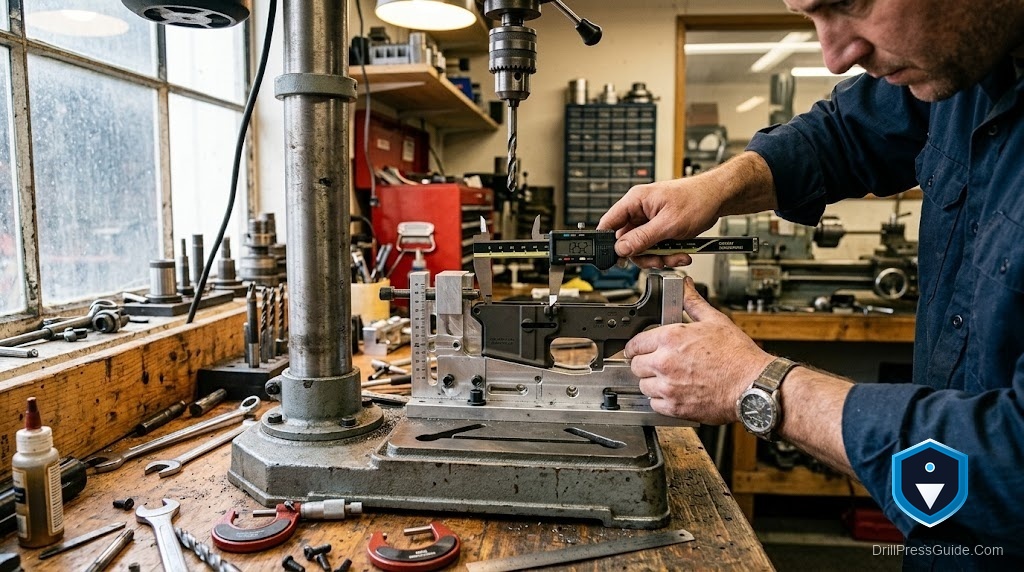
If you’ve started researching 80% lower builds, you’ve probably already landed on a jig - the Easy Jig Gen 2, 5D Tactical, or something similar. And you’ve probably already noticed something important: almost none of the serious jigs are sold on Amazon. That’s not an accident, and it’s not something I’m going to dance around.
What IS on Amazon, and what actually determines whether your build goes smoothly, is the drill press itself. The jig is just a fixture. The machine behind it is what keeps your holes perpendicular, your spindle centerline where it needs to be, and your lower receiver from becoming expensive scrap aluminum.
This guide is about the drill press side of the equation - specifically what specs matter, what to ignore, and which benchtop machines are worth your time.
First, the Honest Part About 80% Lower Jigs
The best-known 80% lower jigs - the Easy Jig Gen 2, Easy Jig Gen 3, and 5D Tactical - are sold through dedicated firearms and tooling retailers, not Amazon. If you search Amazon for these by name, you won’t find them. What you’ll find are generic drill press jig attachments and a handful of unrelated machining fixtures.
That’s fine. Knowing where NOT to look saves you time and money. Buy your jig from the manufacturer or a dedicated retailer. Buy your drill press from wherever has the best selection - which, for benchtop tools, often is Amazon.
The jig and the press are two separate purchases. Let’s talk about the press.
Why the Drill Press Matters More Than You Think
Most people building their first 80% lower underestimate the drill press. They figure any machine with a 1/2-inch keyed chuck will do the job. That’s partially true for polymer 80 builds, where the material is forgiving. It’s much less true when you’re working aluminum.
Here’s what actually goes wrong with an inadequate press:
- Spindle wobble causes oversize holes and sloppy pin fits
- Insufficient quill travel (spindle travel) means you can’t reach full depth in a single plunge on some jigs
- A flimsy work table flexes under lateral load, walking your drill bit off centerline
- No speed control means you’re running aluminum at wood speeds, which burns your bits and heats your workpiece
These aren’t hypothetical failure modes. They’re the reason forum threads are full of ruined lowers.
The Specs That Actually Matter
Swing
Swing is the distance from the column to the spindle centerline, doubled. It tells you the largest-diameter circle you can drill through the center of. For AR-15 lower work, a 10-inch swing is the practical minimum. A 12-inch swing gives you more table real estate and easier workholding.
Don’t let anyone tell you an 8-inch benchtop press is adequate for this work. The table is too small and the column gets in the way when you’re positioning a jig that’s wider than it looks.
Spindle Travel (Quill Stroke)
This is the distance the quill can travel in a single plunge. Most budget benchtop presses offer 2 inches of spindle travel. That’s workable for pin holes, but tight when you’re drilling the trigger slot pilot hole on a drill-press-style jig.
If you’re planning to use a jig that requires one deep, continuous plunge rather than multiple shallow passes, look for at least 2.5 inches of quill travel. If you’re using a router-based jig that only needs the drill press for pin holes, 2 inches is fine.
Speed Control and RPM Range
Aluminum wants lower speeds than wood - somewhere in the 500 to 1,200 RPM range depending on your drill bit diameter. A fixed-speed press running at 2,800 RPM will gall and work-harden the aluminum before your bit can cut cleanly.
Variable speed via a continuously adjustable dial (as opposed to a stepped pulley system) lets you dial in the right RPM for each hole diameter without stopping to change belts. It’s genuinely useful here, not just a marketing feature.
A digital speed readout makes this even simpler. You can confirm you’re at the right RPM rather than guessing from belt position.
Table Stability and Clamping
The work table needs to hold your jig without any flex or rock. Cast iron tables are noticeably more rigid than stamped-steel tables. If you can flex the table by hand before you buy, don’t buy it.
Clamping slots matter too. Your jig needs to be bolted down, not just resting on the table. If the table has no T-slots or clamping notches, you’ll be improvising with clamps that may not reach.
Chuck Capacity and Runout
You need a 1/2-inch keyed chuck for 80% lower work - most jig toolkits include 3/8-inch shank drill bits and larger pilots that require it. More importantly, the chuck needs to run true. Cheap chucks with high runout will walk your drill bit off its starting point even when everything else is perfect.
An MT2 spindle taper (as opposed to a JT33 or proprietary taper) is a good sign in a budget press - it indicates the spindle geometry is robust enough to accept mill-grade tooling if you ever upgrade.
What to Ignore
Laser guides - useful for wood, meaningless for 80% lower work because your jig’s drill bushings locate the bit for you.
Work lights - fine to have, irrelevant to the outcome.
Horsepower ratings on the spec sheet - manufacturers inflate these. Look at the amp draw on the induction motor instead.
Drill Presses Worth Considering on Amazon
Best Overall: VEVOR 12 in. Benchtop Drill Press
VEVOR 12 in Benchtop Drill Press, Variable Speed, 5 Amp
The VEVOR 12-inch is the one I’d buy first for this work. You get a 12-inch swing, 5-amp induction motor, continuously variable speed from 580 to 3,200 RPM, an LED digital speed readout, and 3.54 inches of spindle travel. The cast iron table locks down firmly. The laser guide is there if you want it for other work, and easy enough to ignore when you don’t. The main knock is that VEVOR’s fit-and-finish is utilitarian. The column-to-table interface sometimes needs shimming out of the box, and the chuck key storage is an afterthought.
Pros: Variable speed with digital readout, 12-inch swing, 3.5-inch quill travel, solid cast iron table Cons: Fit-and-finish requires some user attention, chuck key storage poorly designed
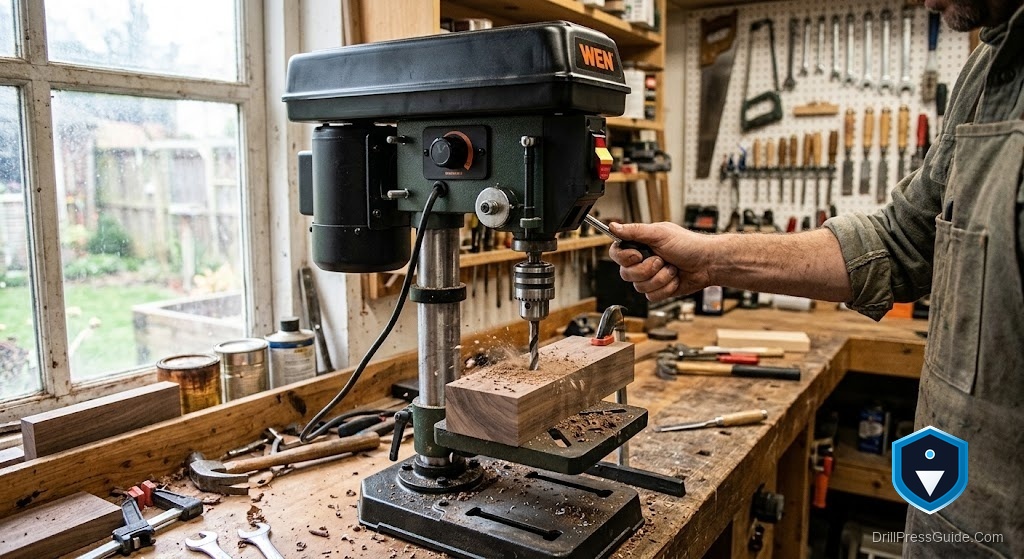
Best Budget Option: WEN 4208 8 in. 5-Speed Drill Press
WEN 4208 8 in. 5-Speed Drill Press
If you’re doing polymer 80 work only, the WEN 4208 can handle it. The 8-inch swing is legitimately tight, and the 2-inch spindle travel is the minimum you want. The five-speed stepped pulley runs from 740 to 3,100 RPM. The 1/2-inch keyed chuck is the right size. What you give up is rigidity. For aluminum billet, save up for the VEVOR.
Pros: Compact, affordable entry point, 1/2-inch chuck, five speed settings Cons: 8-inch swing is cramped, table shows more flex, no variable speed
Best Mid-Range: SKIL 6.2 Amp 10 in. 5-Speed Benchtop Drill Press
SKIL 6.2 Amp 10 In. 5-Speed Benchtop Drill Press with Laser Alignment
The SKIL sits between the WEN and VEVOR in every meaningful way - 10-inch swing, 6.2-amp induction motor, five speeds from 610 to 2,800 RPM, 2-inch spindle travel, and an adjustable depth stop. The 6.2-amp motor is genuinely strong for a benchtop press. The depth stop is well-made and holds its setting. The main limitation is the 2-inch quill travel and the stepped rather than variable speed.
Pros: Strong induction motor, reputable brand, solid depth stop, 10-inch swing Cons: Stepped speeds only, 2-inch spindle travel is the minimum
The Measurement Checklist Before You Buy
Before you order, confirm these numbers against the jig you’ve already chosen:
- Swing: 10 inches minimum, 12 preferred
- Spindle travel: 2 inches minimum, 2.5 or more for drill-press-primary setups
- Speed range: Low end must reach 500-600 RPM for aluminum
- Speed control type: Variable preferred; if stepped, confirm one speed is in the 800-1,200 RPM range
- Chuck capacity: Must accept 1/2-inch shank tooling
- Table material: Cast iron preferred
- Table clamping: Confirm T-slots or clamping notches exist before you need them
My Verdict
For polymer 80 work on a tight budget: the WEN 4208 gets the job done. For aluminum AR-15 80% lower work with a router jig for milling and a drill press for holes: the SKIL is a solid, reputable choice. For anyone who wants to do this properly - aluminum, drill press handling all operations, or simply wanting the right tool for the long haul: buy the VEVOR 12-inch. The extra quill travel and variable speed are worth it.
The jig matters. The lower blank matters. But a drill press that wanders, flexes, or runs too fast will compromise all of it. Start with a machine that won’t let you down at the point of operation.
FAQ
Can I use any drill press for an 80% lower jig? Not reliably. You need a press with at least a 10-inch swing, a 1/2-inch keyed chuck, and a low-end speed of 600 RPM or below for aluminum work.
Do I need variable speed or will a 5-speed stepped drill press work? A 5-speed press works if one of those speeds falls in the 800-1,200 RPM range, which most 5-speed benchtop presses do. Variable speed is more convenient but not strictly required.
What’s the minimum spindle travel I need for 80% lower jig work? 2 inches is the practical minimum for pin and selector hole work. If your jig requires the drill press to plunge through the full depth of the fire control pocket in one pass, you’ll want 3 inches or more.
The Easy Jig Gen 2 says it doesn’t need a drill press - is that true? The Gen 2 and Gen 3 are router-based jigs. They use a router for all milling operations. You still need a drill press for the pin and selector holes, but the requirements are much less demanding.
Is an MT2 spindle taper important for this work? It’s a quality indicator more than a functional requirement. Most 80% jig toolkits use standard drill chuck tooling, not MT2 tooling. But an MT2 taper signals a more robust spindle design overall.
References
- VEVOR 12 in. Benchtop Drill Press: Check on Amazon
- SKIL 6.2 Amp 10 in. Benchtop Drill Press: Check on Amazon
- WEN 4208 8 in. 5-Speed Drill Press: Check on Amazon