Delta Tabletop Drill Press: How the Benchtop Range Breaks Down
The Delta tabletop drill press is a category more than a single machine, and that is exactly what confuses people shopping for one. Delta built a whole line of benchtop presses over the years, small and large, light and more capable, and “tabletop Delta” could mean any of them. If you want to buy the right one, or identify the one you already have, you need to see how the range breaks down: the compact models, the general-purpose ones, and where each fits. Here is a practical guide to Delta’s benchtop drill presses and how to choose.
The Delta tabletop drill press is any of Delta’s benchtop-mounted drilling machines, spanning compact light-duty models (like the 10-inch 11-985 and the Shopmaster DP200) through general-purpose 12-inch machines (like the 11-990), each with a cast-iron tilting table, belt-driven speeds, and a keyed chuck, built to sit on a bench rather than a floor column.
Short answer: Delta’s tabletop range breaks down by size and duty. Compact models like the Shopmaster DP200 and the 10-inch 11-985 are light-duty; the 12-inch 11-990 is the more general-purpose benchtop; and the 11-950 sits in between. All are bench-mounted, belt-speed, cast-iron machines for wood and light metal. Choose by swing, power, and parts availability. Here is the breakdown.
The range by size and duty
Delta’s benchtop presses sort into a few groups:
- Compact light-duty (Shopmaster DP200, 11-985): The smallest machines. The Shopmaster DP200 and the 10-inch 11-985 are light presses for small bits in wood, plastic, and thin metal. Least power, smallest tables.
- General light-duty (11-950): A slightly larger, still light-duty benchtop press, a common homeowner machine.
- General-purpose (12-inch 11-990): The 11-990 is the fuller benchtop, a 12-inch swing, a 1/3-HP motor, 5 speeds, a larger table, and a work lamp. The one for general woodworking.
All share the tabletop format: a cast-iron head and tilting table on a short column that bolts to a bench, with belt-driven speeds and a keyed chuck.
What they share
Across the tabletop range, expect:
- Bench mounting on a short column, not a floor base.
- Belt-driven speeds set by moving the belt (no variable-speed dial).
- Tilting cast-iron table for angle drilling.
- Keyed chuck (commonly 1/2 inch).
- Light-to-general power (roughly 1/4 to 1/3 HP).
- Short-to-moderate quill stroke.
They are woodworking and light-metal machines, not heavy or production presses.
Choosing the right one
- For the smallest, lightest tasks (models, small repairs, thin stock), a compact DP200 or 11-985 fits and takes little space.
- For general woodworking (furniture, shop tasks, occasional light metal), the 12-inch 11-990 is the better pick for its swing, table, and speeds.
- For parts availability, check before buying: some older models (like the 11-985) have discontinued parts, while more common machines are easier to service. Identify the model and type number and confirm parts through Delta and Sears PartsDirect.
Setting one up
- Mount it solidly to a sturdy bench.
- Square the table with a rod in the chuck and a square, in two directions.
- Set the belt speed to the bit and material.
- Use the depth stop for repeatable depths.
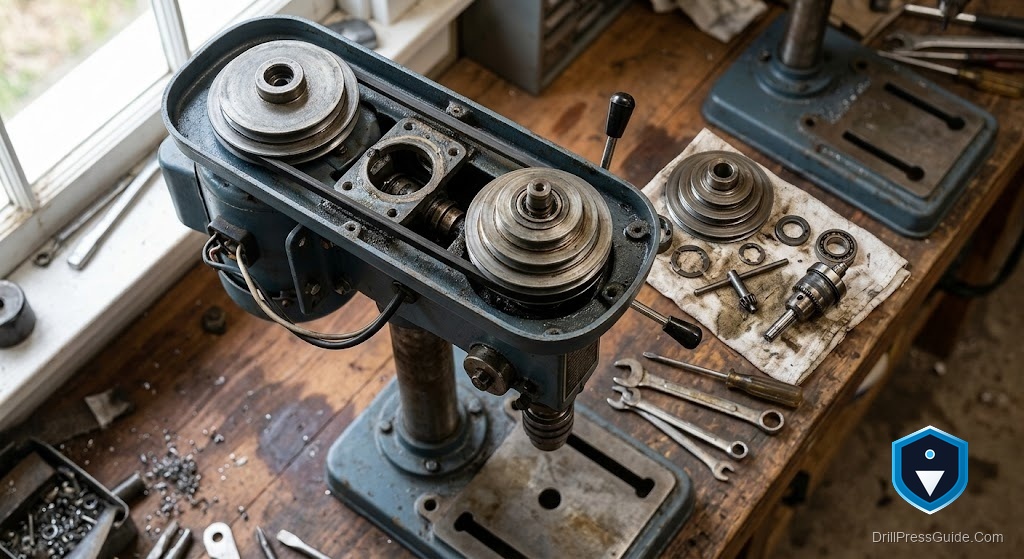
- Service the belt and chuck first; they are the common wear items.
The honest flaws
Belt-change speeds. No variable-speed dial anywhere in the tabletop range.
Light-to-general power. These are not machines for large bits in hardwood volume or heavy metal.
Short strokes. Deep holes need the table reset on the smaller models.
Parts vary by model. Some older tabletop Deltas have discontinued parts, so buy used with that in mind.
Parts and support
Delta tabletop parts come through Delta’s parts network and Sears PartsDirect, keyed to the model and type number, covering belts, chucks, springs, pulleys, and switches, plus matched generics for belts and chucks. Availability is best on the common machines and spottier on older ones. Our Delta drill press replacement parts guide explains how to search and substitute.
How it compares
Against a current variable-speed benchtop like the WEN 4212T 10-inch or the WEN 4214T 12-inch, the Delta tabletop machines trade a variable-speed dial, a work light, and a fresh warranty for cast-iron simplicity and used-market value. For buyers who want convenience out of the box, the WEN machines are the easier choice; for those who value Delta’s build and can find a clean example with parts support, the tabletop Deltas remain solid. If you need more capacity, a Delta floor press like the Delta 17900 is a different class.
The verdict
The Delta tabletop drill press is a range, not one machine, and it breaks down cleanly by size and duty: compact light-duty models like the Shopmaster DP200 and 10-inch 11-985, a general light-duty 11-950, and the more general-purpose 12-inch 11-990. All are bench-mounted, belt-speed, cast-iron machines for woodworking and light metal, with no variable speed and light-to-general power. Choose by swing, power, and, importantly, parts availability, since some older models have discontinued components. For a well-built used benchtop press, a clean Delta tabletop machine is a good value; for variable speed and a warranty out of the box, a current WEN benchtop is the more practical buy.
Frequently asked questions
What is a Delta tabletop drill press? It is any of Delta’s benchtop-mounted drilling machines, models that bolt to a bench on a short column rather than standing on a floor base. The range spans compact light-duty models like the Shopmaster DP200 and 11-985 through the general-purpose 12-inch 11-990.
Which Delta tabletop drill press is best for woodworking? The 12-inch 11-990 is the most general-purpose, with more swing, a larger table, and 5 speeds. Compact models like the DP200 and 11-985 suit lighter, smaller work. Choose by the size of workpiece and bits you use.
Do Delta tabletop drill presses have variable speed? No. The tabletop range uses belt-driven speeds set by moving the belt between pulley steps. For a variable-speed dial with a digital readout, a current benchtop from another brand is the alternative.
Can you still get parts for Delta tabletop drill presses? It depends on the model. Common machines have good parts availability through Delta and Sears PartsDirect, while some older models (like the 11-985) have discontinued parts. Identify the model and type number and confirm availability before buying used.
What is the difference between the Delta 11-985 and 11-990? The 11-985 is a smaller 10-inch light-duty press (1/4 HP), while the 11-990 is a 12-inch general-purpose machine (1/3 HP) with more swing, a larger table, and more speeds. The 11-990 handles broader woodworking; the 11-985 suits lighter tasks.
How do I identify my Delta tabletop drill press model? Check the ID plate on the machine for the model and type number. Those numbers tell you the exact specifications and are what you use to look up parts and manuals through Delta and Sears PartsDirect.
Are Delta tabletop drill presses good for metal? For thin metal with small bits at a slow speed, yes. Their light-to-general power and small capacity are not suited to large bits in steel or heavy continuous metal drilling. Match your bits and speed to the machine.
References
- Delta Machinery, drill press models and parts support: https://www.deltamachinery.com
- Sears PartsDirect, Delta benchtop drill press parts by model and type: https://www.searspartsdirect.com
- Fine Woodworking, benchtop drill press guidance: https://www.finewoodworking.com