
Drill Press Table and Fence: Choosing the Right Upgrade
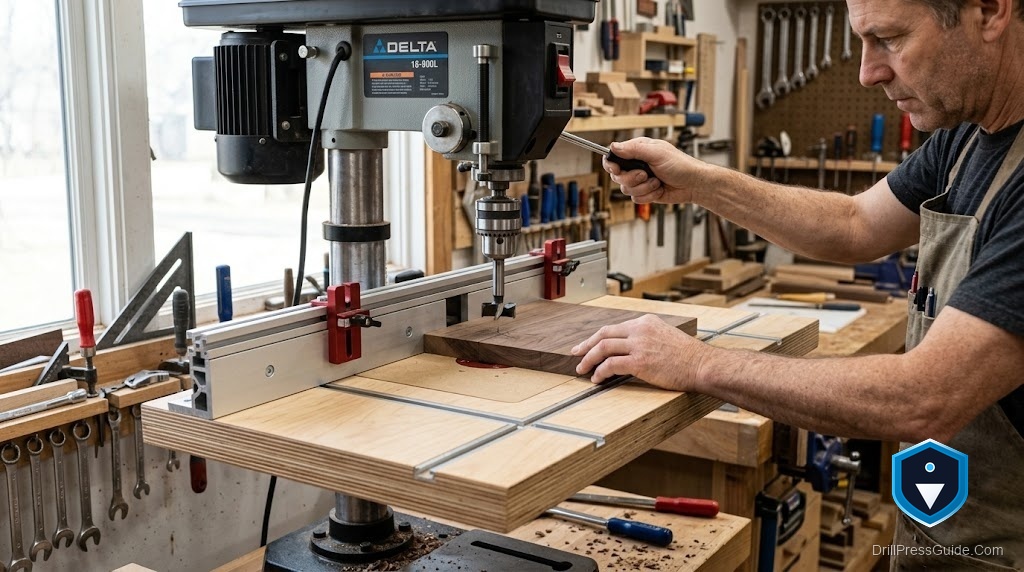
The stock table that came with my first drill press was a sad little cast-iron square with a hole in the middle and a slot that never quite lined up with anything. The first time I tried to drill a row of evenly spaced holes in a shelf, the board wandered, the bit grabbed near the end, and I spent more time chasing the workpiece than drilling it. That afternoon taught me what every serious drill-press owner eventually learns: the table and fence do half the work, and the stock ones rarely do it well.
A good drill press table gives you a flat, wide surface, T-tracks for clamping, a fence for repeatable alignment, and a replaceable insert so you stop drilling into metal. It is one of the highest-value upgrades you can make, and unlike the machine itself, it is something you can genuinely improve for a modest sum. Let me walk you through what matters, where the compromises hide, and which options actually earn their place.
Why the Stock Table Falls Short
Most factory tables are small, offer a single narrow slot, and force you to clamp awkwardly or not at all. Worse, when your bit breaks through the workpiece it plunges straight into cast iron, dulling the tip and leaving no support around the exit hole, which causes tear-out. A dedicated table solves both problems with a wide clamping surface and a sacrificial insert.
The fence is the other half of the story. Without one, every hole is a fresh guess. With one, you set a distance once and drill ten identical parts. A fence turns the drill press from a one-hole-at-a-time tool into something you can actually do repeatable work on.
What Makes a Great Drill Press Table
Start with the surface. You want it flat, wide enough to support long stock, and fitted with multiple T-tracks so you can position hold-down clamps and stops anywhere. The WEN drill press table with fence is a popular starting point because it combines an aluminum work surface, dual T-tracks, an adjustable fence, and a replaceable insert in one package that bolts onto most tables.
For a larger, more robust upgrade, the POWERTEC 14 x 24 inch drill press table offers a bigger footprint with a laminated MDF surface, an aluminum fence, and multiple tracks, which suits woodworkers handling wider panels. If you want maximum flatness and durability, a cast-iron style option like the VEVOR cast iron drill press table trades some clamping flexibility for rigidity and mass that dampens vibration.
The Fence: The Feature That Changes Everything
A fence is only as good as its adjustability. Look for one that locks square and stays put, ideally with its own T-track so you can add flip stops for repeatable hole spacing. An aluminum extruded fence resists warping better than a bare wood one, and a taller face supports tall workpieces standing on end.
If your current table is fine but you only need better alignment, a standalone fence like the POWERTEC drill press fence with T-track can retrofit onto many surfaces. Just confirm your mounting slots line up before buying, because a fence that will not attach to your table is nothing more than an expensive aluminum bar.
The Removable Insert Detail Everyone Forgets
The small square or round insert at the center of a good table is the unsung hero. It sits directly under the bit, takes the breakthrough damage, and pops out to be flipped or replaced when it wears. Without it, you drill into the table itself, ruining both the surface and your bit tips.
Before you buy, check that replacement inserts are available and inexpensive, or that the insert is a standard size you can cut yourself from hardwood or MDF. A table with a proprietary insert you cannot easily replace becomes frustrating the moment the first one wears out.
Fit and Compatibility Come First
Here is where people get burned. Not every table fits every drill press. The mounting holes on the underside must align with your existing cast-iron table, or you need a table that clamps around it. Measure your table’s dimensions and slot spacing before ordering, and confirm the new table does not extend so far that it hits the column or blocks the quill handle.
Height matters too. A thick tabletop raises your workpiece, which eats into the quill travel and the distance between the chuck and the table. On a benchtop press with limited travel, a tall table can leave you unable to drill through thicker stock, so factor that clearance into your decision.
Build It or Buy It
Plenty of woodworkers build their own table from plywood or MDF, and it is a genuinely satisfying weekend project that yields exactly the size and features you want. A shop-made table can include custom T-track placement, a dust port, and an insert sized to your bits. The tradeoff is time and the fussy work of getting everything flat and square.
A manufactured table saves that effort and usually arrives flatter than most of us can build. For anyone who would rather spend the weekend using the tool than building accessories for it, the ready-made options are worth the money. Neither choice is wrong; it comes down to whether you value the time or the customization more.
Verdict
If you want the single best all-around upgrade, the WEN table with fence covers the essentials at a fair price and fits a wide range of machines. Woodworkers handling bigger panels should look hard at the POWERTEC 14 x 24 for its larger surface, while anyone chasing rigidity and vibration control will appreciate a cast-iron option like the VEVOR. If your table is adequate and you only lack alignment, add a standalone POWERTEC fence and skip the rest. Whatever you choose, measure your machine first, confirm the insert is replaceable, and mind the height so you keep the quill travel you need.
- The stock table and missing fence are the biggest limits on drill press accuracy and repeatability.
- A great table has a flat wide surface, multiple T-tracks, an adjustable fence, and a replaceable insert.
- Always confirm mounting-hole and slot alignment before buying, and mind added table height eating quill travel.
- Buy a manufactured table for convenience and flatness, or build one for full customization.
FAQ
Do I really need a drill press table and fence upgrade? If you drill repeatable holes, work with wood, or clamp awkward parts, yes, the upgrade pays for itself quickly. The fence gives you repeatable alignment and the table gives you clamping and breakthrough support. For occasional single holes in metal, the stock table may be enough.
Will an aftermarket table fit my specific drill press? Often yes, but you must check. Measure your existing table size and slot spacing, then confirm the new table’s mounting method matches, whether it bolts through your slots or clamps around the table. Also verify it will not hit the column or block the handle.
How much quill travel will a new table cost me? A thicker tabletop raises the workpiece and reduces the usable distance between chuck and table. On benchtop presses with limited travel this can matter, so subtract the table thickness from your current clearance. If you drill thick stock, favor a thinner table.
What is the insert for, and why does it matter? The insert sits under the bit and absorbs breakthrough damage so you do not drill into the metal table. It supports the workpiece around the exit hole to reduce tear-out and can be flipped or replaced when worn. Confirm replacements are cheap or easy to make.
Should I build my own drill press table instead of buying one? Building your own gives you exactly the size, T-track layout, and features you want, and it is a rewarding project. Buying saves time and usually delivers a flatter surface than most home builds. Choose based on whether you value customization or convenience more.
Is a cast iron table better than aluminum or MDF? Cast iron offers superior rigidity and vibration damping, which helps with metalwork, but it is heavy and less flexible for clamping. Aluminum and MDF surfaces are lighter and easier to add T-tracks and inserts to. The best material depends on whether you prioritize mass or versatility.
Can I add just a fence without replacing the whole table? Yes, standalone fences exist and can retrofit onto many tables, giving you repeatable alignment without a full upgrade. The key is confirming the fence’s mounting slots line up with your table. If they do, it is an inexpensive way to gain most of the accuracy benefit.
References
- WEN Products official documentation and specifications
- POWERTEC tool manuals and product listings
- Fine Woodworking, drill press setup and jig articles
- Popular Woodworking, shop-made drill press table plans
- Manufacturer owner manuals for benchtop and floor drill presses


