Drilling a Bowling Ball on a Drill Press: The Jig That Makes It Safe
The first person who told me they drill bowling balls on a drill press got a skeptical look from me. A twelve-pound sphere, a spinning bit, and a machine designed to hold flat stock? It sounded like a recipe for a launched ball and a broken hand. Then I watched it done properly, with the right jig, and it clicked. The whole trick is a fixture that turns an impossible-to-hold sphere into a rock-solid, precisely angled workpiece. Get the jig right and it is safe and repeatable. Skip it and you are gambling.
Why a bowling ball fights you
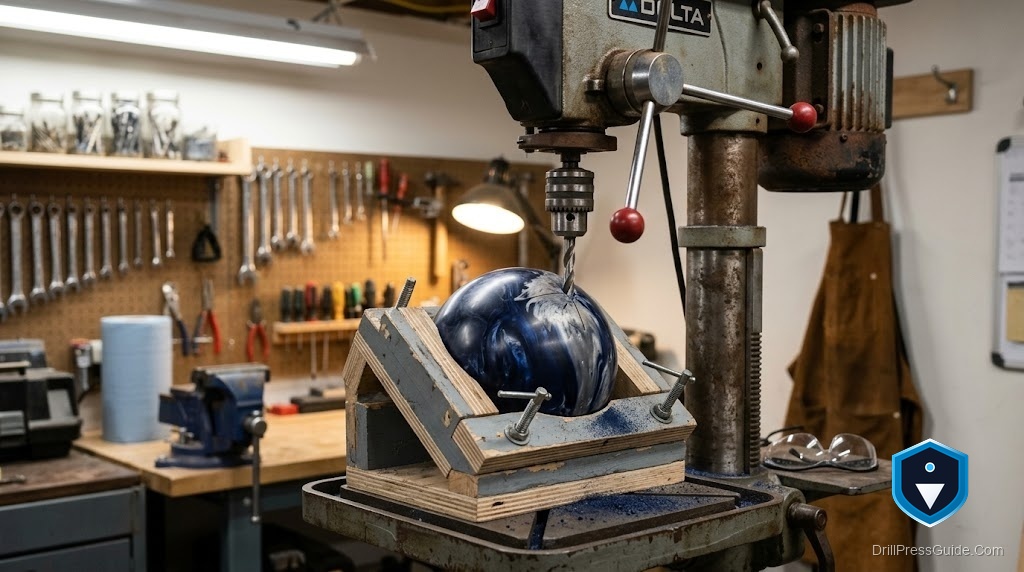
A bowling ball is the worst possible shape to hold under a drill. It is a smooth, heavy sphere that wants to rotate in every direction at once. The forces at a drill press only make it worse: as the bit bites, it tries to spin the ball, and if the ball is not locked down, it will grab, twist, and throw. That is the danger, and it is why you never, ever hold a ball by hand or in a simple vise. You need a cradle that captures the sphere from multiple contact points and lets you tilt it to precise angles, because the finger holes in a bowling ball are drilled at specific pitches, not straight down.
The pro solution and the home-shop reality
Professional pro shops use a dedicated jig with a rotating cradle, angle scales, and clamps. That is the ideal, and if you drill balls regularly, a purpose-built fixture is the right answer.
For occasional home use, an X-Y compound table gives you the precise, lockable positioning a sphere demands, and something like the Vevor compound slide table provides two-axis control and T-slots you can build a cradle onto. Pair it with proper cutters, and the Vacula bowling ball finger-hole bits are the kind of specialized cutters made for this job, sized for grip inserts and cutting cleanly through the coverstock without chipping.
But let me be honest about the home-shop version: a drill press works for drilling bowling balls only if you build or buy a genuine cradle. A flat table and a hand are not a substitute, no matter how careful you think you are.
How the job actually goes
With a proper jig, the process is methodical. You mark the ball’s layout based on the bowler’s span and pitch. You clamp the ball in the cradle, tilt it to the first hole’s angle, and lock every axis. You choose the correct bit diameter for the thumb or finger, set a depth stop so you do not drill through, and run the press at a slow speed to avoid melting the coverstock. Then you unlock, rotate to the next hole’s angle, re-lock, and repeat. Slow speed and a sharp bit keep the plastic from gumming, and clearing chips often keeps the hole clean.
Depth control matters enormously here. Bowling ball holes are blind holes, and a depth stop is what keeps you from punching through the far side. Set it, test it on the shallow side, and trust it.
The honest cautions
This is a specialized job, and I will not pretend a drill press is the ideal machine for it. The flaws are real. Most drill press tables are not designed to hold a sphere, so the jig is doing all the work, and a poorly built jig is worse than no jig. Coverstock plastic melts if you run too fast, leaving a rough hole. And a ball that shifts even slightly mid-cut ruins the layout and endangers you. If you are fitting an expensive ball for serious play, a pro shop’s dedicated equipment will do a cleaner, more accurate job than a drill press ever will. For a spare ball, a practice ball, or learning the craft, a well-jigged drill press is a reasonable path.
Safety comes first, always
Eye protection is mandatory, because coverstock chips fly. Clamp the ball at multiple points and confirm nothing moves before the bit touches it. Keep your hands entirely clear of the cutter. Run slow, feed gently, and never force the bit. And if the ball so much as twitches in the cradle, stop and re-clamp. A launched bowling ball is a genuine hazard, and no hole is worth an injury.
Verdict
Drilling a bowling ball on a drill press is entirely doable, but the machine is almost beside the point. The jig is everything. With a real cradle that captures the sphere and lets you lock precise angles, plus the right bits and a slow speed, you get clean, safe, repeatable holes. Without that fixture, do not attempt it, and for high-stakes fitting, let a pro shop handle it.
- A bowling ball must be held in a multi-point cradle that locks precise angles, never by hand.
- An X-Y compound table gives the lockable two-axis positioning a sphere demands.
- Use specialized finger-hole bits, a slow speed, and a depth stop for clean blind holes.
- For serious league equipment, a pro shop beats a drill press; reserve the DIY route for practice balls.
FAQ
Can you drill a bowling ball on a drill press? Yes, but only with a proper cradle jig that captures the sphere from multiple points and lets you lock precise angles. A flat table and freehand holding are dangerous and will not produce accurate holes.
Why is holding a bowling ball by hand so dangerous? A bowling ball is a heavy, smooth sphere that the bit tries to spin as it cuts. Without a locking jig, the ball can grab, twist, and launch, risking serious injury to your hand.
What bits do I need to drill finger holes? Specialized bowling ball bits sized for thumb and finger holes or grip inserts cut the coverstock cleanly without chipping. Standard wood or metal bits tend to grab and melt the plastic.
What speed should I use for drilling a bowling ball? A slow speed is best, because the coverstock plastic melts and gums up at high RPM. Slow speed plus a sharp bit and frequent chip clearing keeps the hole clean.
How do I keep from drilling through the ball? Use a depth stop on the drill press. Bowling ball holes are blind holes, so set and test the depth stop before drilling to avoid punching through the far side.
Do I really need an X-Y table, or can I use a fixed cradle? Either works if it locks the ball securely and sets accurate angles. An X-Y compound table adds fine two-axis positioning, while a dedicated rotating cradle is what pro shops use for repeatable layouts.
Should I just take it to a pro shop instead? For an expensive ball fitted to your exact span and pitch, a pro shop’s dedicated equipment is more accurate and cleaner. A well-jigged drill press is fine for practice balls, spares, or learning the craft.
References
- United States Bowling Congress, equipment specifications and drilling guidance, bowl.com
- Vevor, compound slide table specifications, vevor.com
- Occupational Safety and Health Administration, drill press and workholding safety, osha.gov
- Popular Mechanics, workholding and drill press technique guidance, popularmechanics.com