
Adding a Milling Table to a Drill Press: What You Can and Cannot Do
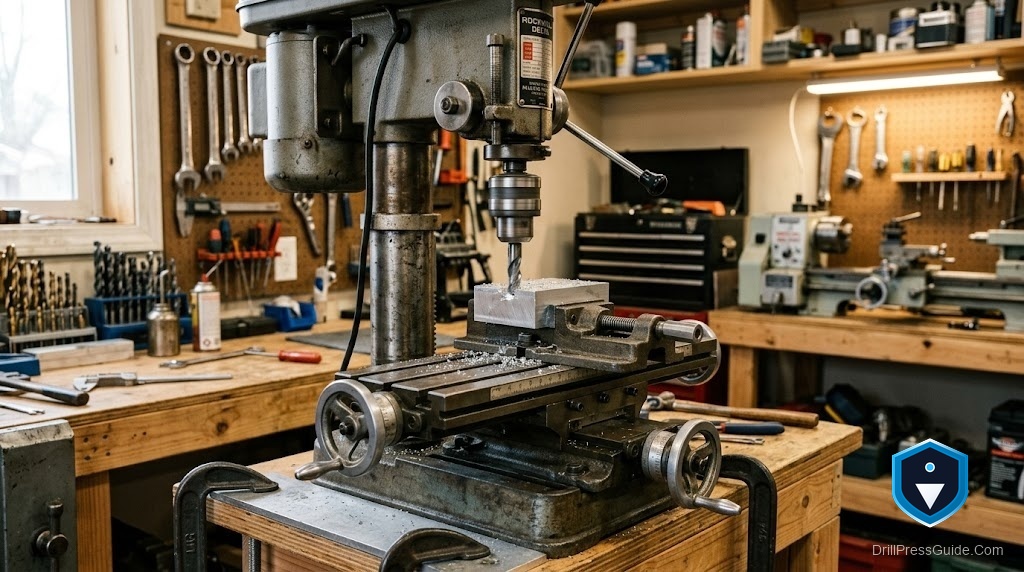
Every few weeks someone in a forum asks the same hopeful question: can I bolt a milling table to my drill press and start milling metal? I understand the temptation completely. You already own the drill press, an X-Y milling table is inexpensive, and the idea of cutting slots and pockets without buying a milling machine is genuinely appealing. So let me give you the straight answer, because getting this wrong can hurt you and wreck your machine.
What a milling table actually adds
A milling table, also called an X-Y table or a compound cross slide, is a metal platform with two handwheels that move the top precisely along two axes. Bolt it to your drill press table, clamp a workpiece to it, and you can position that workpiece with fine, repeatable control in both X and Y. For drilling, this is legitimately useful. You can lay out a grid of holes, drill one, then dial the table to the next location without re-clamping or re-marking.
The Proxxon KT 70 compound table is a popular small option for exactly this kind of precise hole positioning on light work, and a larger unit like the Grizzly compound cross slide table gives more travel and a heavier casting for bigger workpieces.
The hard truth about milling on a drill press
Here is where I have to be honest with you, because your safety depends on it. A drill press is not a milling machine, and adding an X-Y table does not make it one. The reason is the spindle and its bearings.
A drill press spindle is built for axial load, meaning downward thrust along the axis of the bit. Its bearings and its Morse taper are designed to resist push, not sideways force. Milling generates heavy lateral load, the cutter pushing sideways against the work. Feed a drill press into a side-cutting operation and three bad things happen. The spindle bearings, never meant for radial load, wear out fast. The chuck, which sits on a friction taper, can work loose and drop, because side load is exactly what unseats a taper-mounted chuck. And a standard drill bit or an unsupported end mill can grab, climb, and throw the workpiece or shatter.
So the honest verdict is this: an X-Y table on a drill press is an excellent precision drilling and hole-positioning accessory. It is not a safe platform for real milling. Light, careful edge-touching on soft material like plastic or aluminum with a proper end mill holder is the absolute ceiling, and even that shortens your bearings’ life.
If you still want to try light work
If you accept the risks and only want gentle, occasional work, minimize the danger. Never hold a milling cutter in a standard drill chuck, because a Jacobs taper will release under side load; use a collet system that draws the cutter in positively. Take microscopic cuts. Climb-milling and deep passes are how people get hurt, so keep cuts shallow and feed slowly. Clamp everything to the table with real hold-downs, never a hand. And accept that you are trading spindle life for convenience.
A smaller table like the Vevor 2-axis compound slide table can work for this kind of light positioning and gentle touch-up, but treat its milling capability as marginal, not a feature to rely on.
Where the money is better spent
If your real goal is precise, repeatable holes, an X-Y table is money well spent and I recommend it without reservation. If your real goal is milling slots, pockets, and profiles in metal, the honest advice is to save toward an entry-level milling machine or a mill-drill. A drill press with a milling table will disappoint you at true milling and cost you a spindle rebuild in the process. Matching the tool to the job saves money in the long run, even when it costs more up front.
Verdict
A milling table transforms a drill press into a precise hole-positioning machine, and for that job it is superb. As an actual milling setup it is a compromise that stresses bearings never designed for side load and risks a chuck letting go mid-cut. Buy one to drill accurate patterns, not to mill, and your machine and your fingers will both last longer.
- An X-Y milling table is excellent for precise, repeatable hole positioning on a drill press.
- A drill press spindle handles downward thrust, not the sideways load that milling creates.
- A taper-mounted chuck can work loose under side load, so real milling is genuinely risky.
- For true milling of metal, save toward a mill-drill or milling machine instead.
FAQ
Can I use a milling table on my drill press? Yes, as a precision hole-positioning accessory. An X-Y milling table lets you dial in exact hole locations in two axes. Just do not treat it as a license to mill, since the spindle is not built for side load.
Why is milling on a drill press considered unsafe? A drill press spindle and its bearings are designed for downward thrust, not the lateral force milling creates. Side load wears the bearings quickly and can unseat a taper-mounted chuck, dropping the cutter mid-cut.
What is the difference between a milling table and a milling machine? A milling table is just the X-Y platform that positions the workpiece. A milling machine adds a rigid spindle and bearings engineered for side-cutting loads, which a drill press does not have.
Can I mill aluminum on a drill press with an X-Y table? Only the lightest touch-up work, with a collet holding the cutter, tiny cuts, and everything clamped down. Even then you are shortening spindle life, so it is a compromise, not a real capability.
Why can’t I hold an end mill in my drill chuck for milling? A drill chuck sits on a friction taper meant for axial load. Side force from milling can pull the chuck off the taper, so a positive-locking collet system is essential if you attempt any side cutting.
What should I look for in an X-Y table for drilling? Look for smooth handwheels with minimal backlash, clear travel markings, T-slots for clamping, and a base that matches your drill press table size. Travel range should suit the largest hole pattern you drill.
Is it cheaper to add a milling table or buy a mill? A milling table is far cheaper up front, and it is the right buy for precise drilling. If you truly need to mill, an entry-level mill-drill costs more but saves you from a ruined spindle and disappointing results.
References
- Proxxon, KT 70 compound table specifications, proxxon.com
- Grizzly Industrial, compound cross slide table documentation, grizzly.com
- Machinery’s Handbook, spindle load and milling force reference, Industrial Press
- Occupational Safety and Health Administration, machine guarding and milling safety, osha.gov


