
Getting Better Results from a Drill Press Stand
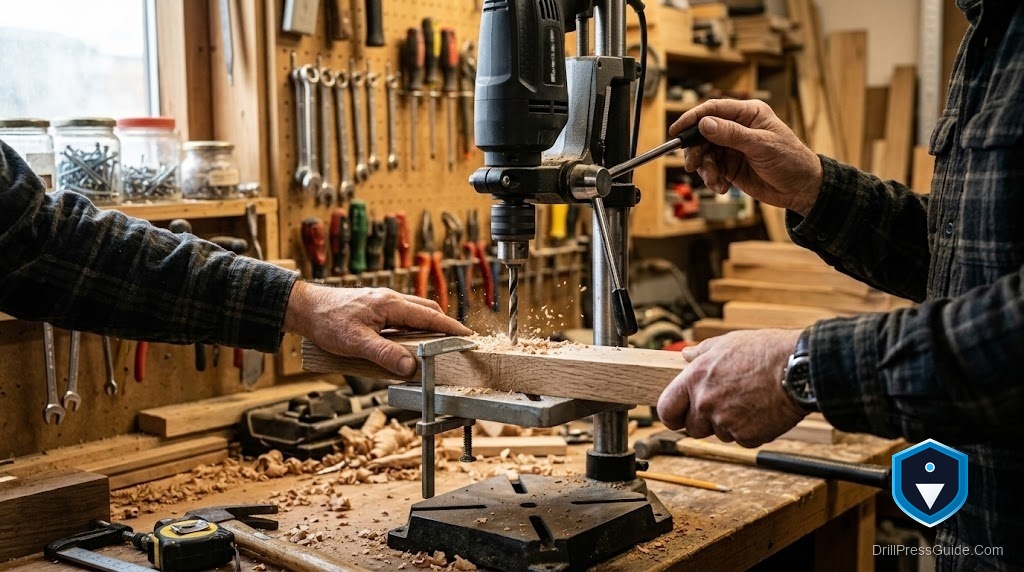
For years I chased hole accuracy the hard way, with a hand drill and a lot of hope. Then I set up a proper drill press stand, clamped a scrap block, and drilled ten holes that were actually perpendicular and actually where I wanted them. That was the day I understood that most of my “bad drilling” was never a skill problem. It was a rigidity problem. The stand, the column, the whole structure holding the spindle steady, does the work your wrist cannot.
So let me help you get more out of a drill press stand, whether you are buying your first one or trying to figure out why your current setup drifts.
Know which “stand” you are actually talking about
The phrase drill press stand gets used three ways, and mixing them up leads to bad purchases.
First, there is the stand as the structure of the machine itself: the base, the column, the head. On a benchtop drill press stand this column is short and bolts to a bench. On a floor standing drill press stand the column runs to the floor and gives you room for tall work. Second, there is a separate drill press stand for a portable drill, a frame that holds a hand drill and pushes it down a guided axis. Third, some people mean an accessory table stand that a benchtop machine sits on. When you shop, be clear which one you need, because a drill press stand for a drill is not the same tool as a floor machine.
The specs that decide your results
Here is what actually governs the quality of your holes.
Swing is the headline number, the distance from the spindle centerline to the column, doubled. It tells you how wide a piece you can reach the center of. A benchtop machine with modest swing is fine for most work, but if you drill the middle of wide panels, you want more.
Spindle travel, sometimes called quill travel, is the one people forget and regret. It is how deep the quill plunges in a single pull. Short travel means you cannot drill a deep hole or clear a 4x4 in one stroke. A floor machine like the WEN floor standing drill press offers generous spindle travel and a twelve-speed range specifically so you can push through thick stock and a wide RPM band without a fight.
Speed control matters more than horsepower for most people. An induction motor runs quieter and smoother than a universal motor, and variable speed or a wide range of belt speeds lets you match RPM to the material. A digital speed readout is a genuine convenience if you switch materials often, though plenty of excellent machines still use belts and a chart.
The extras: useful, and the ones that are just marketing
Some features earn their keep. A depth stop is essential the moment you drill blind holes or want consistent depth across a batch. A work light saves your eyes. A solid work table that tilts lets you drill angles without jigs. A keyed chuck with a decent chuck capacity, driven by a chuck key, holds bits far more securely than the cheap keyless chucks on bargain units, and most quality machines use an MT2 spindle taper so you can swap the chuck later.
Some features are mostly show. A laser guide sounds great and is nice for rough alignment, but it will not deliver a precise hole on its own, and I have never trusted one over a center punch. Treat it as a bonus, not a reason to buy.
Where cheaper stands disappoint
The honest flaws cluster in predictable places. Runout, the wobble of the spindle and chuck, is the silent killer on budget units, and it shows up as oversized, ragged holes. Thin columns flex under side load. And the quill return spring and depth stop on inexpensive machines can feel gritty or slip out of adjustment.
A compact, well-made benchtop unit like the WEN variable speed benchtop drill press sidesteps most of that at the small end, with a cast structure and a speed range that suits a home shop. Step up in size and the Genesis floor drill press gives you a table that rotates and tilts and an induction motor for smoother running. Neither is a machinist’s dream, but both are honest tools that hold a bit steady, which is the entire job.
Getting more from the stand you already own
You do not always need to buy. Most drift comes from setup. Clamp the work rather than holding it. Set the table square to the bit with a rod and a small square. Match your speed to the material, slower for metal and large bits, faster for small bits in wood. Keep the point of operation clear and never reach past the rotating chuck. And clear chips with a brush, not your fingers, because a fresh cut throws hot debris. A little discipline here beats a lot of new hardware.
Verdict
A drill press stand is really a rigidity machine, and rigidity plus the right speed is what makes clean, square, repeatable holes. Buy for spindle travel and a steady spindle before you get seduced by a laser or a digital readout, and match the size of the stand to the work you actually do.
- Decide which kind of stand you need: a full machine, a portable drill guide, or a table stand.
- Prioritize spindle travel and low spindle runout over flashy extras.
- An induction motor and a wide speed range beat raw horsepower for real-world results.
- A depth stop, a keyed chuck, and a tilting table are the features you will use every session.
FAQ
What is the difference between a drill press stand and the drill press itself? A drill press stand can mean the column and base that hold the spindle, a separate frame for a hand drill, or a table stand a benchtop machine sits on. When shopping, be specific, because a drill press stand for a drill is not the same as a complete machine.
Is a benchtop drill press stand good enough, or do I need floor standing? A benchtop drill press stand handles most home and hobby work. Choose a floor standing drill press stand when you drill tall pieces or need more swing and spindle travel than a short column allows.
Does a drill press stand for a portable drill actually work? A drill press stand for a drill or a drill press stand for a portable drill improves accuracy over freehand drilling, but it cannot match the rigidity of a dedicated machine. It is a solid choice when space or budget rules out a full press.
What spec matters most for clean holes? Low spindle runout and adequate spindle travel matter most. A steady spindle drills a round, accurately sized hole, while enough quill travel lets you finish a deep hole in one stroke.
Are the laser guide and digital speed readout worth it? A digital speed readout is a real convenience if you change materials often. A laser guide is handy for rough alignment only, so do not let it drive your decision. A center punch is still more reliable.
What should I know about the chuck and spindle taper? Look for a keyed chuck with a chuck key and a chuck capacity that fits your largest bit. Most quality machines use an MT2 spindle taper, which lets you replace the chuck later if you need to.
How do I stay safe at a drill press stand? Clamp the workpiece, wear eye protection, and keep hands clear of the point of operation and the rotating chuck. Match speed to material, use the depth stop for consistency, and brush away chips rather than touching them.
References
- WEN Products, floor standing and benchtop drill press specifications, wenproducts.com
- Genesis Power Tools, drill press motor and table specifications, genesispowertools.com
- Occupational Safety and Health Administration, drill press and machine guarding guidance, osha.gov
- Popular Mechanics, drill press speed and technique guidance, popularmechanics.com


