
Drill Press Table: What to Measure Before You Buy
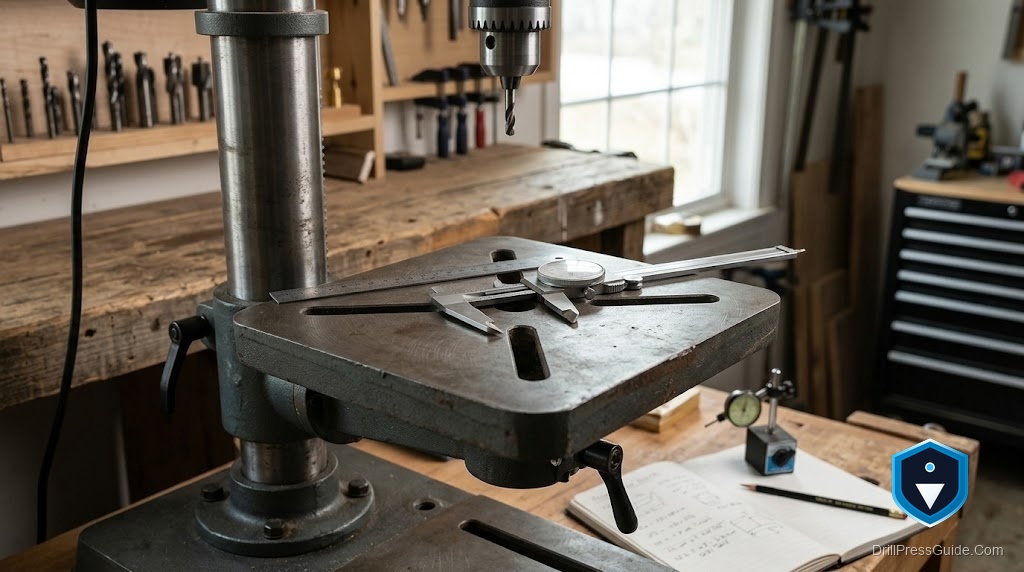
I bought my first upgrade table in a hurry and learned an expensive lesson: it did not clear the column. The back edge hit the post before the front edge sat where I wanted it, and no amount of wishing fixed the geometry. That is the thing nobody tells you about a drill press table. The table is the easy part. The measurements around it are what decide whether the thing works or becomes a shelf ornament.
So before you buy, grab a tape measure and spend five minutes with your machine. It will save you a return and a bad afternoon.
Measure your column clearance first
Set your existing table where you normally drill, then measure from the center of the chuck straight back to the column. That distance is your hard limit. Any aftermarket top has to fit between the bit and the post without the back edge fouling the column. A lot of drill press tables are sold as one-size-fits-all, and they mostly are, but a deep top on a small benchtop machine can crowd the column and shrink your usable area.
While you are there, note the size of your factory table and its table insert or center hole. You want the new top’s removable insert to sit over your bit so you can drill through-holes without chewing up the surface.
The features that actually earn their place
Here is what separates a table that gets used daily from one that frustrates you.
An MDF table is the standard body material for good reason. It is flat, cheap to replace, and forgiving when your bit breaks through. A sturdy one-inch MDF top resists warping and wobbling far better than thin stock. The WEN drill press table with an adjustable fence and stop block is a clean example of the type, built around a thick MDF body sized to fit the common bench machines.
The adjustable fence is the feature you will touch most. A sliding fence with a left stop and a right stop, plus onboard rulers, turns repeat drilling into a two-second setup instead of a re-measure every time. A good stop block clamped to the fence lets you drill a row of evenly spaced holes without marking each one.
The removable insert matters more than people expect. When it wears out or you drill a big hole through it, you pop it out and flip or replace it rather than resurfacing the whole top. That single feature is why a laminated top lasts years.
Fence and track systems
If your work leans toward woodworking, look hard at T-track. A top with tracks accepts a hold-down clamp anywhere along its length, and that is the honest secret to clean holes: the workpiece cannot creep. The POWERTEC drill press table with a T-track fence system leans into this, pairing a laser-etched sliding fence with hold-down clamps and flip stops. It fits tables of a certain size or larger, so confirm your factory table is big enough to mount it before you commit.
For metalworkers, a different path makes sense. A magnetic drill press table accessory, like the Magswitch drill press fence with a stop block, clamps to a steel table with on-off magnets and repositions in seconds. It is not for a wooden or MDF surface, but on a steel table it is genuinely quick.
What about an X-Y table for a drill press?
An x-y table for drill press work is a different animal from a flat top. Instead of enlarging your surface, it lets you move the workpiece precisely along two axes. It is wonderful for spaced hole patterns and poor as a general work surface, because it is small and tall. Most people who think they want an X-Y table actually want a good fence and a stop block. Buy the X-Y table only if precise repeatable coordinates are the whole reason you are shopping.
Bench versus a full setup
A bench drill press table, a compact MDF top with a short fence, is plenty for a small shop. If you have space and do production-style work, a larger top with a drill press table stand or a dedicated table stand gives you more support for long boards. The universal versions, like the VEVOR drill press table with an adjustable fence and stop block, advertise wide T-slot compatibility and a built-in scale, which is handy if you own an oddball machine.
Whatever you choose, remember the humble things: proper workpiece support so long stock does not tip, a drill press table vise or clamps for anything round, and a top you are not afraid to drill into.
The flaws worth knowing
No upgrade top is perfect. Clamp-on mounting can loosen under vibration, and more than one owner ends up adding tape or an extra bracket to keep the table from shifting on the factory surface. Onboard rulers drift out of true if the fence racks. And a big top on a small machine can make the whole assembly top-heavy. None of these are dealbreakers, but they are the reasons to measure and mount carefully rather than trusting the marketing photo.
Verdict
A drill press table is the cheapest way to make a mediocre machine feel precise, but only if the measurements line up. Spend the five minutes with a tape measure and buy for your column clearance and factory table size, not for the biggest top you can find.
- Measure column clearance and factory table size before buying anything.
- An adjustable fence with a stop block and onboard rulers is the feature you will use most.
- A removable insert and a thick MDF body are what make a top last.
- Choose T-track for wood, magnetic fences for steel, and an X-Y table only for precise hole patterns.
FAQ
How do I know a drill press table will fit my machine? Measure your column clearance, the center of the chuck to the post, and the size of your factory table. Many drill press tables mount to tables of a minimum size or larger, so confirm both numbers before you buy.
Is an MDF table good enough, or should I get something tougher? A thick MDF table is the practical standard. It stays flat, absorbs the shock of breakthrough, and is cheap to replace. The wobbling and warping people complain about usually comes from thin stock, not from MDF itself.
What is the point of an x-y table for a drill press? An x-y table for drill press work moves the workpiece along two axes for precise, repeatable hole locations. It is superb for patterns and poor as a general surface because it is small and tall.
Do I need a drill press table stand? A drill press table stand or table stand helps only if you handle long boards that need extra workpiece support. For a small shop, a compact bench drill press table with a fence is usually enough.
How do drill press table clamps and a fence work together? The adjustable fence sets the position across the table, while drill press table clamps or a hold-down clamp lock the workpiece down so it cannot creep. Together with a stop block, they make repeat holes fast and consistent.
Can I use a drill press table vise on the new top? Yes. A drill press table vise bolts to the T-track or through the top’s holes, giving you secure clamping for round or irregular parts that a fence alone cannot hold.
What about a mini drill press table or a magnetic drill press table? A mini drill press table suits small benchtop machines with limited travel. A magnetic drill press table accessory clamps to a steel surface with on-off magnets and repositions instantly, but it will not work on wood or MDF.
References
- WEN Products, drill press table specifications and fit notes, wenproducts.com
- POWERTEC, 71539 drill press table and fence system documentation, powertecproducts.com
- VEVOR, drill press table T-slot and capacity specifications, vevor.com
- Fine Woodworking, drill press table and fence jig guidance, finewoodworking.com


