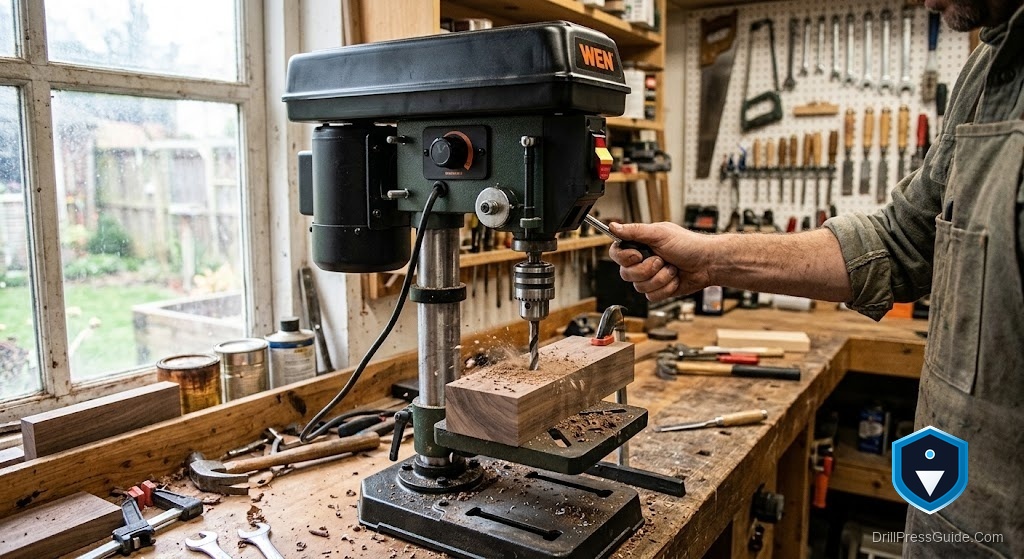
Convert a Drill Press Spindle to an MT2 Spindle: Diagnose the Fit Before Replacing Anything
You found a great deal on an MT2 chuck and a set of MT2 collets, and now you want your press to run them. Before you buy anything else, stop and check one thing, because the plan to convert a drill press spindle to an MT2 spindle fails most often for a reason people discover only after the parts show up: their spindle was never going to accept a Morse taper in the first place.
Here is the honest version. “Converting” a spindle to MT2 is usually not a conversion at all. It is either swapping a removable arbor, or accepting that your spindle uses a fixed Jacobs taper that cannot take an MT2 tool. Diagnose which machine you own first, and you will save yourself money and a returned box.
What MT2 is and what it is not
MT2 means Morse Taper number 2, a self-holding tapered shank that seats directly into a matching MT2 socket. A true MT2 spindle has that female socket bored into the quill, so an MT2 arbor, chuck, or drill shank slides straight in and locks by friction. Many mid-size and floor drill presses are built this way.
A Jacobs taper (like JT33) is different. It is a short external taper on the spindle nose that a chuck grips. It is not a socket, and it will not receive an MT2 shank. Plenty of benchtop presses, including the common Shop Fox W1668, use an integral JT33 nose with no internal Morse taper at all.
The direct answer
If your quill already has an MT2 socket, you do not convert anything. You drift out whatever arbor is in there now and drop in an MT2 tool. If your spindle has a fixed JT33 nose, you cannot make it accept an MT2 shank without replacing the spindle assembly itself, because there is no socket to convert. The middle path, for a press whose quill takes MT2 but whose chuck is JT33, is to fit an MT2 arbor that ends in a Jacobs taper for the chuck.
Step one: diagnose your spindle before you buy
Find your model number and serial number, then pull up your manual and read the spindle section. This tells you the taper faster than any guessing.
Now inspect the machine with the chuck removed. Two questions:
Does the quill have a socket? Look up into the quill after the chuck and any arbor are out. A bored tapered hole means you likely have a Morse-taper spindle. A solid nose with an external taper means Jacobs, and no MT2 tool will fit.
Is there a drift slot? An elongated hole (the spindle access window) through the quill signals a removable Morse-taper arbor you can drive out with a taper drift. No slot usually means an integral taper.
Do this before ordering. A W1668, for example, has the integral JT33 nose, so an MT2 arbor has nothing to seat into.
Path A: your quill already takes MT2
This is the easy case. Remove the current chuck and arbor, clean the MT2 socket until it is spotless and dry, and seat your MT2 tool with one firm push. To run a chuck, use an MT2 arbor that carries a Jacobs taper on the business end, then mount the chuck on that. A hardened, ground MT2 to JT33 drill chuck arbor with tang end is the standard bridge piece, and the tang lets you drift it back out later.
If you would rather skip the two-piece stack, an all-in-one MT2 keyed drill chuck with a Morse Taper 2 shank seats straight into the socket and grips bits up to 5/8 inch. One flaw to plan for: a bare Morse taper has no drawbar on most drill presses, so heavy side load or a grabby bit can drop the tool. Seat it clean and dry, and reseat it if it ever feels loose.
Path B: your spindle is a fixed Jacobs taper
If the nose is integral JT33, there is no socket to convert, full stop. You have three real options.
Keep the JT33 setup and just upgrade the chuck, which fixes most grip and runout complaints without any conversion. Replace the entire spindle with one bored for a Morse taper, if your press even offers that part, which is a real teardown of the quill assembly. Or accept the machine’s limits and buy a different press for MT2 work. Do not let a forum post talk you into forcing an MT2 arbor against a nose that cannot hold it.
Keyed or keyless: pick before you commit
Since you are changing tooling anyway, choose the chuck style that fits your work. A keyed chuck grips harder and slips less under torque, which matters for larger bits and metal. A keyless chuck lets you swap bits fast by hand, which is great for wood and repetitive drilling but can loosen under heavy load or reverse. For an MT2 drill press doing mixed duty, keyed is the safer default, and a keyless is a fine second chuck for speed.
Seating and safety that people skip
Morse tapers hold by friction, so cleanliness is everything. Wipe the shank and the socket with a dry rag, remove every trace of oil, chips, and rust, then seat with one confident push or a light tap using a wood block. Never seat a taper by running the motor down into the table.
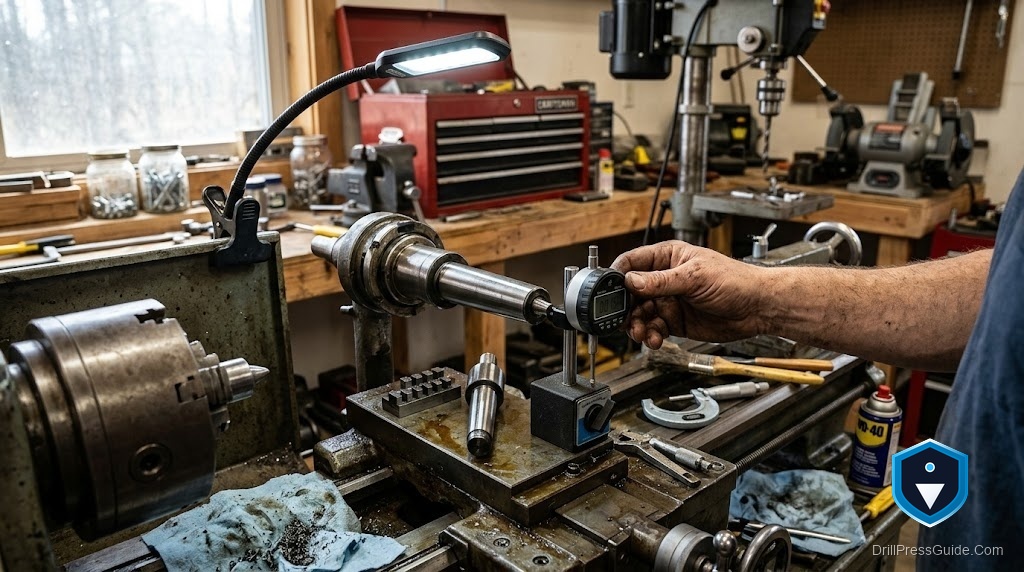
Check that the tool runs true by spinning the spindle by hand with an indicator. If it wobbles, the taper is dirty or nicked, not properly converted. And keep speed sane: match your RPM to the bit and material using the speed chart, since a poorly seated taper plus high speed is how tools launch.
A quick reality check on brands and models
Model numbers matter more than badges here. A benchtop Shop Fox W1668 is integral JT33 and will not convert, while larger floor presses across brands often ship with MT2 sockets from the factory. If you own a different Shop Fox, a Grizzly, or a JET, do not assume it matches a friend’s machine or a number like a W1670 you saw online. Read your own spindle spec. The wrong assumption is what fills return bins with unused MT2 arbors.
Conclusion
Converting to MT2 is really a diagnosis problem, not a parts problem, and the machine decides what is possible.
- Confirm whether your quill has an MT2 socket before buying a single tool.
- A fixed JT33 nose cannot accept an MT2 shank, so upgrade the chuck instead or change machines.
- If you do have MT2, use a clean, dry taper and an MT2 to JT33 arbor to run a chuck.
- Remember there is no drawbar on most presses, so seat tapers well and reseat if they loosen.
FAQ
Can every drill press be converted to MT2? No. Only a press whose quill has a Morse-taper socket can run MT2 tools. A press with an integral Jacobs taper nose, like the Shop Fox W1668, has no socket to accept an MT2 shank and cannot be converted without replacing the spindle.
How do I tell if my spindle is MT2 or JT33? Check your model and serial number against the manual, then remove the chuck and look. A bored tapered socket in the quill points to a Morse taper, while a smooth external taper on the nose is a Jacobs taper that only grips a chuck.
What is an MT2 to JT33 arbor for? It bridges a Morse-taper socket to a Jacobs-taper chuck. The MT2 end seats in the quill, and the JT33 end holds a standard drill chuck, so you can run your existing chuck on an MT2 spindle.
Do I need a drawbar for an MT2 drill press spindle? Most drill presses hold the taper by friction alone with no drawbar. That is fine for normal drilling, but side loads or grabby cuts can drop the tool, so seat it clean and reseat it if it works loose.
Should I get a keyed or keyless MT2 chuck? Keyed chucks grip harder and resist slipping under torque, which suits metal and larger bits. Keyless chucks trade some grip for fast hand changes, which suits wood. For mixed work, keyed is the safer main chuck.
Will an MT2 arbor fit a Shop Fox W1668? No. The W1668 uses an integral JT33 spindle nose with no Morse-taper socket, so an MT2 arbor has nothing to seat into. On that machine, upgrade the JT33 chuck instead.
Why does my MT2 tool keep falling out? Almost always a dirty or oily taper, or a nick on the shank or socket. Clean both surfaces bone dry, remove any burrs, and seat with a firm tap on a wood block. If it still drops, check the taper for damage.
References
- Shop Fox W1668 Owner’s Manual and Spindle Specifications, Grizzly Industrial: https://cdn0.grizzly.com/manuals/w1668_m.pdf
- Shop Fox W1668 Parts List, Grizzly Industrial: https://cdn0.grizzly.com/partslists/w1668_pl.pdf
- JET DCA-233 MT-2 x JT-33 Drill Chuck Arbor Specifications: https://jettools.com/mt-2-x-jt-33-drill-chuck-arbor
- Jacobs Chuck Manufacturing, Mounting and Removing Chucks: http://www.jacobschuck.com/uploads/ueditor/file/20200604/1591240204146153.pdf