A Practical Guide to Convert Central Machinery Drill Press to DC Motor
Your Central Machinery drill press bogs down in steel, the lowest belt speed is still too fast, and you are tired of moving the belt every time the job changes. That is usually the moment people decide to convert a Central Machinery drill press to DC motor power. Done right, you get a wide speed range from one knob and real torque down low. Done wrong, you get a screaming motor, a cooked controller, or a spindle that stalls the second it touches metal.
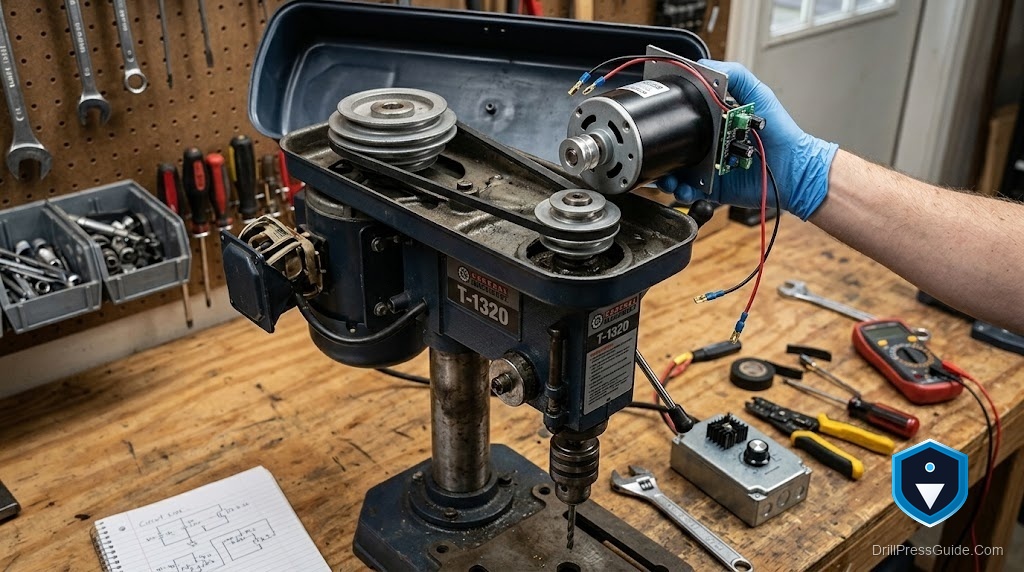
A DC conversion means pulling the original single-phase AC induction motor and driving the same belt and pulley with a permanent-magnet DC motor, usually a treadmill motor, fed by a matching DC speed controller. You keep the whole mechanical head. You change only what spins the pulley and how you control it.
Here is the direct answer. Yes, it works well on these machines, and it is one of the better upgrades for low-speed torque. The catch is matching three things: the motor voltage and horsepower, a controller rated for that exact motor, and a pulley reduction that keeps the spindle in a usable RPM band. Get those right and you drill steel slowly without touching the belt. Get them wrong and the controller pays for it.
Know your machine before you buy a motor
Different Central Machinery presses need different motors and mounts, so read your plate first.
- Central Machinery item 38142 (13 inch bench): 3/4 HP, 16 speeds from 240 to 3600 RPM, 120VAC 60Hz 7.5A single-phase, chuck capacity 7/64 inch to 5/8 inch, quill stroke about 3-1/8 inch, roughly 125 lb.
- T-583 (16 inch floor): 1 HP, 16 speeds from 170 to 3800 RPM, a number 2 Morse taper spindle nose, about 3 inch quill travel, and a 1 HP 120/240V single-phase motor.
Write down the model number, serial number, and manufacture date from the plate. Whether your plate reads KA682, the machine is the model 34231, a 20 inch swing 1-1/2 HP floor unit, an 8 inch benchtop, or a small 10 inch, the plate tells you the motor frame and the mounting you have to match.
Why people convert (and the smoking-motor question)
The real reasons are low-speed torque, one-knob speed control, and an easy reverse option for tapping.
If your Central Machinery drill press motor is smoking, rule out a shorted start capacitor or a seized bearing before you condemn the motor. A smoking AC motor is often a failed cap, not a dead winding, and a capacitor is a fast, inexpensive swap. Convert because you want variable speed and torque, not only because the old motor let go.
Pick the DC motor
Treadmill permanent-magnet DC motors are the usual donor because they are powerful and easy to find used. Two rules save you here:
- Read the continuous duty rating, not the peak number on the sticker. A “2.5 HP” treadmill motor is often around 1 to 1.5 HP continuous, which matches a 3/4 to 1 HP press nicely.
- Check base RPM. Treadmill motors spin fast at full voltage, so you keep the belt reduction to bring the spindle down into a sane range instead of overspinning it.
Match the controller to the motor
The controller has to suit the motor type and voltage, not just the horsepower. KBIC-series DC drives are a known-good match for permanent-magnet and shunt-wound DC motors up to about 3 HP with a heat sink. A unit like the KB Electronics KBIC-225 DC motor control covers the 1/50 to 1.5 HP band these conversions live in and takes a standard speed potentiometer, so you get a clean control knob without reinventing the wiring.
Skip the treadmill’s original control board unless you fully understand it. Many of those boards float the potentiometer leads near mains voltage, which is a real shock hazard on an open bench.
Keep the belt and pulley
You do not throw away the drive train. Keep the spindle pulley and the V-belt, and resize or replace the motor pulley to fit the new motor shaft. Read the belt code printed on the side and buy the same section; an M-section V-belt is common on these heads. The pulley nut and spindle shaft stay as they are. You are changing the prime mover, not the quill.
Mounting and wiring
Build a motor bracket that still lets you slide the motor to tension the belt. Keep a no-volt (magnetic) switch in the switch box so the press will not restart on its own after a power blip, which matters more once a torquey DC motor is involved. Fuse the DC side, and wire polarity so a reverse switch actually reverses cleanly.
Keep the mechanicals honest while you are in there
If the quill needs attention during the swap, the quill return spring sits under the quill spring cap. Unwind it slowly, because it is under real tension and will bite you if it gets away. A stuck arbor comes out with a wedge drift. Check the table support, the arm with scale, and the column rack for slop, and reseat the drill-press chuck on a clean, dry taper so it does not run out.
When a conversion is the wrong call
If your real goal is milling, and you are searching how to convert a T-583 to milling duty, understand that a drill press quill is not built for side load. A DC motor does not fix that. Side pressure from an end mill wears the quill and bearings fast, and the chuck can shake loose. For real milling you want a machine with a proper spindle and a drawbar. Convert a Central Machinery press for drilling torque and speed, not to turn it into a mill.
The verdict
A DC conversion is one of the highest-value upgrades on a Central Machinery press if you drill metal or bore large holes in wood. Match the controller to the motor as a pair, keep the belt reduction so the spindle lands in a real speed range, and keep a no-volt switch on the front. That combination gives you slow, strong, quiet drilling that the stock belt-only machine never had.
Four things to hold onto:
- Match motor, controller, and pulley reduction as one system, not three separate buys.
- Rule out a bad capacitor before you write off a smoking AC motor.
- Keep the belt, pulley, and no-volt switch; change only the motor and control.
- Do not expect a conversion to make the press a milling machine.
FAQ
Can any treadmill motor drive a Central Machinery drill press? Most permanent-magnet treadmill DC motors will, as long as the continuous rating is close to the original motor and you keep the belt reduction. Match the motor to a controller rated for it, and confirm the base RPM is not so high that the spindle overspins.
What controller should I use for a DC drill press conversion? A DC drive matched to your motor’s type and voltage, such as a KBIC-series unit for permanent-magnet or shunt-wound motors up to about 3 HP. The controller must be rated for the motor, so size it to the motor’s horsepower and voltage rather than picking the cheapest board.
My Central Machinery drill press motor is smoking. Should I convert? Check the start capacitor and the bearings first. A smoking AC motor is frequently a failed capacitor, which is a quick fix. Convert if you want variable speed and torque, and treat the dead motor as a reason to upgrade rather than the only reason.
Do I lose the speed chart and belt positions after converting? You keep the belt and can still use a couple of belt positions for coarse ranges, but the controller gives you fine control within each range. Many people leave the belt on a mid position and do almost everything from the knob.
Will a DC conversion let me use my drill press as a mill? No. The quill and bearings are not built for the side loads milling creates, and a variable-speed motor does not change that. Use the conversion for stronger, slower drilling, and buy a real mill for milling.
Can I add reverse for tapping? Yes, a DC motor reverses by flipping polarity, and many controllers support a reverse switch. Wire it through proper switching and never flip direction while the spindle is spinning under load.
What horsepower DC motor matches a 3/4 HP drill press? A treadmill motor with roughly 1 to 1.5 HP continuous is a good match for a 3/4 HP press, since treadmill sticker ratings are peak numbers. Match the controller to that motor and you will have torque to spare at low speed.
References
- Central Machinery 38142 Owner’s Manual and Safety Instructions (ManualsLib, manualslib.com)
- Practical Machinist, DC motor conversions forum thread (practicalmachinist.com)
- Make:, Use a Treadmill Motor to Seriously Upgrade Your Drill Press (makezine.com)
- KB Electronics KBIC-series DC drive documentation (kbelectronics.net)