
Central Machinery Drill Press Replacement Motor: Diagnose the Fit Before Replacing Anything
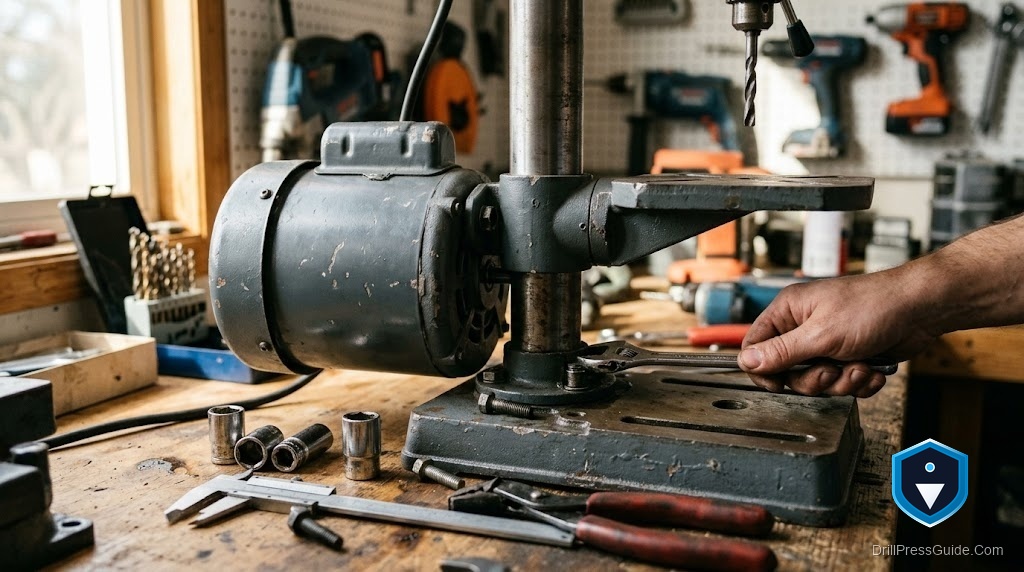
A dead motor feels like the end of a worn-out import press, but before you write off the whole machine or order the first motor you find, it pays to ask two questions: is the motor actually the problem, and is this press worth a new motor at all? A Central Machinery drill press replacement motor is a reasonable repair on a solid press, but only after you have diagnosed the fault and decided the machine earns the investment.
The motor is the electric drive that turns the spindle through the belt. On a Central Machinery press it is a single-phase motor bolted to a bracket and wired through a switch, so a correct replacement matches the shaft, mounting, power rating, and wiring, not just the horsepower number.
Short answer: confirm the motor is truly dead rather than a failed capacitor or switch, decide whether the press is worth a new motor, then match shaft diameter, RPM, horsepower, frame, and voltage to a replacement.
First, the repair-or-replace decision
Before buying a motor, weigh two things:
- Is it the motor? A press that hums but spins by hand usually has a bad start capacitor, a far smaller fix. A silent press often has a switch or cord fault.
- Is the press worth it? If the bearings, quill, and column are sound, a new motor makes sense. If the whole machine is worn out, the motor is money into a tired press.
Match these five specs
- Shaft diameter, so the pulley fits.
- RPM, typically 1725, which the speed chart assumes.
- Horsepower, matched to the original so the belt and pulleys behave.
- Frame and mounting, to line up with the bracket.
- Voltage and rotation, to match your outlet and turn the right way.
The replacement to match against
When the motor really is finished and the press is worth saving, a 1/2 HP 1725 RPM single-phase motor is a common size for these presses and a solid target to match your specs against. Confirm the shaft and mounting against your bracket before ordering.
The honest drawback: a universal motor rarely matches the original bracket and shaft perfectly, so expect to adapt the mount or change the pulley if the shaft size differs. Who should skip a new motor: anyone whose fault is a capacitor or switch, or whose press is too worn to justify it.
Fitting it, step by step
- Unplug the press.
- Confirm the diagnosis, capacitor, switch, or motor.
- Note the old motor’s shaft, RPM, horsepower, frame, and voltage.
- Remove the belt, unbolt the old motor, and transfer the pulley if the shaft matches.
- Bolt on the matched motor, wire it correctly through the switch, and set belt tension to about half an inch of deflection.
Diagnose, decide, then match
Replacing a Central Machinery motor is worth doing on a sound press, once you have ruled out the capacitor and switch and matched the five specs. Confirm the fault, judge the machine, and match the motor to the bracket.
Three takeaways:
- Rule out the capacitor and switch before condemning the motor.
- Decide whether the press is sound enough to earn a new motor.
- Match shaft, RPM, horsepower, frame, and voltage, and expect to adapt the mount.
FAQ
How do I know the motor is dead and not the capacitor? If the motor hums but the spindle spins freely by hand, suspect the start capacitor. A silent motor usually points to the switch or cord first.
Is it worth replacing the motor on a Central Machinery press? Yes, if the bearings, quill, and column are sound. If the whole press is worn out, a new motor is money into a tired machine.
What size motor does it use? Often a 1/2 HP single-phase motor at 1725 RPM, but confirm your model’s rating, shaft, and frame before buying.
Will a universal motor bolt right on? Rarely a perfect match. Expect to adapt the bracket or change the pulley if the shaft diameter differs from the original.
Do I need to match the RPM? Yes. The speed chart assumes 1725 RPM, so a different speed changes every setting.
Can I wire the new motor to the old switch? Usually yes, if the voltage and phase match. Wire it correctly through the existing switch and confirm the rotation direction.
References
- Harbor Freight, Central Machinery drill press manuals and parts: https://www.harborfreight.com
- Grizzly Industrial, drill press motor specifications reference: https://www.grizzly.com/products/grizzly-motor-1-2-hp-single-phase-1725-rpm-odp-110v-220v-for-g4008-09/h5373


