
How to Align a Drill Press Table Without Losing Accuracy
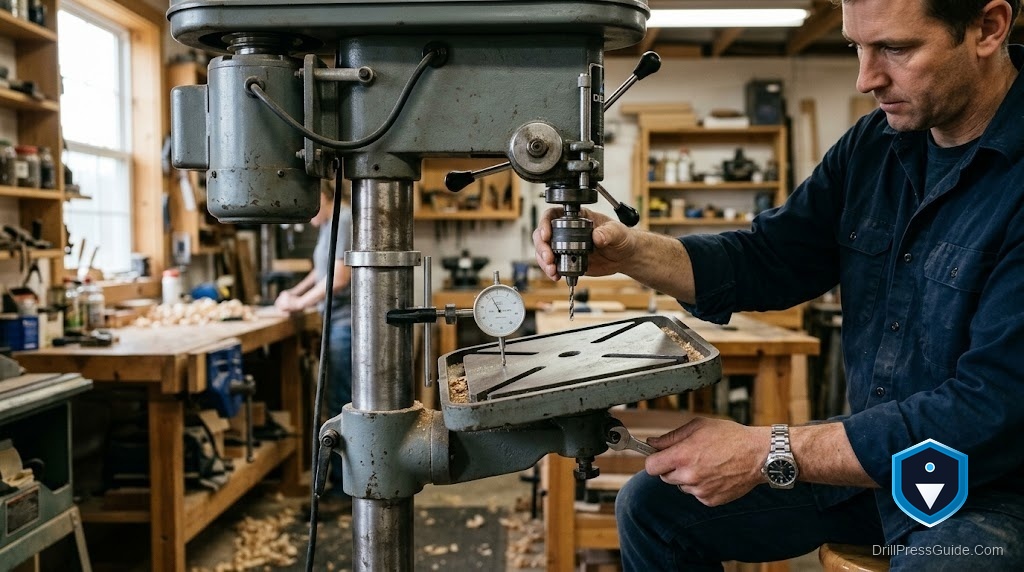
A drill press is only as accurate as its table is square, and a table that leans even a degree turns every hole into a slanted one. Learning how to align a drill press table is the single highest-value tune-up you can do, and it takes one measuring tool and about ten minutes. Get it right and drilled holes come out perpendicular, dowels seat flush, and your work stops rocking.
Aligning the table means setting it perpendicular to the spindle in both directions, front-to-back and left-to-right, so the bit enters the work at ninety degrees. On most presses the table pivots on a trunnion at the column, and that pivot is where alignment is set and lost.
Short answer: chuck a straight rod, set a square against the rod and the table in two directions, and adjust the table trunnion until both readings show no gap. Confirm by drilling a test hole and checking that it is perpendicular.
The tool that makes it exact
Eyeballing square never holds up. A machinist combination square has a ground blade and head that give you a true ninety-degree reference against the rod and table, so you adjust to a real measurement instead of a guess. Its hardened edges stay accurate in a way a folding rule never will.
The honest drawback: a combination square checks square, not runout, so if the rod itself wobbles you have a chuck or spindle issue to sort first. Who should skip it: anyone who already owns an accurate machinist square, since one is enough.
Aligning it, step by step
- Unplug the press.
- Chuck a straight, known-true rod or a long drill bit.
- Set the square’s blade flat against the rod and its base on the table, front to back. Look for light under the blade.
- Loosen the table trunnion bolt and tilt the table until the gap closes, then check left to right the same way.
- Tighten the trunnion and recheck both directions, since locking it can shift the setting.
- Drill a test hole through scrap and confirm it is perpendicular.
Common alignment mistakes
- Trusting the table’s cast degree scale, which is often off. Measure against the spindle instead.
- Checking only one direction. A table can be square front-to-back and tilted side-to-side.
- Forgetting to recheck after tightening the trunnion.
- Using a bent rod, which throws the whole reading.
Square in both directions, then prove it
Aligning a drill press table is a measure-and-adjust job: reference the table to a rod in the chuck, close the gap in both directions, lock it, and verify with a test hole. Skip the cast scale and trust the square.
Three takeaways:
- Align the table to the spindle in both directions, not to the cast degree scale.
- Use a combination square against a true rod for a real reference.
- Recheck after tightening the trunnion, then confirm with a test hole.
FAQ
How do I know my drill press table is out of square? Chuck a straight rod and set a square against it and the table. Light under the blade, or a slanted test hole, means the table is off.
Which way do I check alignment? Both front-to-back and left-to-right. A table can read square one way and be tilted the other, so check two directions.
Can I trust the degree scale on the table? No. The cast scale is often inaccurate. Set alignment against the spindle with a square, then use the scale only as a rough guide.
Why does the table shift after I tighten it? Tightening the trunnion bolt can nudge the table. Always recheck square after locking, and adjust if it moved.
What if the rod itself wobbles? That is runout, a chuck or spindle problem, not a table issue. Fix the wobble before aligning the table.
How do I confirm the table is aligned? Drill a test hole through scrap and check that it is perpendicular with a square. A clean, straight hole confirms the setting.
References
- VintageMachinery.org, drill press setup and alignment documentation: http://vintagemachinery.org


