IMS DP-5P Drill Press Motor Replacement: Diagnose the Fit Before Replacing Anything
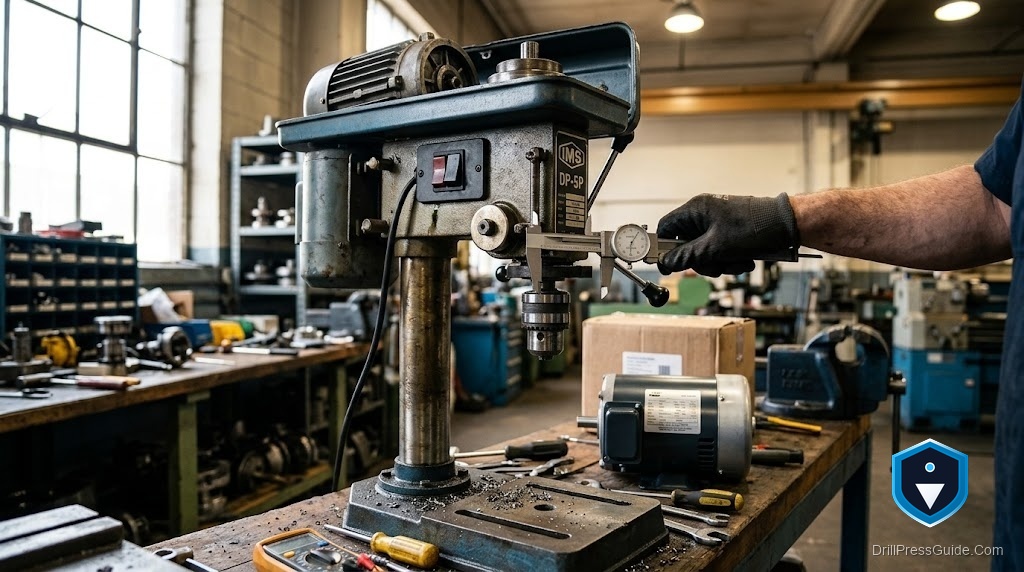
Most botched motor swaps do not fail because someone bought a bad motor. They fail because the new motor would not bolt to the bracket, or its shaft was the wrong size for the pulley, or it spun the spindle at double the intended speed. An IMS DP-5P drill press motor replacement is really a fit-and-spec problem first, and a shopping problem a distant second. Measure the machine, and the right motor almost picks itself.
The motor on the DP-5P is the single-phase induction motor that drives the spindle through a belt and stepped pulleys. A replacement has to match the machine on power, speed, voltage, shaft diameter, and the base mounting pattern, in that order of how often they trip people up.
Short answer: read the old nameplate and measure the shaft and bolt pattern before buying. For this class of press, aim for about 1/2 HP, 1725 RPM, single-phase 120V, with a shaft and base that match what you measured. A general-purpose 1/2 HP, 1725 RPM motor with a 5/8 inch shaft is the usual fit, provided your pulley bore agrees.
Take four measurements first
Grab a tape and a caliper before you open a single product page:
- Shaft diameter and length. This decides whether your existing pulley will slide onto the new motor. Many modern motors use a 5/8 inch shaft; older ones often used 1/2 inch.
- Bolt hole spacing. Measure center to center on the mounting holes so the new base lines up with your bracket.
- Nameplate power and speed. Note the HP and the RPM (look for 1725, not 3450).
- Voltage and rotation. Confirm 120V and which direction the shaft must turn for your setup.
Those four numbers turn a guessing game into a match.
The spec that ruins swaps: shaft versus pulley
The single most common surprise is shaft diameter. If your DP-5P came with a 1/2 inch motor shaft and your replacement has a 5/8 inch shaft, the old pulley will not fit. You then have two clean options: buy a pulley with the correct bore, or find a motor with the matching shaft. Neither is hard, but discovering it after the motor arrives sets you back a week.
RPM is the second trap. A drill press wants a 1725 RPM motor. A 3450 RPM motor of the same horsepower looks identical on paper and will send every pulley step spinning far too fast for wood or metal work.
The motor that fits most of these presses
For a DP-5P that measures out to the standard specs, a 1/2 HP, 1725 RPM single-phase motor with a 5/8 inch shaft is the right-speed, right-power choice for 120V wiring.
The honest drawback: it comes with a 5/8 inch shaft, so if your original was 1/2 inch you will need a matching pulley to go with it. Who should skip it: anyone whose measurements show a nonstandard frame or a 1/2 inch shaft they cannot easily match, since forcing a fit creates more problems than it solves.
Rotation and wiring, the last checks
Before you call it done, confirm the new motor turns the correct direction for your pulley arrangement; many single-phase motors can be reversed by swapping two leads inside the junction box, and the diagram is usually on the nameplate or inside the cover. Then dress the wiring cleanly so nothing can vibrate into the belt.
Measure twice, buy once
An IMS DP-5P motor replacement rewards the person who measures before they shop. The failures come from shaft mismatch, wrong RPM, and bolt patterns that do not line up, not from a lack of horsepower. Take the four measurements, match the specs, and the new motor drops in and drives the spindle at the right speed.
Three takeaways:
- Measure shaft diameter and bolt spacing before anything else; those cause the most returns.
- Hold to 1725 RPM. A 3450 RPM motor overspins every pulley step.
- If the shaft size changes, plan on a new pulley in the same order.
FAQ
What motor specs does an IMS DP-5P drill press need? Typically about 1/2 HP, 1725 RPM, single-phase 120V. Confirm with your old nameplate, and measure the shaft and bolt pattern before buying.
Why will my new motor not fit the pulley? The shaft diameter probably changed. A 5/8 inch shaft will not accept a pulley bored for 1/2 inch. Match the pulley bore to the new shaft.
What happens if I use a 3450 RPM motor? Every pulley speed roughly doubles, which is too fast for most drilling and hard on the belt and bearings. Use a 1725 RPM motor.
How do I measure the mounting pattern? Measure center to center between the base bolt holes, and note the base type. The new motor base must line up with your bracket.
Can I reverse the motor direction? Most single-phase motors reverse by swapping two leads in the junction box. Check the nameplate or the diagram inside the cover.
Should I match voltage exactly? Yes. Most of these presses are 120V single phase. A dual-voltage motor is fine as long as it is wired for your supply.
Is a slightly larger motor a safe upgrade? A small step up can work if it fits the mount and the pulleys can handle it. A big jump risks bracket fit and belt life, so match the original when unsure.
References
- Grizzly Industrial, 1/2 HP single-phase 1725 RPM replacement motor specifications and frame dimensions: https://www.grizzly.com/products/grizzly-motor-1-2-hp-single-phase-1725-rpm-odp-110v-220v-for-g4008-09/h5373