
IMS DP-5B Drill Press Motor Replacement: A Workshop Troubleshooting Guide
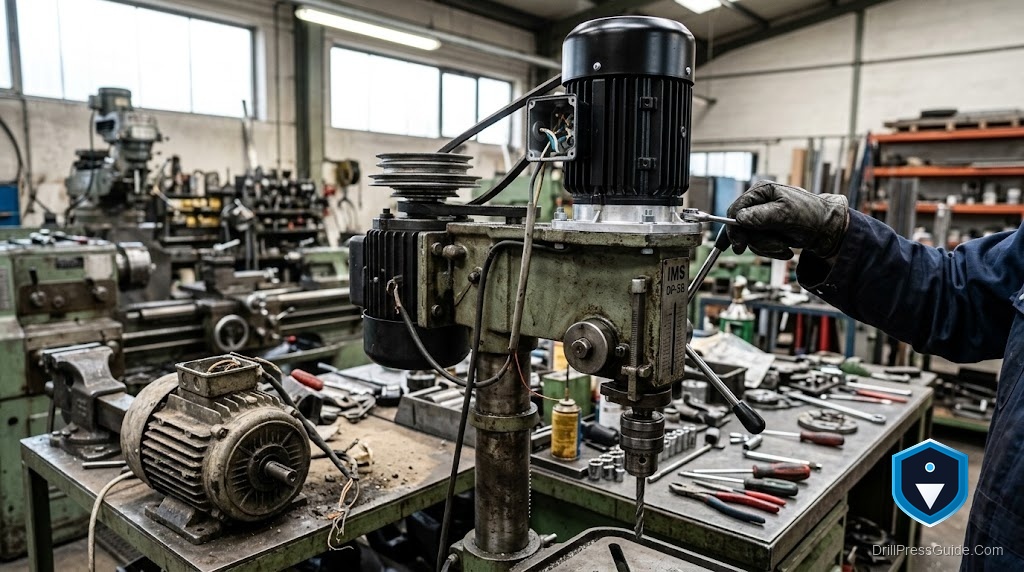
You hit the switch and the motor just hums, or it groans up to speed and stalls the moment a bit touches wood. Maybe it smells faintly hot. Before you spend on an IMS DP-5B drill press motor replacement, it pays to be sure the motor is actually the part that died, because two of the most common failures on a small press look like a dead motor and are not.
The motor on a benchtop press like the DP-5B is a single-phase induction motor that drives the spindle through a belt and stepped pulleys. Replacing it means matching five things: horsepower, speed in RPM, voltage, shaft diameter, and the base mounting pattern. Miss any one and the new motor either will not bolt on or will not turn your pulley.
Short answer: confirm the failure first (a hum usually means the start capacitor, silence often means the switch or thermal overload, a rumble means bearings). If the motor is genuinely done, match roughly 1/2 HP, 1725 RPM, single-phase 120V, a 5/8 inch shaft, and the existing base holes. A general-purpose 1/2 HP, 1725 RPM motor with a 5/8 inch shaft is the standard replacement for this class of press.
Troubleshoot before you buy a motor
Work through this with the press unplugged between tests:
- It hums but will not spin. Spin the pulley by hand and flip the switch. If it then runs, the start capacitor or centrifugal start switch has failed. Both are simpler fixes than a motor.
- Total silence, no hum. Suspect the on/off switch, a tripped thermal overload, or the cord before the motor windings.
- It runs but rumbles or squeals. Feel the shaft for side-to-side play. Worn motor bearings can sometimes be pressed out and replaced instead of scrapping the motor.
- It runs, then cuts out after a few minutes. That is the thermal overload doing its job, usually because of a failing capacitor or a dragging spindle, not a dead motor.
If you have ruled all of that out and the windings are open or burnt, then a replacement is the right call.
Match these five specs
- Horsepower. Small presses like the DP-5B are typically around 1/2 HP. Do not oversize wildly; a much larger motor may not fit the mount and can overspin the pulley setup.
- Speed. Look for 1725 RPM (sometimes written 1720 or 1750). This is the standard drill press motor speed. A 3450 RPM motor will run every pulley step too fast.
- Voltage. Most are 120V single phase. Confirm on the old nameplate.
- Shaft diameter. Measure the old shaft. Many replacements come with a 5/8 inch shaft, while some older motors used 1/2 inch. This matters because your pulley has to fit the new shaft.
- Base mounting. Measure the bolt hole spacing so the new motor drops onto the existing bracket.
The replacement to use
For most DP-5B-class presses, a 1/2 HP, 1725 RPM single-phase motor with a 5/8 inch shaft is the correct-speed, correct-power swap. It runs at the right RPM for a drill press and handles 120V wiring.
The honest drawback: if your old motor had a 1/2 inch shaft, this motor’s 5/8 inch shaft means your existing pulley will not slide on, so you also need a pulley with a 5/8 inch bore. Who should skip it: anyone whose only real failure is the start capacitor, because replacing a small capacitor beats buying a whole motor.
When a new motor is not worth it
Be honest about the whole machine. If the DP-5B has a rough spindle, sloppy quill, and now a dead motor, you are rebuilding a light-duty press one failure at a time. A fresh motor on a tired press is money you may regret. If the rest of the machine is tight and true, though, a correct-spec motor gives it another long stretch of life.
Prove the failure, then match the specs
The fastest DP-5B motor replacement is often no replacement at all, just a capacitor or a switch. When the motor really is gone, the job is a measuring exercise: horsepower, RPM, voltage, shaft, and mount. Get those five right and the new motor bolts on and turns your pulley the first time.
Three takeaways:
- Test for a bad capacitor or switch before condemning the motor.
- Match RPM and shaft diameter as carefully as horsepower; a 3450 RPM motor or a mismatched shaft causes more grief than low power.
- On a worn-out press, weigh a new motor against a new machine.
FAQ
Why does my drill press motor hum but not spin? Usually a failed start capacitor or centrifugal start switch. Spin the pulley by hand as you switch on; if it then runs, replace the capacitor rather than the motor.
What horsepower motor does an IMS DP-5B use? Small benchtop presses in this class are typically around 1/2 HP. Confirm by reading your old motor’s nameplate before buying.
What RPM should a drill press motor be? 1725 RPM is standard. A 3450 RPM motor will drive every pulley speed roughly twice as fast as intended.
Will a 5/8 inch shaft motor fit my press? Only if your pulley bore matches. If your old shaft was 1/2 inch, you will also need a pulley with a 5/8 inch bore to fit the new motor.
Can I use a bigger motor for more power? A modest step up can work, but a much larger motor may not fit the mount and can overload the belt and pulleys. Match the original size unless you know the machine can take more.
How do I know if it is the motor or the switch? No hum at all points to the switch, cord, or thermal overload. A hum with no spin points to the motor’s start components.
Is it worth replacing the motor on an old benchtop press? Yes if the spindle and quill are still tight. If the whole machine is worn, the money is often better spent on a new press.
References
- Grizzly Industrial, 1/2 HP single-phase 1725 RPM replacement drill press motor specifications: https://www.grizzly.com/products/grizzly-motor-1-2-hp-single-phase-1725-rpm-odp-110v-220v-for-g4008-09/h5373


