Powermatic Drill Press Model 1150 Motor Replacement: The Checks That Prevent a Bad Repair
The Powermatic 1150 is a heavy, well built floor press that owners keep running for decades, so a motor replacement is usually about preserving a machine worth preserving rather than replacing a throwaway. That raises the stakes on getting the match right, because a 1150 often runs a larger motor and may be wired for 240V single phase, and the checks before you buy are what keep a good press from ending up with a motor that will not bolt up or run. A Powermatic drill press model 1150 motor replacement rewards careful matching over a quick horsepower guess.
The motor drives the spindle through a belt and pulleys. On a press this size the frame sets the mounting and shaft, and the voltage and phase set the electrical fit, so matching all of them, not just horsepower, is what makes the motor drop in.
The direct answer: confirm the 1150 motor’s frame, shaft, voltage, phase, and speed from the old motor’s plate, then match a replacement to all of them so it bolts to the existing mount and runs on your supply. On this press especially, confirm the voltage and phase, since many run 240V and some shops have three phase.
The checks before you buy
Read the old motor’s plate and the press ID label:
- Frame size sets the mounting and shaft height. A press this size often uses a larger frame than a benchtop, so match it exactly.
- Shaft diameter must fit your pulley.
- Voltage and phase. Many 1150s run 240V, and some are single phase while others are three phase. Match your actual shop supply.
- Speed, commonly 1725 RPM, so belt speeds stay right.
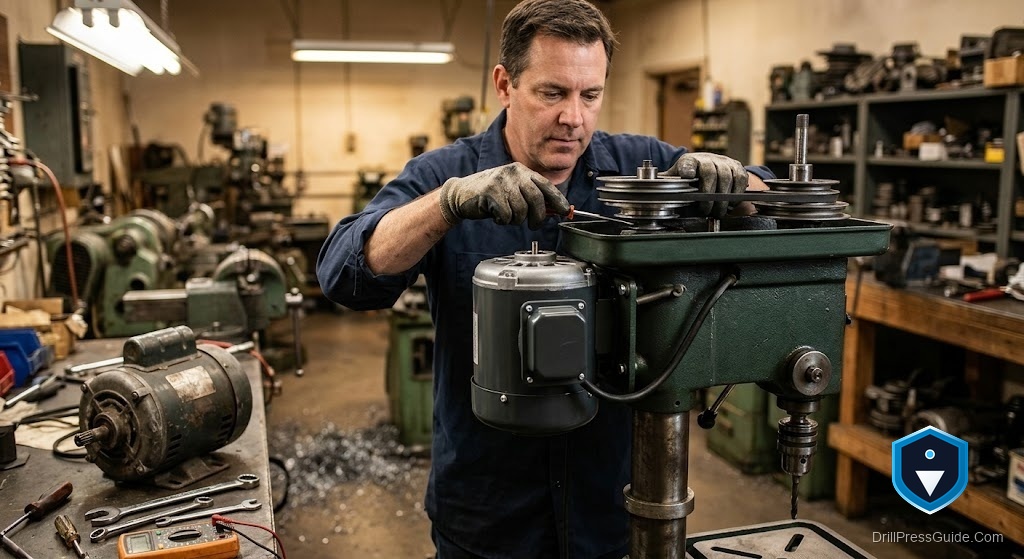
A matching drill press motor in the correct frame sized to your plate is the closest fit, your existing drill press step pulley moves to the new shaft, and a fresh drill press V belt keeps slip from hiding the result. Verify the motor plate readings with a digital multimeter before wiring.
The replacement, step by step
- Unplug the press and confirm it is dead at the motor with the multimeter.
- Photograph the wiring, noting the voltage and phase connections.
- Remove the belt and unbolt the heavy motor with help or a support.
- Move the pulley to the new shaft and align it with the spindle pulley.
- Bolt on the new motor and wire it to match your photo and the plate.
- Refit and tension the belt, spin by hand, check rotation, then test under a light cut.
Where people go wrong
The first mistake is matching horsepower alone and overlooking the larger frame a 1150 uses, so the mount does not line up. The second is a voltage or phase mismatch, ordering a 120V or three phase motor for a 240V single phase shop or the reverse. The third is dropping the heavy motor while unbolting it alone, damaging the motor or the press.
The verdict
A 1150 is worth matching carefully. Read the old motor’s frame, shaft, voltage, phase, and speed, and match all of them so the new motor bolts to the mount and runs on your supply. Confirm the voltage and phase especially, since this press often runs 240V. Support the heavy motor during the swap, move the pulley over, and check rotation before a real cut. Do that and a press built to last decades gets a motor that fits it properly, with no mismatch and no damage to a machine worth keeping.
Three takeaways:
- Match the larger frame, shaft, voltage, phase, and speed exactly.
- Confirm voltage and phase; many 1150s run 240V.
- Support the heavy motor during removal and refit.
FAQ
How do I choose a replacement motor for a Powermatic 1150? Match the frame, shaft, voltage, phase, and speed from the old motor’s plate so the new motor bolts to the existing mount and runs on your supply. Do not match by horsepower alone.
What voltage and phase does the 1150 use? Many run 240V, and some are single phase while others are three phase. Read the motor plate and match your actual shop supply before ordering.
What frame do I need? A press this size often uses a larger frame than a benchtop. Read the old motor’s frame designation and match it so the mounting holes and shaft height line up.
Can I convert it to 120V? Only if a suitable motor and your circuit support it. Usually it is simpler to match the existing voltage and phase, since the press and wiring are already set up for it.
Can I reuse my pulley? Usually yes, if the new shaft diameter matches. Move the pulley to the new shaft and align it with the spindle pulley.
Why check with a multimeter? To confirm the press is dead before working, and to verify the supply voltage matches the motor plate before wiring the new motor.
Do I need help to remove the motor? On a press this size, yes. The motor is heavy, so use a helper or a support so it cannot drop and damage the motor or the press.
References
- The Engineering ToolBox, Belts: Pulley Diameters vs. Speed. https://www.engineeringtoolbox.com/pulley-diameters-speeds-d_1620.html
- Occupational Safety and Health Administration, Woodworking eTool: Drill Presses. https://www.osha.gov/etools/woodworking/production/machines-tools/drill-press