Replacement Drill Press Table Bracket: A Workshop Troubleshooting Guide
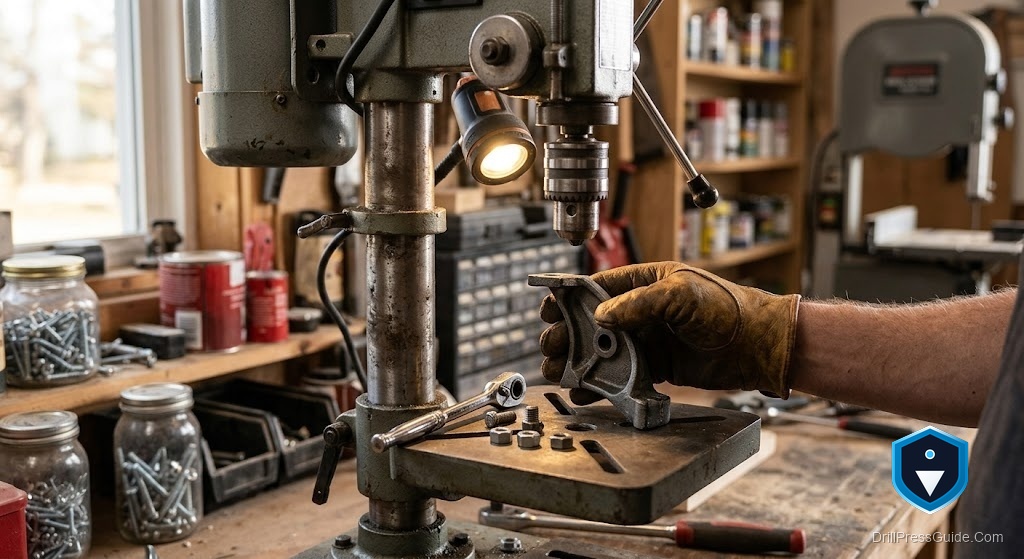
The table bracket is the unglamorous casting that clamps your worktable to the column and lets it rise, drop, and tilt. Nobody thinks about it until it cracks, and it usually cracks at the worst moment, with the table sagging under a clamped workpiece and the raising handle spinning uselessly. A replacement drill press table bracket looks like a simple part to buy. It is, right up until you learn how little these castings share between brands and even between model years.
The table bracket (also called the table support) is the clamp collar and arm that grips the round column and carries the table. It houses the locking mechanism that holds table height, and on many presses it also carries the rack and pinion that raises the table.
The direct answer: identify your press by model and serial number, match the bracket by exact part number from an exploded diagram, and confirm the column diameter, because a bracket sized for a different column will not clamp true even if it looks identical.
Column diameter is the make or break number
Before anything else, measure your column’s outside diameter with a caliper or tape. The bracket clamps around that column, and column diameters vary between benchtop and floor presses and across brands. A bracket bored even slightly oversize will never lock solid, and one bored undersize will not slide on at all. This single measurement prevents most wrong orders.
Then the model lookup
Read the model number, serial number, and manufacture date from the ID label on the head or column. Find the exploded parts diagram for that model. The diagram gives the part number and shows whether the bracket includes the rack, the pinion, and the lock as one assembly or as separate pieces. Delta and Craftsman owners in particular need the exact model, because both sold many similar looking presses over the years.
Match the part to the failure
- Cracked clamp casting. Structural. Match the exact bracket for your model and column diameter.
- Worn raising rack or pinion. Often part of the bracket assembly. Check whether the rack teeth are chewed before ordering.
- Stripped or seized lock. Sometimes just the locking bolt, handle, or a set screw. Inspect before replacing the whole casting.
- Bent table arm. Usually means the whole bracket, since a straightened casting rarely runs true.
When the original part does not exist
Many older and off brand presses have no bracket available at all. Rather than chasing a discontinued casting, two paths work. Some owners fabricate a bracket, and search results for a drill press table bracket turn up universal clamp style supports that fit common column diameters. Others give up on the factory table entirely and fit an aftermarket drill press table that clamps to the column, which sidesteps the missing casting. Match either to your measured column diameter. For lock hardware alone, a set of replacement lock handles is the simple fix.
Where people go wrong
The first mistake is ordering by photo and ignoring column diameter, which is the one measurement that has to be right. The second is replacing the whole bracket when a five dollar locking bolt was the actual failure. The third is spending weeks hunting a discontinued casting when a universal clamp bracket or aftermarket table would have had the press working the same afternoon.
The verdict
A table bracket repair lives or dies on two numbers: your exact model and your column diameter. Match structural castings by part number, inspect the lock hardware before assuming the casting is done, and if the original is gone, fit a universal bracket or aftermarket table rather than chasing a ghost. The goal is a table that locks rock solid at any height, and there is more than one road to it.
Three takeaways:
- Measure the column diameter before you buy anything.
- Match structural brackets by model and part number.
- If the casting is discontinued, a universal or aftermarket route wins.
FAQ
How do I find the right table bracket for my drill press? Measure your column’s outside diameter, then match the bracket by part number using an exploded diagram for your exact model. Both the column size and the model must match.
Why does column diameter matter so much? The bracket clamps around the column. If the bore is oversize it will not lock solid, and if it is undersize it will not slide on. The diameter has to match.
My raising handle spins but the table will not rise. What broke? Usually the rack or pinion teeth are stripped, or the bracket cracked at the rack channel. Inspect the teeth before ordering.
Can I use a universal table bracket? Often yes, if it matches your column diameter. Universal clamp brackets are a common fix when the original is discontinued.
What if no bracket is available for my press? Fit a universal clamp bracket sized to your column, or install an aftermarket column mount table. Both avoid chasing a part that no longer exists.
Is a cracked bracket safe to keep using? No. A cracked clamp can let the table drop under load. Replace it before drilling anything heavy.
Where do I find the model number? On the ID label, usually on the head casting or column, along with the serial number and manufacture date.
References
- West Virginia University EHS, Drill Press Safety. https://www.ehs.wvu.edu/files/d/468960e4-730d-4a60-98ea-58ee020f4ab8/drill-press-safety.pdf
- Occupational Safety and Health Administration, Woodworking eTool: Drill Presses. https://www.osha.gov/etools/woodworking/production/machines-tools/drill-press